
Birmingham is a city of terraces, semis, villas, tower blocks and brand-new apartments, often all within a few streets of each other. That variety is exactly why plastering here isn’t one-size-fits-all. RCR Connections Ltd is a specialist plastering and rendering company with an office at Studio 9, 50-54 St Paul’s Square, in the Jewellery Quarter. We plaster and render homes, rental properties and small commercial spaces across the city, from Handsworth, Aston and Erdington to Moseley, Kings Heath, Harborne, Selly Oak, Northfield, Hall Green, Yardley and Sheldon.
The team has 62 years of combined experience. We spend every working day on walls, ceilings and render, so we can usually tell from a few photos whether you need a quick skim, a full re-plaster or something in between, and we’ll tell you honestly.
This guide covers each service we offer in Birmingham, what the city’s different types of housing usually need, the planning and conservation rules that can apply (Birmingham City Council is your planning authority), how a job runs, drying and aftercare, how to pick a plasterer, and what shapes your quote.
Our services in Birmingham
Plastering walls and ceilings
When we talk about plastering, we mean taking a wall or ceiling from bare brick, block or board to a smooth surface you can paint. On masonry we’ll normally apply a backing plaster first to build up the surface and fill out any dips, then a finishing plaster. On new plasterboard, we tape the joints and go straight to the finish coat.
A lot of our Birmingham work comes from renovations: a back room knocked through to the kitchen in a Stirchley terrace, a bathroom stripped to the brick in Erdington, or a whole Acocks Green semi being done up before the owners move in. We plan the order of work so the plaster has time to dry before the kitchen fitter, flooring or decorator arrives.
Finish coat over sound walls
A finish coat, or skim, is a thin coat of finishing plaster, trowelled until it’s smooth and flat. It’s the right answer for walls and ceilings that are firmly attached but look tired: covered in old filler, cracked, bumpy from decades of decorating, or marked by removed wallpaper.
What it can’t do is fix plaster that’s failing underneath. In older Birmingham terraces we often find plaster that has lost its grip on the brick, especially around chimney breasts, window reveals and the bottom of ground-floor walls. Before we quote for a skim we check for hollow areas and signs of damp. If a section is blown, we’ll cut it out and patch it before skimming, or recommend re-plastering if it’s widespread.
Re-plastering and patch repairs
Full re-plastering is a bigger job. The old plaster is hacked off back to the masonry, the wall is prepared, and new backing and finish coats are applied. It’s common after damp-proofing, on party walls that have been repaired, and in houses that have had decades of poorly matched patches.
Patch repairs are where many Birmingham jobs start: an electrician has chased in new cables, a plumber has moved pipes, a boiler has been relocated, a fireplace has been opened up or blocked off, or a door frame has been moved. We cut back to sound edges, fill to the right depth and finish so the repair sits flush with the rest of the wall. Rental properties often need several of these at once between tenants, and we can work to a letting agent’s timescale.
MultiFinish over plasterboard
Most new walls and ceilings in extensions, lofts and new builds are plasterboard. We tape every joint with scrim, then put on a finish coat of Thistle MultiFinish. It goes on in two thin coats, about 2 mm in total, and is trowelled up until it is smooth, flat and ready for paint. MultiFinish also works well over old plaster that is still firm, once it has been primed.
Bonding and Hardwall backing coats
On bare brick or block, the wall needs a backing coat first to fill dips and build it out flat. We pick the backing plaster to suit the wall:
- Hardwall is for walls that soak up water fast, such as common brick and most block. It is tough, sets quickly and stands up well to knocks.
- Bonding is for walls that soak up very little, such as smooth concrete, engineering brick or walls treated with a bonding primer. It grips where other plasters would slide off.
Backing coats usually go on at about 8 to 11 mm, ruled flat with a straight edge and scratched so the finish coat has a good key. Our guide to plaster coats explained goes into each one in more detail.
Ceilings
Ceilings take more care than walls, because every mark shows when the light falls across them. We fix new boards where the old ones sag, tape the joints, and finish in MultiFinish. Old lath and plaster ceilings can often be over-boarded rather than pulled down, which keeps the mess down. See our page on ceiling plastering and repairs.
Coving
Coving hides the joint where the wall meets the ceiling, and gives a room a neat, finished look. We fit plaster coving in plain and classic shapes, cut clean mitres at the corners, and fill the joints so they do not show. In older houses we can match a short run of missing coving so it blends in. See our page on plastering and coving.
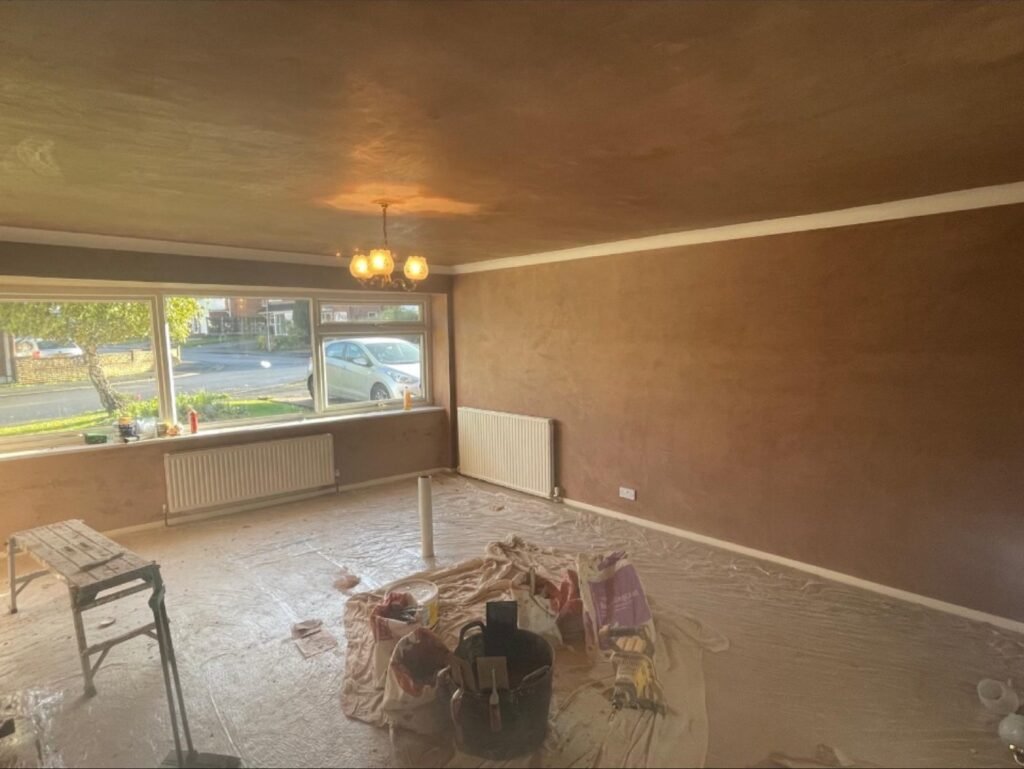
Plastering over Artex
Plenty of Birmingham homes still have textured ceilings, especially those decorated in the 1970s and 80s. Whether yours is a stipple in a Kingstanding semi or deep swirls in a Moseley flat conversion, the aim is the same: a smooth ceiling.
We either seal the texture and skim it in coats, or fix new plasterboard over the top and skim that. Over-boarding is the better choice if the ceiling has cracks, sags, or a very heavy pattern. Both methods leave the original coating in place.
That matters because textured coatings applied before 2000 can contain asbestos. If you want the coating removed rather than covered, get it tested first. Our article on skimming over Artex explains the options in more detail.
Dry lining and boarding
Dry lining is plasterboard fixed to walls or ceilings, either stuck on with adhesive dabs, screwed to battens or fixed to a timber or metal stud frame. It’s then skimmed, or taped and filled for paint.
Birmingham’s loft conversions, rear extensions and HMO conversions all involve a lot of boarding. We board ceilings that need replacing, new partition walls, and stud walls that divide large rooms. We also use dot and dab to straighten out badly uneven solid walls, as long as there’s no damp behind them. Where the boards are going onto an outside wall, insulated plasterboard can help with heat loss, but on older solid walls we check moisture levels first so nothing gets trapped.
K-Rend monocouche render
Monocouche means “one coat”: it’s a through-coloured render with the colour mixed into the material itself, and K-Rend monocouche is a leading brand of it. Once it’s been applied and scraped back, the surface is finished. There’s no painting needed, and the colour won’t peel.
In Birmingham, through-coloured render is often used on rear extensions, side elevations, new builds and full house makeovers. It needs a suitable background, the right beads and trims, and good weather while it’s applied. See our K-Rend monocouche page and our comparison of K-Rend monocouche, silicone and sand and cement render for a deeper look.
Silicone render
Silicone render is a thin decorative coat applied over a reinforced base. Its main strength is water repellency: rain beads off the surface instead of soaking in, which helps keep it clean and reduces staining. It’s available in lots of colours and textures and is flexible enough to handle the small movements every house goes through.
In a city with plenty of traffic, trees and terraced streets where one side never gets much sun, that self-cleaning quality is a real advantage. Silicone is also the finish most often used on insulated render systems.
Sand and cement render
Sand and cement is the traditional render most people picture: two or three coats built up on the wall, then painted with masonry paint. It’s tough and widely used, and it’s often the most sensible option for repairs on houses that already have painted render, for garden walls, plinths and for areas that will be painted anyway.
We don’t use it everywhere. On solid brick Victorian walls that need to let moisture out, a hard cement render can do more harm than good. On some older Birmingham houses, a lime render or a breathable system is a better fit.
Insulated render
An insulated render system is insulation boards fixed to the outside of the house and finished with a mesh-reinforced base coat and a decorative top coat. It’s aimed at solid-walled houses, which are common in the city’s older terraces and some post-war homes, and it can change the look of a property completely.
It’s a bigger project than standard rendering. Window sills, gutters, pipes, meter boxes and the roof edge often need adjusting, building regulations apply, and on a terrace you have to think about how the finish meets the house next door. Planning rules matter too, particularly in conservation areas. We’ll talk you through what’s involved before you decide.
Render repairs
Render problems in Birmingham tend to follow the same pattern: a crack appears, water gets in, the render behind it goes hollow, and a cold winter pushes a section off the wall. Leaking gutters and downpipes, render that runs below the damp-proof course, and old cement render on soft bricks make it worse.
We cut out cracks and fill them, replace hollow sections, rebuild damaged corners and bellcast beads, and patch around new windows and doors. If the render has been patched so many times that it’s failing everywhere, re-rendering may be better value. Our article on the signs your render needs repairing before winter is a useful checklist.
Free, no-obligation quote in Birmingham: WhatsApp me on 07453 614095 with a few photos, or send us a message.
Birmingham’s housing and what it means for your walls
Victorian and Edwardian terraces
Large parts of inner Birmingham were built as rows of terraced houses in the late 1800s and early 1900s: Balsall Heath, Sparkbrook, Small Heath, Handsworth, Aston, Bordesley Green, Stirchley, Selly Oak, and much of Kings Heath and Erdington. Many are “tunnel-back” terraces, with a rear wing and a passage between pairs of houses.
These houses usually have solid brick walls, and the original plaster is often lime-based. Over the years they’ve been rewired, re-plumbed, damp-proofed and patched with whatever plaster was to hand, so a single room can have three or four different materials on the walls. Common jobs include re-plastering the lower part of ground-floor walls after damp treatment, re-doing chimney breasts, repairing or replacing lath and plaster ceilings, and plastering rear wings that have been knocked through into a kitchen-diner. Outside, many have painted render on the back, and some fronts have been rendered or pebbledashed in the past.
Larger Victorian and Edwardian villas
Moseley, Edgbaston, Harborne, Handsworth Wood and parts of Kings Heath and Erdington have larger, older houses, some converted into flats. These often have high ceilings, decorative cornices and ceiling roses, deep window reveals and lath and plaster throughout.
The work needs a careful touch. High ceilings need proper access towers. Cornices may need protecting while the ceiling is repaired. Lath and plaster ceilings can sometimes be fixed back and over-boarded rather than pulled down. And because many of these roads are in conservation areas, any rendering needs checking with the council first.
Interwar council estates and private semis
Between the wars, Birmingham built huge numbers of homes, both council estates such as Kingstanding, Weoley Castle and Fox Hollies, and private semis across Hall Green, Acocks Green, Yardley, Sheldon, Kings Norton and Perry Barr. Most are solid, well-built houses, usually with cavity walls, and many have rendered or pebbledashed fronts.
Inside, we often skim whole rooms that have been papered over for decades, replace cracked ceilings, plaster knock-throughs between front and back rooms, and patch after rewires. Outside, the pebbledash on these houses is frequently cracked or hollow in places, and owners often choose to repair it, render over it once it’s sound, or remove it and start again.
Post-war and 1960s to 1970s housing
The city’s post-war rebuilding produced estates such as Castle Vale, Shard End, Druids Heath and Bartley Green, along with many high-rise flats and maisonettes. Some homes from this period use non-traditional construction methods, which can affect what render or insulated render is suitable. Inside, textured ceilings and plasterboard with cracked joints are common. If you’re not sure how your home was built, tell us when you get in touch and we’ll take it into account.
New builds and city-centre apartments
Newer homes, from apartments in the city centre and the Jewellery Quarter to estates at Longbridge and on the city’s edges, are mostly plasterboard on dabs or on metal studs. The usual jobs are patching damaged boards, re-taping or skimming walls where the joints have shown through, and fixing cracks where the building has settled. Apartments often have rules from the freeholder or management company about work, noise and access, so check those before booking anything.
Across the wider Midlands
RCR Connections Ltd is Birmingham based, covering the whole of the Midlands, and we see the same mix of homes well beyond the city. The Black Country, from Dudley to Wolverhampton and West Bromwich, has many Victorian terraces and interwar semis with solid brick walls and old lime or gypsum plaster. Coventry was largely rebuilt after the war, so post-war homes with plasterboard ceilings are common there. Solihull and Sutton Coldfield have lots of 1930s semis and larger detached houses, often with coving and older ceilings. Warwickshire towns such as Warwick and Leamington Spa have older town houses that need a gentler touch, while new estates around Tamworth, Lichfield and Rugby are mostly plasterboard.
Planning, conservation areas and building control in Birmingham
Plastering inside a house almost never needs planning permission. Rendering is different, because it changes how a building looks from outside. Here’s what to know. Please check with Birmingham City Council’s planning service before starting work, as this is a general guide.
When render may need permission
National permitted development rules allow most houses to be re-rendered without a planning application if the new finish looks similar to the existing one. If you’re changing the appearance, for example rendering bare brick or switching to a very different colour or texture, you may need planning permission.
In conservation areas, cladding any part of the outside of a house with render is not permitted development, so planning permission is needed. Article 4 Directions can remove further rights, so even smaller changes such as new windows or painting may need permission in some areas. Flats don’t have the same permitted development rights as houses. Listed buildings need listed building consent for significant work, including some internal work.
Homes on the Bournville Village Trust estate may also need the Trust’s consent under its Scheme of Management before changing the outside of a house, in addition to anything the council requires. Our Bournville page has more detail.
Birmingham’s conservation areas
Birmingham City Council lists 29 conservation areas:
- Anchorage Road, Sutton Coldfield
- Aston Hall and Church
- Austin Village (Article 4(2) Direction)
- Barnsley Road, Edgbaston
- Bournville Tenants
- Bournville Village (Article 4(2) Direction)
- Colmore Row and Environs
- Digbeth, Deritend and Bordesley High Streets
- Edgbaston (Article 4(2) Direction)
- Four Oaks
- Greenfield Road, Harborne (Article 4(2) Direction)
- Harborne Old Village
- High Street, Sutton Coldfield (Article 4(2) Direction)
- Jewellery Quarter
- Kings Norton
- Lee Crescent, Edgbaston
- Lozells and Soho Hill
- Moor Pool, Harborne (Article 4(2) Direction)
- Moseley (Article 4(2) Direction)
- Northfield Old Village
- Old Yardley (Article 4(1) Direction)
- Ryland Road, Edgbaston
- St Agnes, Moseley (Article 4(2) Direction)
- St Augustines, Edgbaston
- School Road, Hall Green
- Selly Park (Article 4(2) Direction)
- Selly Park Avenues (Article 4(2) Direction)
- Steelhouse, City Centre
- Warwick Bar, Digbeth
The council publishes maps and appraisal documents for each one. If your home is in or close to one of these areas, check before planning any rendering. We can supply product details, colours and photos to support an application.
Building regulations
Most internal plastering doesn’t need building regulations approval. Rendering can. The energy efficiency rules in Approved Document L treat rendering the outside of a wall, or stripping a wall back to brick and rebuilding it, as renovating a thermal element. If more than half of a wall’s surface is renovated, the whole wall may need to be brought up to a better insulation standard, where that’s technically, functionally and economically feasible. Insulated render is building-regulated work in its own right.
Before re-rendering a whole elevation or installing insulated render, talk to building control. You can use the council’s building control service or a registered building control approver. We’ll plan the job around what they need.
Common wall and ceiling problems in Birmingham homes
Most enquiries we get from around the city fall into a handful of familiar problems. Knowing which one you have helps you describe it, and helps us give you a quicker, more accurate quote.
Cracks
Fine hairline cracks in a skim are common, especially in new plaster that dried too quickly or on board joints that have moved slightly. They’re usually cosmetic and can be filled or skimmed over. Wider cracks, cracks that run diagonally from the corners of windows and doors, or cracks that keep coming back after filling, can point to movement in the building. In that case it’s worth getting the cause checked before you plaster, because new plaster won’t stop a wall moving.
Blown or hollow plaster
Tap a wall with your knuckle. If one area sounds hollow compared with the rest, the plaster has probably lost its bond with the brick. This is very common in older terraces, behind radiators, around chimney breasts and on the lower part of ground-floor walls. Small areas can be cut out and patched. Large areas are better re-plastered. Our blown plaster guide shows how to spot it.
Water-damaged ceilings
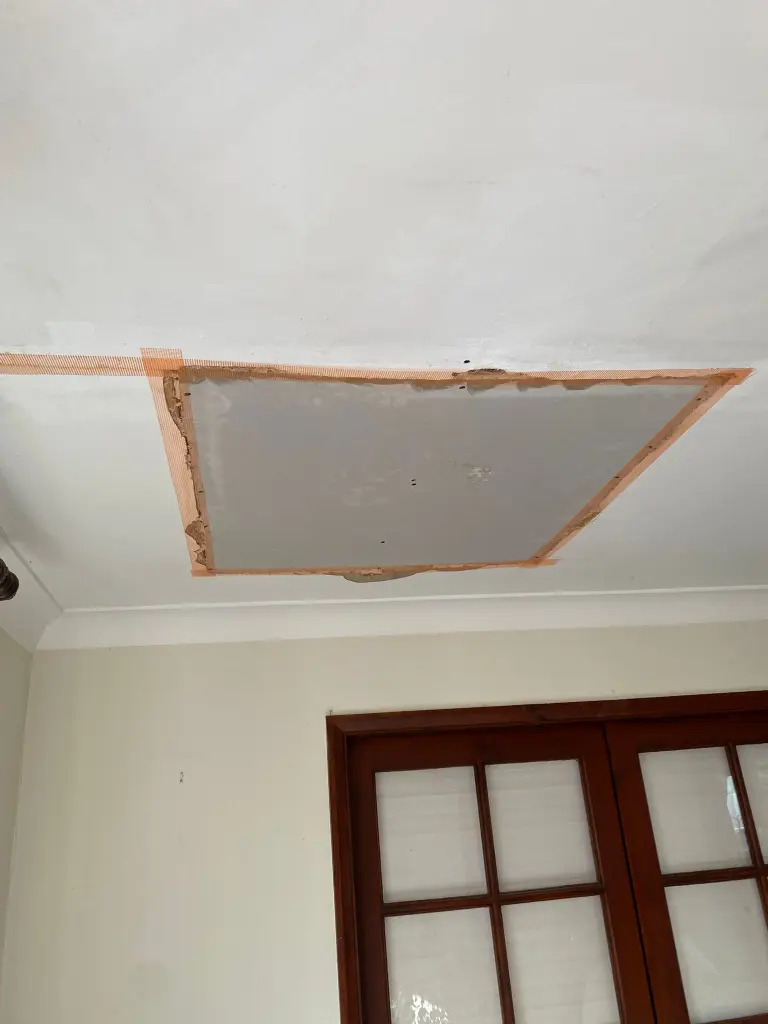
A leaking bath, a burst pipe or a roof leak can leave a stained, sagging ceiling. Once the leak is fixed and the area has dried, we can replace the damaged boards or section of ceiling and blend the repair in, or over-board and skim the whole ceiling if it’s cracked elsewhere too. If your insurer is involved, we can provide a written quote for them.
Condensation and mould
Bathrooms and kitchens without good extraction, and bedrooms on cold outside walls, often show black mould and peeling paint. New plaster won’t solve that on its own. Better ventilation, steady heating and, on very cold solid walls, insulated boarding or insulated render can all help. We’ll talk through options with you.
Popped screws and shrinkage in newer homes
In new builds and recent conversions, small round bumps where screw heads have pushed through, and cracks along board joints, are common as the building dries out and settles. These are usually straightforward to fix, and a skim over the affected walls gives a more durable finish than repeated filling.
Damp
Damp shows up as dark patches, flaky paint, white salts or plaster that crumbles. New plaster will not cure damp, and gypsum plaster put back on a damp wall will soon fail again. The cause has to be found and fixed first. Common ones are leaking gutters and pipes, a bridged damp-proof course, garden soil piled against the wall, and condensation in rooms with poor air flow. Once the wall is dry, we may use a sand and cement backing or a salt-resistant plaster before the finish coat, so the new plaster lasts.
For more on hollow plaster, see our guide to blown plaster. For cracks, holes and blown patches, see our page on plastering repairs.
Landlords, letting agents and commercial work
We do a lot of work for Birmingham landlords, from single buy-to-let terraces to HMOs and flats above shops. Jobs include patching between tenancies, re-plastering after leaks or damp works, boarding out new room layouts, and making good after fire door and electrical upgrades. If you manage several properties, we can give you a consistent way to send photos, get quotes and book work, and we’ll deal with tenants directly on access if you’d like.
We also take on plastering and small rendering jobs for shops, offices and other small commercial premises. Tell us what’s needed and when the space is available.
How a Birmingham job runs
Before we start
- Send photos. WhatsApp 07453 614095 with pictures of the walls, ceilings or outside of the house, rough measurements and your postcode. If you’re a landlord, include the property address and any access arrangements.
- Quote or survey. We’ll quote from photos where we can. For damp, cracked or sagging ceilings, big render jobs or conservation area homes, we’ll arrange a visit.
- Written quote. It sets out what’s included, from preparation and beads to waste removal.
- Agree a date. We’ll tell you how long the job should take and how long to allow for drying.
On the day
- Parking and access. On terraced streets with permit parking or tight access, let us know in advance so we can plan.
- Protection. We sheet floors and stairs, cover furniture and seal doorways where needed. Outside, we protect windows, doors, paths and neighbours’ property.
- Preparation. Loose plaster or render is removed and bagged. Beads and trims are fitted, and the surface is primed or bonded.
- Application. Coats are applied and finished. Render jobs often need several visits, because each coat needs time before the next.
- Tidy-up. Waste is removed, rooms are swept and you get clear advice on drying and decorating.
Working around other trades
On renovations, plastering usually follows the electrician’s and plumber’s first fix and comes before kitchens, flooring and decorating. If you’ve got other trades booked, share their dates and we’ll fit around them so nobody is waiting.
Step by step: how we plaster a room
This is the order we follow on a typical room, from bare wall to a finish you can paint.
- Protect the room. We sheet the floors and stairs, cover what cannot be moved, and tape up sockets and switches. Doors to other rooms are sealed off where needed, so dust stays in one place.
- Prepare the wall. Loose and blown plaster is cut back to a firm edge. Nails, old plugs and flaky paint are taken off, and the wall is brushed down.
- Fit the beads. Angle beads go on outside corners, and stop beads go on edges and round frames. They give straight lines and stop corners getting knocked.
- Prime the wall. The primer depends on the wall. On walls that soak up water fast, we use SBR mixed 1 part SBR to 4 parts water as a suction primer, so the plaster does not dry out before we can work it. On painted or low suction walls we use a bonding primer or PVA, and plaster onto it while it is still tacky.
- Backing coat if needed. On bare masonry, Hardwall or Bonding goes on first, ruled flat and scratched for a key.
- Mix the finish. We mix MultiFinish in a clean bucket with clean water, about 11.5 litres of water to a 25 kg bag. Water goes in first, then the plaster, mixed to a smooth, lump-free cream.
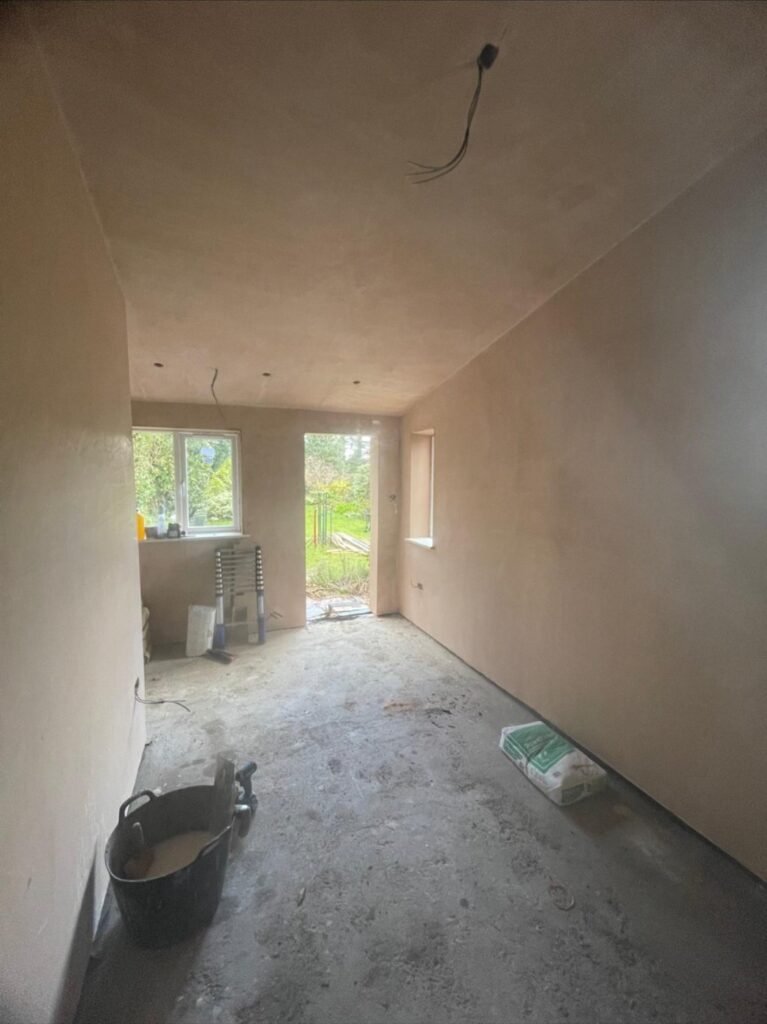
- First coat. The first thin coat goes on and is flattened off. On board, scrim tape is bedded in at this stage.
- Second coat. As soon as the first coat has firmed up a little, the second coat goes on. Together they make about 2 mm.
- Trowel up. As the plaster sets, we trowel it two or three times, with a light splash of water, until it is hard, flat and smooth.
- Clean up. Tools and buckets are washed, waste is bagged and taken away, and the room is swept. We then tell you how to dry the room.
Why working time matters
Once MultiFinish is mixed, there is only about 40 minutes of working time before it starts to set. That is why we mix one bag at a time and plan the order of the walls, so each wall gets its two coats and trowelling at the right stage. Dirty buckets or old water make plaster set faster, so we keep everything clean between mixes. A bigger room may need two of us working together to keep a wet edge and avoid lines.
Drying and aftercare
New plaster
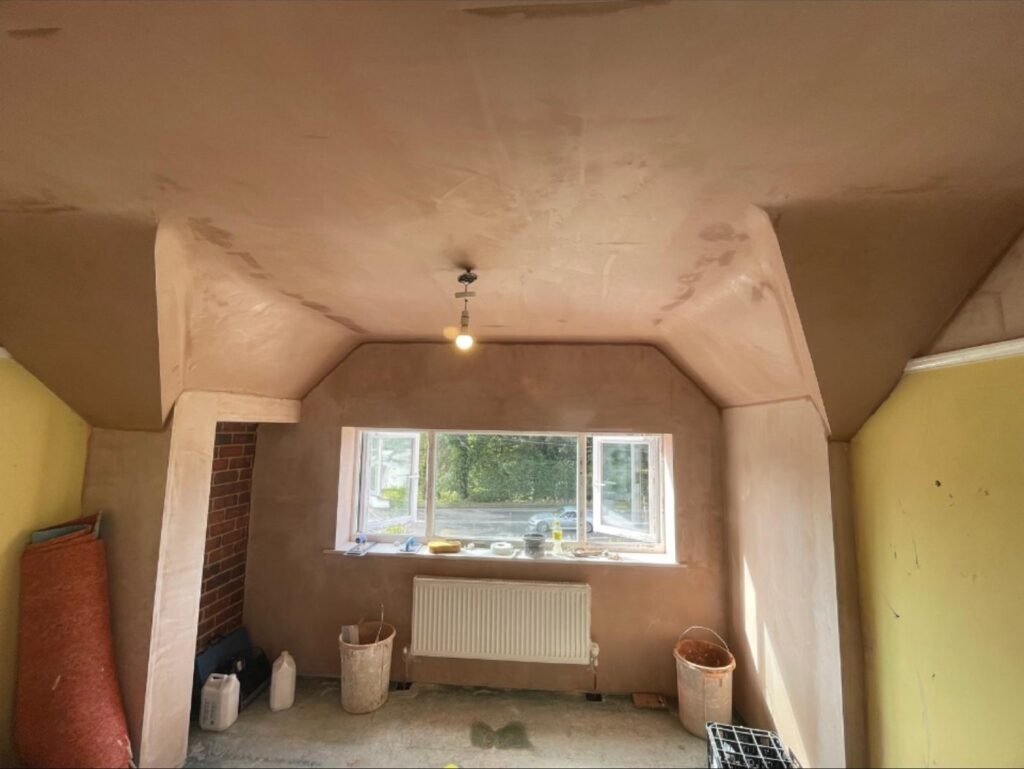
Fresh plaster is dark and slowly turns an even pale pink as it dries. A skim usually needs a few days. Backing coats and full re-plastering need longer, often a week or more, and longer still in cold, damp weather or rooms with little airflow.
- Keep windows slightly open and internal doors open to help moisture escape.
- Keep the heating on low and steady rather than blasting it. Heaters pushed against fresh plaster can cause cracks.
- Don’t paint until the whole surface is an even pale colour.
- Start with a mist coat: watered-down matt emulsion that soaks in and seals the surface.
- Hold off on vinyl or wipe-clean paints until the plaster is fully dry.
Our full guide on how long plaster takes to dry before painting has more detail.
The mist coat
New plaster soaks up paint like a sponge. If you put normal emulsion straight on, it dries on the top, does not grip, and can peel. A mist coat fixes that. Use a plain, cheap matt white emulsion and water it down, often about 3 parts paint to 1 part water, though the tin may give its own advice. Roll it on, let it soak in and dry, then put on your normal coats. Avoid vinyl, silk or wipe-clean paints for this first coat, as they sit on top and stop the plaster breathing.
New render
Render needs suitable weather while it cures, so we won’t apply it in frost, heavy rain or strong sun if it risks the finish. Through-coloured and silicone renders don’t need painting. Sand and cement render should be fully cured before it’s painted with a breathable masonry paint.
To keep render in good shape, clear gutters and fix leaks quickly, keep garden soil and paving below the bottom edge of the render, and wash off any green growth gently. Avoid pressure washers, which can damage the surface.
Plastering in cold weather
We plaster all year round, but winter needs a bit more care. Cold, damp air slows drying right down, and plaster that freezes before it sets can crumble and fail.
- Keep the room warm. The room and the wall should be above about 5°C while we work and while the plaster sets. Leave the heating on low the day before we arrive.
- No wet or frozen walls. We do not plaster onto walls that are damp from rain or still cold from frost. Fresh brickwork and wet backing coats need time first.
- Gentle heat, not fierce heat. Steady, low heating helps. Fan heaters or gas heaters pointed at the wall dry the face too fast and can cause cracks. Gas heaters also add water to the air.
- Let the damp air out. Open a window a little and keep inside doors open. A dehumidifier in the room, once the plaster has set, can help in winter.
- Allow more time. A finish coat that dries in a few days in summer can take a week or more in winter. Backing coats can take several weeks.
Our cold weather plastering guide covers drying times, heating and damp in more detail.
Choosing a plasterer in Birmingham
There’s no shortage of plasterers in a city this size, and it can be hard to tell them apart. These are the things worth checking.
- Specialist or general builder? Someone who only does plastering and rendering will often handle tricky walls and older houses better.
- A proper look at the job. Good plasterers ask about damp, check for hollow plaster and look at ceilings before they quote.
- A written quote. It should be clear about preparation, boarding, beads, protection and rubbish removal.
- Experience with older houses. Ask how they’d deal with solid walls, lath and plaster ceilings or lime plaster.
- Insurance. Public liability insurance matters, especially for rendering and scaffold work.
- Examples of work. Ask for photos. You can see some of ours on our projects page.
- Aftercare advice. They should tell you how long to wait before painting and how to do the first coat.
What shapes your plastering quote in Birmingham
Two jobs that sound the same can be very different once you see the walls. These are the main things we look at before we quote.
- Area. How many walls and ceilings, or how much of the house is being rendered.
- Condition. Sound walls need less work. Blown plaster, damp damage or very uneven surfaces need more.
- Ceiling height and type. High ceilings, stairwells and lath and plaster add time and need access equipment.
- Textured coatings. Skimming or boarding over Artex needs extra preparation. Any asbestos testing is separate.
- Render system. Sand and cement, silicone, through-coloured and insulated render each involve different materials and stages.
- Access. Scaffold for render, tight terraced access, parking and how far materials have to be carried.
- Details. Window and door reveals, corners, sills, beads and the number of openings.
- Removing old finishes. Hacking off old plaster or render adds labour and waste.
- Room readiness. An empty room is quicker than one where furniture has to be worked around.
The quickest way to get a free quote: WhatsApp me on 07453 614095 or message the page with photos.
Areas of Birmingham we cover
We work right across the city. These pages give more detail on specific areas:
- North: Sutton Coldfield, Four Oaks, Mere Green, Walmley, Erdington and Castle Bromwich
- South: Moseley, Kings Heath, Bournville, Selly Oak and Northfield
- West: Edgbaston and Harborne
- East: Hall Green, Acocks Green, Hay Mills, Sheldon and Yardley
- Neighbouring: Solihull, Smethwick, West Bromwich, Oldbury and Halesowen
For render, see rendering contractors in Birmingham. For everything we offer, see our plastering and rendering services.
We plaster in towns and villages right across the Midlands, not only Birmingham. See every plastering town we cover on our plastering areas page.
Castle Vale: an estate that changed
Birmingham City Council’s history of Castle Vale explains that the estate was built from 1964 on the old Castle Bromwich airfield. In 1993 residents voted to transfer their homes to a Housing Action Trust, which ran the estate from 1 April 1994 until it was wound up in 2005. Over those years most of the tower blocks came down and were replaced by houses and low-rise flats. The result is an unusual mix: 1960s homes that have been modernised, alongside new houses from the 1990s and 2000s. Older homes often have tired plaster around replaced windows and doors, while the newer ones tend to show nail pops and cracked joints in plasterboard as the timber frames settle.
Kitchens, bathrooms and chimney breasts
When the units come out
Taking out an old kitchen or bathroom often reveals crumbling plaster, old tile adhesive and holes from pipes. We repair or re-plaster these walls so the fitter has a flat, sound surface. Where tiles are going back on, a bonding coat or moisture-resistant board may suit better than a skim.
Back-to-backs and tunnel-back terraces
The city’s surviving back-to-backs in Hurst Street are now cared for by the National Trust, but the far more common tunnel-back terraces of Sparkbrook, Small Heath, Handsworth and Kings Heath run back in narrow wings that hold the kitchen and, usually, the bathroom. These rear rooms often have the worst plaster in the house, because they were added to or altered so many times. We strip back to sound material, deal with any damp and re-plaster so the whole wing matches. If the wing has a flat roof, we check for leaks around the edges first, because water getting in there is a common reason the ceiling plaster has failed before.
Old fireplaces
Many Victorian and inter-war houses have had their fireplaces blocked up. If the chimney isn’t vented, damp and salts can stain the plaster on the breast. We look at the cause, suggest venting where it’s needed and use a salt-resistant plaster before skimming.
More questions from Birmingham homeowners
Can you plaster a room in a rented house between tenants?
Yes. Send the address, photos and the date the property needs to be ready. We’ll tell you if the timescale works, including drying time before the decorator starts.
My terrace has damp at the bottom of the walls. Should I just re-plaster?
Not on its own. Find and fix the cause first: a bridged damp-proof course, high ground outside, leaking pipes or condensation are all common. Once it’s sorted, we can re-plaster with materials that suit the wall.
Can you repair a lath and plaster ceiling?
Often. Small areas can be patched. If the plaster is coming away from the laths but the ceiling is otherwise sound, it can sometimes be screwed back and over-boarded. If it’s badly sagging, it may need taking down and replacing with plasterboard.
Do you work in flats and high-rise blocks?
Yes, as long as the building’s management allows it. Many blocks have rules about working hours, lifts and waste, so check with your management company first.
Can I render just the back of my terrace?
Often, yes. Rendering a rear wall or rear wing is a common job. If the front of the house is in a conservation area, or the new finish looks very different from what’s there, check planning first.
Is pebbledash worth keeping?
If it’s well bonded and you like the look, a repair and a coat of masonry paint can be the simplest option. If it’s hollow, cracked or patchy, removing it and re-rendering gives a better, longer-lasting result.
How messy is plastering?
There’s always some dust and mess, especially when old plaster is hacked off. We sheet everything, keep the work area contained and clear up at the end of each day.
Do you offer plastering in the city centre and Jewellery Quarter?
Yes. Our office is in St Paul’s Square. Parking and access can be tight in the centre, so let us know about loading bays or building rules.
Can you plaster over painted walls?
Yes, with the right preparation. Painted walls usually need cleaning and a bonding coat so the new plaster grips. Flaking paint has to come off first.
What should I do before you arrive?
Clear the room as far as you can, take down curtains, pictures and shelves, and arrange for an electrician to loosen sockets and switches if we need to plaster behind them.
Birmingham homes we plaster
Birmingham is a big city with every kind of house in it, and each one needs something a bit different from its plaster. Here’s where we work most, the homes you’ll find there and the plastering jobs that come up.
- Moseley, Kings Heath and Balsall Heath. Victorian and Edwardian terraces and villas with old lime plaster and lath and plaster ceilings. Replastering after a rewire, sagging ceilings over-boarded and plastered, and chimney breasts made good.
- Harborne and Edgbaston. Larger Victorian and Edwardian houses with high ceilings, bay windows and coving. Ceilings brought back flat, walls replastered room by room, and new extensions at the back plastered to match.
- Erdington, Kingstanding and Perry Barr. 1920s and 1930s council and private semis. Artex ceilings covered, walls replastered after a rewire or new central heating, and through lounges finished after a knock-through.
- Hall Green, Acocks Green and Yardley. Interwar semis with bay fronts. New kitchen extensions and garage conversions plastered, plus tired walls and cracked ceilings.
- Northfield, Longbridge and Selly Oak. Interwar estates, post-war homes and newer houses at Longbridge. Extensions and loft rooms, and rented houses in Selly Oak replastered between tenants.
- Sheldon, Stechford and Castle Vale. Post-war houses, maisonettes and flats. Artex ceilings, patch repairs and full replasters after a rewire.
- The city centre, Jewellery Quarter and Digbeth. Apartments and converted works buildings. Plasterboard cracks, patch repairs after other trades and new stud walls plastered.
Whatever the house, RCR Connections Ltd brings 62 years of combined experience to it. We’re Birmingham based, covering the whole of the Midlands, and we work Monday to Friday 7am to 5pm and Saturday 7am to 1pm. WhatsApp me on 07453 614095 or message the page with photos of the room and your road or postcode in Birmingham.
Outside, we also fit K-Rend monocouche and silicone render, see rendering in Birmingham. If you’re just over the border, we’re also the plasterer in Solihull.
What our customers say
Was amazed by the punctuality from them as far as tradesmen go and the experience was stress-free with a great finish to my maisonette.
James Tranter
We chose them for our home extension, and the transformation was amazing. Their work is top-notch, and I’d recommend them to anyone seeking both quality and luxury in construction.
Emma S
These guys were great lads, grafted hard, and was really happy with the price and the end result. Blimey, it was outstanding!
Michael T
Very impressed with the workmanship and attention to detail. The project was completed on time and exceeded my expectations!
Sophia Reynolds, Property Manager
Plastering guides
We write plain guides to help you plan your job and look after new plaster. These are the most useful ones for plastering:
- Plastering coats explained: Bonding, Hardwall and MultiFinish
- Plastering in cold weather: drying times, heating and damp
- How long does plaster take to dry?
- Blown plaster: how to spot it and what to do
- Plastering over Artex in Birmingham
- Plastering after a damp proof course: how walls are replastered
- Plastering new plasterboard: tape, beads and MultiFinish
- Plastering day: how to get a room ready for the plasterer
- Plastering and rendering primers: SBR slurry, PVA and bonding agents
You can find all of our guides, on plastering and rendering, in our guides section.
Get a free plastering or rendering quote in Birmingham
WhatsApp me on 07453 614095 or message the page with photos of the walls or ceilings, rough room sizes and your postcode. We’ll come back with a free, no-obligation quote. RCR Connections Ltd is Birmingham based, covering the whole of the Midlands, and we work Monday to Friday 7am to 5pm and Saturday 7am to 1pm.
Plastering in Birmingham: common questions
Do you cover Birmingham and the surrounding area?
Yes. RCR Connections Ltd is Birmingham based, covering the whole of the Midlands, and works across Birmingham and the surrounding area. We also cover rendering in Birmingham, Solihull and Coventry. For the full list, see areas we cover.
How do I get a plastering quote in Birmingham?
WhatsApp photos of the walls or ceilings to 07453 614095, with rough room sizes and what you would like done. We will come back with a free, no-obligation quote, or arrange a visit if the job needs a closer look.
How soon can I decorate after plastering?
A skim usually needs a few days to dry, and thicker backing coats need longer, depending on ventilation and the time of year. Wait until the plaster is an even pale colour all over, then start with a mist coat (watered-down emulsion).
Can you plaster over Artex?
Yes. We can skim over Artex, or over-board and skim ceilings that are cracked or uneven. If the Artex went up before 2000, have it tested for asbestos before anyone scrapes or sands it.
What is MultiFinish and when do you use it?
MultiFinish is a gypsum finish plaster. We use it as the final smooth coat over plasterboard, over Hardwall or Bonding backing coats, and over old plaster that is still firm. It goes on in two thin coats, about 2 mm in total.
What is the difference between Bonding and Hardwall?
Both are backing coats that go on before the finish. Hardwall suits walls that soak up water fast, such as most brick and block, and is tough and quick to set. Bonding suits walls that soak up very little, such as smooth concrete or engineering brick.
Do you prime walls before plastering?
Yes, when the wall needs it. On walls that soak up water fast, we use SBR mixed 1 part to 4 parts water as a suction primer. On painted or low suction walls we use a bonding primer or PVA, and plaster onto it while it is still tacky.
How long do you have to work with MultiFinish once it is mixed?
About 40 minutes. We mix about 11.5 litres of clean water to each 25 kg bag, in a clean bucket, and mix one bag at a time so each wall is finished at the right stage.
Can you plaster in winter?
Yes. We keep the room above about 5°C, never plaster onto wet or frozen walls, and use gentle, steady heat rather than fan or gas heaters aimed at the wall. Drying takes longer in winter, so allow more time before painting.
What is a mist coat?
A mist coat is the first coat of paint on new plaster. It is cheap matt white emulsion watered down, often about 3 parts paint to 1 part water, so it soaks in and seals the plaster. Normal coats go on once it is dry.
Why has my new plaster cracked?
Small cracks often come from plaster drying too fast, from heaters aimed at the wall, or from board joints that were not taped. Fine cracks can usually be filled once the plaster is dry. Wider or growing cracks need a closer look, so WhatsApp me on 07453 614095 or message the page with a photo.
Do you fit coving?
Yes. We fit plaster coving in plain and classic shapes, with clean mitred corners and filled joints. We can also match short runs of missing coving in older homes.
What hours do you work?
Monday to Friday 7am to 5pm and Saturday 7am to 1pm.
Popular areas we cover
Plastering: Plasterer in Solihull, Plasterer in Sutton Coldfield, Plasterer in Shirley, Solihull, Plasterer in Coventry, Plasterer in Tamworth, Plasterer in Wolverhampton.
Rendering: Rendering in Solihull, Rendering Contractors in Birmingham, Rendering in Tamworth, Rendering in Redditch, Rendering in Bromsgrove, Rendering in Walsall. See every town on our areas we cover page.
More services: Plastering repairs · Plastering and coving · Plastering extensions and lofts.
More plastering towns
We also plaster in Alcester, Alvechurch, Atherstone, Balsall Common, Barnt Green, Bedworth, Bentley Heath, Berkswell, Bidford-on-Avon, Bromsgrove, Burntwood, Cannock, Chelmsley Wood, Cheswick Green, Coleshill, Copt Heath, Dickens Heath, Dudley, Halesowen, Hampton-in-Arden, Henley-in-Arden, Hockley Heath, Kenilworth, Kidderminster, Kineton, Kingswinford, Kinver, Lapworth, Leamington Spa, Lichfield, Marston Green, Meriden, Nuneaton, Oldbury, Olton, Redditch, Rugby, Shenstone, Smethwick, Southam, Stourbridge, Studley, Tanworth-in-Arden, Tettenhall, Tidbury Green, Walsall, Warwick, Wellesbourne, Worcester, Wythall.
See every plastering town on our plastering areas page, or every rendering town on our rendering areas page.