
Render does two jobs at once. It keeps the weather out of the brickwork, and it decides how your house looks from the road. Get it right and it can stay sound for decades. Get the preparation or the product wrong and you’ll see cracks, staining or hollow patches within a few winters. RCR Connections Ltd is a plastering and rendering specialist, Birmingham based and covering the whole of the Midlands, and our team has 62 years of combined experience. You’ll find our render on houses, extensions, garden walls and small commercial buildings all over the borough, from Shirley (see our page on rendering in Shirley), Olton and Elmdon to Balsall Common, Meriden, Marston Green and Chelmsley Wood.
This page is a proper guide rather than a sales sheet. It explains each render system we use and where it suits Solihull houses, how colours and textures work, what happens to a wall before any render goes on, why the weather and the time of year matter so much, and how planning and building regulations apply to rendering in Solihull Metropolitan Borough. You’ll also find how a job runs, how to look after new render and a long list of questions people ask us.
K-Rend in Solihull: rendering across the borough
Solihull is a leafy borough with a huge mix of houses, and K-Rend monocouche and silicone render is the finish most Solihull homeowners ask us about. RCR Connections Ltd is Birmingham based, covering the whole of the Midlands, and Solihull is one of our busiest areas, a short run out from our Birmingham base along the A41 Warwick Road or the A45. These are the parts of the borough we work in most, the houses you find there and the K-Rend jobs they tend to need.
- Solihull town centre, Malvern Park, Sharmans Cross and Streetsbrook Road. 1920s and 1930s detached and semi-detached houses, many with rendered bays and upper storeys and mock-Tudor gables. Typical jobs are swapping tired painted render on the upper floor for through-coloured K-Rend monocouche, and silicone on walls under the big trees, where green staining builds up fast.
- Olton, Elmdon and Lyndon. Interwar semis off the Warwick Road and Lode Lane, often with grey pebbledash that has cracked or gone hollow. We take off what is loose, put on a meshed base coat and finish in K-Rend monocouche or silicone.
- Hillfield, Cranmore, Elmdon Heath and Damsonwood. Homes from the 1960s to the 1980s, with rendered panels, gable ends, porches and garage fronts. Rear extensions and garage conversions finished in K-Rend to match or lift the rest of the house are common here.
- Chelmsley Wood, Kingshurst, Smith’s Wood and Fordbridge. Post-war estates with semis, terraces and maisonettes, some of them built with non-traditional methods. We check how the house was built before we choose a system, then K-Rend monocouche or silicone gives ex-council homes a clean, modern front.
- Castle Bromwich and Marston Green. Interwar and 1950s semis, many with pebbledash or painted render. Castle Bromwich sits just over the boundary from Walmley, and our page on rendering in Sutton Coldfield covers the homes on that side.
- Shirley, Monkspath and Dickens Heath. See our page on rendering in Shirley for the B90 side of the borough.
- Hampton-in-Arden, Meriden, Balsall Common and Bentley Heath. Older cottages with solid walls, where a breathable silicone or lime system protects the wall, alongside 1960s and 1970s bungalows and newer homes where K-Rend is the usual choice.
Wherever you are in the borough, the first step is the same: WhatsApp me on 07453 614095 or message the page with a photo of each side of the house and your road or postcode. We work Monday to Friday 7am to 5pm and Saturday 7am to 1pm, and between us we have 62 years of combined experience.
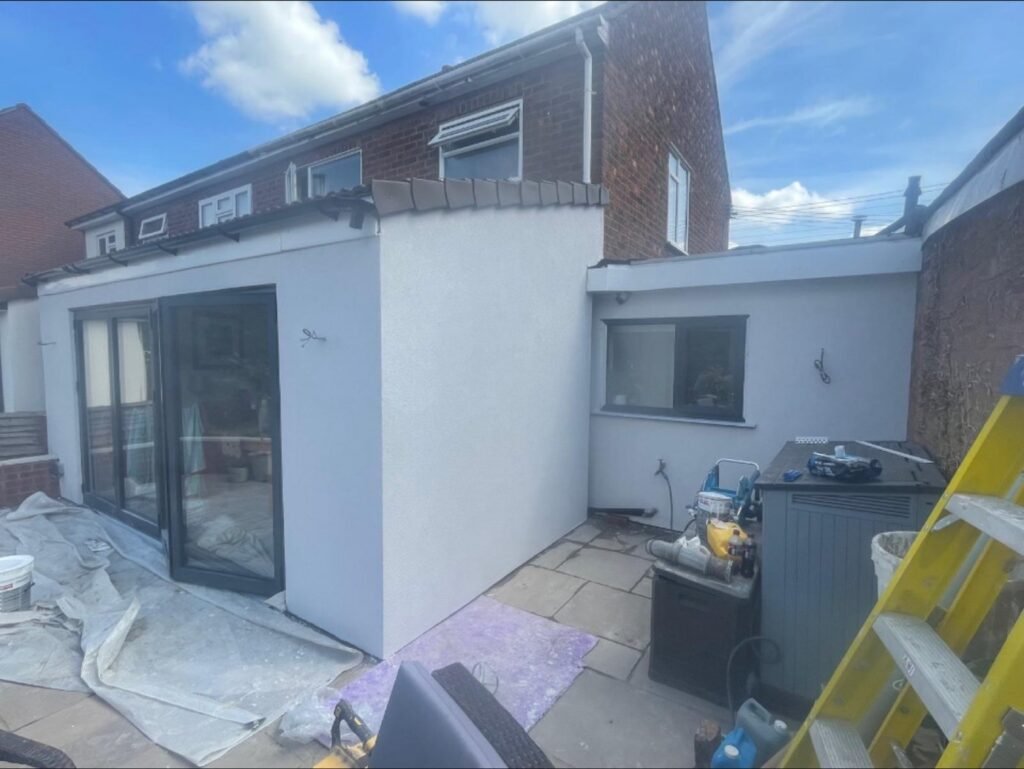
Render systems we use in Solihull
There’s no single best render. The right one depends on what the wall is made of, how exposed it is, what’s on it now, how the house was built and the look you’re after. These are the systems we work with.
K-Rend monocouche render
Monocouche means “single coat”. It describes a factory-made, through-coloured render, and K-Rend monocouche is one of the best-known brands of it. The pigment is part of the dry mix, so the colour runs all the way through rather than sitting on the surface as paint. Despite the name, we normally apply it in two passes, one straight after the other, to build up the thickness the manufacturer specifies. Once it has firmed up, usually later the same day, it’s scraped back with a toothed tool to take off the skin and leave a fine, even texture.
The big advantage is that there’s no painting, either now or in future. A scuff or a chip doesn’t expose a different colour underneath. It suits block-built extensions, houses being changed from brick to a rendered finish, and whole-house makeovers on solid, sound backgrounds.
It has limits. Monocouche needs a background that’s even enough and stable enough, so very uneven or previously painted walls may need a levelling coat or a different system first. Colour can vary slightly between batches, so we order the full quantity for each job in one go and work each wall in a single session, finishing at natural breaks such as corners and beads. And because the colour is fixed, a dark shade on a wall that bakes in the afternoon sun can fade a little over time. For more detail, see our K-Rend monocouche page and our K-Rend monocouche in Birmingham and Solihull page.
Silicone render
Silicone render is a thin-coat system. A cement-based or polymer base coat goes on first with a glass-fibre reinforcing mesh bedded into it. After that has cured, a primer is applied and then the silicone finish is laid on at roughly the thickness of its grain, typically one to three millimetres, and rubbed up with a plastic float to give an even, sandpaper-like texture.
The silicone resin makes the surface water-repellent while still letting water vapour out of the wall. In practice that means rain runs off rather than soaking in, the wall dries out quickly after a shower, and dirt and algae have less to cling to. It’s also more flexible than a traditional cement render, which helps it cope with the small movements every house makes. Colours range from soft whites to deep greys and almost anything in between.
In Solihull, that makes silicone a strong choice for houses under mature trees, which there are plenty of across Olton and the roads around Malvern Park, for elevations that face north or west into the weather, and as the finishing coat over insulation boards.
Sand and cement render
Sand and cement is the traditional method and still very common across the borough. We mix it on site and apply it by hand in two or three coats: a scratch coat, scored to give the next layer something to grip, then a float coat ruled flat and finished. Once it has cured fully, it’s painted with a breathable masonry paint.
It’s tough, familiar to work with and easy to patch, so it’s the obvious choice where a house already has painted cement render and only part of it has failed. It also works well on plinths, garden and boundary walls, and outbuildings. The downsides are that it relies on paint for its colour and weather resistance, so you’ll be redecorating every so often, and it’s relatively rigid, so it can crack if the wall moves. On older solid brick, a strong cement mix can also trap moisture, which is why we look carefully at the wall before we recommend it.
Insulated render
Insulated render is a complete system rather than a single product. Insulation boards are bonded and mechanically fixed to the masonry, a base coat with reinforcing mesh is applied over them, and a decorative finish goes on top, usually silicone. The insulation goes on the cold side of the wall, so rooms lose less heat through it and the inside of the wall stays warmer, which can help with condensation.
It’s mostly considered for solid-walled houses, which can’t be insulated in the cavity because they don’t have one. In Solihull, that typically means some of the older houses in the town centre and the villages, and certain post-war houses built with non-traditional construction. It’s a serious undertaking. The extra thickness means window sills need extending, downpipes, satellite dishes, lights and sometimes meter boxes have to be moved out, and the roof overhang has to be checked to make sure it still covers the top of the new wall. The bottom edge needs particular care so moisture can’t track up behind the boards. Building regulations always apply, and planning may too. We’ll go through all of that with you before you commit to anything.
Render repairs
Plenty of Solihull houses don’t need a full re-render, just a good repair. Typical faults are cracks around window and door corners, hollow patches that sound drummy when tapped, render that has bulged or fallen away at the base, and staining where water has been running down the wall from a leaking gutter or a missing drip detail.
We start by finding the cause, because patching a crack without fixing the reason it opened is a waste of money. Then we cut out the defective area back to sound render with clean edges, treat or replace any rusted beads, and build the patch up in layers to match the existing thickness and texture. On painted render, a fresh coat over the whole elevation usually makes the repair disappear. Through-coloured renders are harder, because the original will have mellowed in the sun, so a new patch can look a shade different for a while. We’ll say so up front. Our article on signs your render needs repairing before winter is a good checklist.
Pebbledash and other old finishes
A lot of Solihull’s interwar and post-war houses were finished in pebbledash, where small stones are thrown onto a wet render coat. When it’s sound, it’s very hard-wearing. When it isn’t, it tends to crack and come away in plates. We can repair small areas, but matching old pebbledash is difficult because the stones and colour are rarely available now. More often, owners decide either to render over it, if it’s firmly bonded, or to hack it off and start again. We tap-test the whole wall before advising which.
Free, no-obligation quote in Solihull: WhatsApp me on 07453 614095 with a few photos, or send us a message.
Matching the render to the house
Solihull has a wider spread of house types than most people realise, and each behaves differently once render goes on.
1920s and 1930s semis
The long roads of semis in Olton, Shirley, Elmdon and Lyndon, and across the older parts of Solihull town, are where we do much of our rendering. Many have pebbledash or painted render on the front, sometimes only on the upper half with brick below, and bays that take careful detailing. These houses usually have cavity walls, although early ones may be solid, so we check before assuming. The usual brief is to deal with tired or cracked pebbledash and give the front a clean, modern look, often in silicone or monocouche. Because they’re semis, we always agree how the finish will stop at the line between your half and next door’s, and whether the change in appearance needs planning.
Post-war estates and non-traditional houses
Chelmsley Wood, Kingshurst, Fordbridge and Smith’s Wood were largely built as overspill estates for Birmingham in the post-war decades, and estates from the same era appear around Shirley and Solihull. Some homes here were built with non-traditional systems such as concrete panels or steel frames. Those need extra care: certain types have known structural issues, and the right render or insulated render system depends on exactly what the wall is made of. We’ll ask what you know about the construction, and on some houses we’ll recommend you get a specialist structural opinion before any rendering decision is made.
Village cottages and older houses
Hampton-in-Arden, Berkswell, Meriden, Barston and Temple Balsall all have older cottages and houses, some timber-framed and many listed or in conservation areas. On these, modern cement and polymer renders can do real harm by trapping moisture in soft brick and old mortar. If lime render is the right material, we’ll tell you, and if the job needs a specialist conservation contractor, we’ll be honest about that too.
Newer homes and extensions
On homes from the 1980s onwards, in Monkspath, Hillfield, Dickens Heath and Cheswick Green, rendering is more often about extensions, part-rendered fronts or giving a plain brick house more character. Block-built extensions are ideal for monocouche or silicone, and we can match an extension to an existing render or deliberately contrast it.
Render problems we see most in Solihull
Every house is different, but the same handful of faults turn up again and again when we survey render around the borough.
Cracks that follow the brick joints or radiate from windows
Fine cracks that run in a stepped pattern, or spread diagonally from the corners of windows and doors, usually mean the render has moved with the wall underneath. Sometimes that’s just thermal movement in an older, rigid render. Sometimes it’s a lintel, a failed sill or movement in the wall itself. We’ll tell you if we think a builder or surveyor should look at the cause before anyone patches it.
Hollow render at the base
The bottom metre of a wall takes the most punishment from rain splash, ground moisture and frost. If the render was carried down below the damp-proof course, or the ground has been built up against it with a new patio or flowerbed, it often turns hollow and crumbly here first. The fix is to cut it back, restore a proper bellcast detail above the damp-proof course and get the ground level down.
Green and black staining
Walls under the trees in Olton, around Malvern Park or along the country lanes, and north-facing gables everywhere, can turn green within a few years. It’s mostly algae, encouraged by a surface that stays damp. Cleaning helps for a while, but if the render is porous and the wall rarely gets sun, a silicone finish is the longer-term answer.
Paint peeling off cement render
Painted render that’s flaking in sheets has often been coated with a non-breathable paint, or water is getting in behind from above. Repainting over the top just hides the problem for a season. We check the render underneath, repair it and recommend a breathable masonry paint, or a change of system if the wall needs it.
Mismatched patches
Many Solihull houses have had a window replaced, a porch added or a pipe moved, with a patch of render that never matched. Sometimes the answer is to re-coat the whole elevation so it reads as one surface again.
Extensions, porches and garden walls
Not every rendering job is a whole house. A lot of our work in Solihull is smaller, and the same care goes into it.
Extensions. New rear and side extensions are usually built in block, which is a good background for monocouche or silicone. The most important decision is whether the extension should match the main house or contrast with it. Matching an old painted render is straightforward: we render the extension and you repaint both. Matching a mellowed through-coloured render is harder, so we often suggest a deliberate contrast instead, or re-coating the whole house so it all matches.
Porches and bay fronts. Small areas with lots of corners, sills and junctions take longer than their size suggests, so we quote on the detail, not just the area.
Garden and boundary walls. Rendered and capped properly, a block garden wall can look smart for years. The cap or coping is what protects it, so we make sure water is thrown clear of the face rather than soaking into the top.
Garages and outbuildings. Detached garages and workshops are often rendered in sand and cement and painted, which is robust and easy to maintain.
Colours, textures and finishes
Choosing the look is the fun part, but a few practical points help.
Colour. Pure brilliant white looks crisp on day one but shows every streak from a window sill or a leaky gutter. Off-whites, soft creams, light stone shades and pale greys tend to stay looking clean for longer, especially on walls that face north or sit under trees. Darker greys and charcoals are popular on extensions and contemporary houses. They look striking, but they absorb more heat and are more likely to show fading over time, so they’re best on walls that don’t take the full afternoon sun.
Texture. Monocouche is usually scraped to a fine, slightly open texture. Silicone comes in different grain sizes, from very fine to a coarser finish that’s better at hiding minor unevenness. Sand and cement can be finished smooth, with a sponge, or textured, and then painted.
Details. Coloured beads at the corners and edges, contrasting plinths, and how the render meets sills, window frames and the roof all affect the final look as much as the colour does. We’ll talk you through the options.
Seeing it first. Colour cards are useful but small. Daylight on a big wall changes how a shade looks, so we can show larger samples, and on some jobs a small test area in an out-of-the-way spot is worth doing. If you’re in a road where most houses share a finish, think about how your choice will sit with the neighbours, especially if planning permission is needed.
Preparation: what happens before the render goes on
Most render failures trace back to something that happened, or didn’t happen, before the finish coat. This is where we spend a lot of the time on a job.
- Survey and tap test. We go over the existing render or pebbledash with a hammer handle, listening for hollow areas, and look for cracks, damp staining, salts and signs of movement.
- Decide what stays. Sound, well-bonded render can sometimes stay and be rendered over with a suitable system. Anything hollow, cracked or loose comes off, back to the masonry.
- Fix the causes. Leaking gutters, overflowing downpipes, failed sills and ground levels that are too high all need sorting out. Render should finish above the damp-proof course, not bridge it, and soil or paving shouldn’t be piled up against it.
- Repair the background. We rake out and fill cracks, rebuild broken brick or block, and treat any areas affected by salts.
- Clean and stabilise. Loose dust, algae and old paint are removed. Depending on the system, the wall is then primed, given a bonding coat, or dampened so it doesn’t suck the water out of the render too quickly.
- Beads and trims. Corner beads, stop beads at edges and around openings, and a bellcast bead at the base go on. The bellcast kicks out slightly so water drips clear of the wall below, and it’s one of the details people most often see missing on failed render.
- Protect everything else. Windows, doors, paths, drives, conservatories, plants and neighbouring property are masked and sheeted.
Weather and the rendering season
Render cures through a chemical reaction and the slow loss of water, and both depend on the weather. Most manufacturers set a minimum temperature, typically around 5°C, which has to hold while the render is applied and for some time afterwards. Frost can ruin fresh render overnight. Heavy rain can wash out the surface or stain the colour before it sets. Strong sun and drying wind can pull water out too quickly, which leads to cracking and patchy colour.
That makes late spring to early autumn the most reliable season in the West Midlands. Winter work isn’t impossible, especially on sheltered walls or with scaffold sheeting, but it depends heavily on the forecast and the product. Our approach is simple: we’d rather move a start date than apply render in conditions that will spoil it. On scaffolded jobs we keep a close eye on the forecast and plan which walls to do on which days, so the most exposed elevations get the best weather.
If you’re planning a project, it’s worth getting quotes in late winter or early spring, so scaffolding and dates can be arranged before the busiest months.
Planning permission and building regulations for render in Solihull
Rendering is one of the few common home improvements where both planning and building regulations can come into play. Your local planning authority is Solihull Metropolitan Borough Council, which also runs a building control service. This is a general guide, so check the council’s own pages for your address before work starts.
Permitted development for houses
Houses, but not flats or maisonettes, have permitted development rights. Under the national rules, the materials used for work on the outside of a house should be of a similar appearance to those already used on it. The Planning Portal explains that replacing render with render of a similar appearance is normally permitted development, while a change in type or colour, or rendering a brick house for the first time, may need permission. If in doubt, you can apply to the council for a Lawful Development Certificate to confirm the position.
Conservation areas and listed buildings
On what the law describes as “Article 2(3) land”, which includes conservation areas, cladding any part of the outside of a house with render isn’t permitted development. That means a planning application. Solihull Council also says detailed planning applications will be needed in conservation areas, that permitted development rights for minor works are restricted there, and that a conservation area may be subject to an Article 4 Direction removing further rights.
Solihull Council lists 20 conservation areas. Some take their names from the borough’s villages and hamlets, such as Barston, Berkswell, Bickenhill, Castle Bromwich, Hampton-in-Arden, Meriden Green, Meriden Hill, Temple Balsall and Walsall End. Others cover parts of the town and its suburbs, such as Ashleigh Road, Granville Road, Grove Avenue, Malvern Hall and Brueton Avenue, Malvern Park Farm, Olton, Solihull, Warwick Road and White House Way.
It has a conservation, heritage and enforcement map you can search by address, and the planning team takes questions at planning@solihull.gov.uk. Listed buildings need listed building consent for works that affect their character, which often includes rendering or removing render.
Building regulations
Render also counts for building regulations, because of energy efficiency. Approved Document L says that applying render to a wall, or stripping a wall right back and re-rendering it, is work on a thermal element. Do that to more than half of any one wall, or to more than a quarter of the house’s whole envelope, and the wall should be insulated to a better standard at the same time, provided that’s technically, functionally and economically feasible. So a full re-render of the front of a solid-walled house can bring insulation into the conversation. Insulated render always needs approval. Building control can be done by Solihull Council or by a registered building control approver; talk to them before the scaffold arrives rather than after.
Other things to check
Some newer estates have planning conditions or covenants that control materials and colours, so check your deeds or the original planning permission. If you’re on a semi or terrace, it’s courteous, and often useful, to talk to your neighbours early, especially if scaffold needs to stand on their side or the finish will stop at the party line. Where scaffold sits on the pavement, a licence from the highway authority may be needed, and the scaffolding firm normally arranges that.
How a rendering job runs
1. Photos and a conversation. Send pictures of each side of the house to 07453 614095 on WhatsApp, with your postcode and a note of what you’d like. Wide shots, close-ups of any cracks or hollow areas, and the base of the wall all help.
2. Survey. For most rendering we’ll visit, because tapping the wall and seeing the details in person tells us far more than a photo. We’ll recommend a system and explain why.
3. Written quote. You’ll get a written quote that sets out the preparation, the system, beads, scaffold and what’s excluded.
4. Planning and approvals. If permission or building control is needed, that comes before booking dates. We can supply product data, colour references and photos for an application.
5. Scaffold and protection. The scaffold goes up, everything that isn’t being rendered is masked, and fittings such as lights, cables and downpipes are taken down where needed.
6. Preparation. Removal of old render, repairs, cleaning, priming and beads.
7. Render. Base coats, mesh where the system needs it, then the finish, all within the weather limits the manufacturer sets. Each elevation is worked in one go to avoid joins.
8. Finishing and handover. Masking comes off, fittings go back, the site is cleared and we walk round the job with you. The scaffold is struck once you’re happy.
Looking after your render
Good render needs very little, but a few habits make a big difference to how long it looks good.
- Gutters and downpipes. Clear them each autumn and fix leaks promptly. Water pouring down one patch of render is the most common cause of staining and early failure.
- Ground levels. Keep soil, bark, gravel and paving below the bottom of the render and the bellcast bead.
- Plants. Climbers look lovely but hold moisture against the wall and can lift the finish. Keep shrubs trimmed back so air can move.
- Cleaning. If green or black growth appears, use a soft brush and a cleaner suitable for the render type. Don’t pressure-wash at close range, which can damage the surface.
- Fixings. When you add a light, a hose reel or a satellite dish, seal the fixings so water can’t get in behind the render.
- Painted render. Repaint sand and cement render with a breathable masonry paint when it starts to look tired, before the paint fails completely.
- Small cracks. Get hairline cracks looked at before winter. They’re quick to deal with early and a much bigger job after a few frosts.
Choosing a rendering contractor in Solihull
Render is a big, visible investment, so it’s worth asking a few questions before you choose.
- Do they survey the wall? Anyone quoting a full re-render without looking at or tapping the existing surface is guessing.
- Do they explain the system? You should know which render, base coat, mesh and beads they plan to use, and why it suits your wall.
- What preparation is included? Removal, repairs, priming and beads should be listed, not assumed.
- How do they handle the weather? A good contractor will talk about temperature limits and won’t promise to render through frost.
- Is the quote written? It should show what’s included, what isn’t, and who arranges the scaffold.
- Are they insured? Public liability insurance matters, especially with scaffold over paths and neighbouring property.
- Can they show you finished work? You can see some of ours on our projects page.
- Do they mention planning? In a conservation area, or if the look is changing, a contractor should tell you to check.
What shapes your rendering quote in Solihull
Every rendering job is different, so every quote is too. These are the things that make the biggest difference.
- Area. The number of square metres to be rendered, and how many elevations.
- The existing surface. Rendering new blockwork is quicker than removing old pebbledash and repairing the wall behind it.
- Removal and disposal. Hacking off old render or pebbledash is labour-intensive and produces a lot of waste.
- The system. Sand and cement, silicone, monocouche and insulated render use different materials and involve different numbers of stages.
- Scaffold and access. House height, ground conditions, conservatories and narrow side passages all affect the scaffold needed.
- Detailing. The number of windows, doors, bays, corners and reveals, and any contrasting plinths or bands.
- Fittings. Moving downpipes, meters, cables and lights, especially for insulated render.
- Repairs to the background. Cracked brickwork, failed lintels or damp problems need fixing first.
- Approvals. Time spent on drawings, product information or building control requirements.
WhatsApp me on 07453 614095 or message the page with a photo of each side of the house, and we’ll set everything out in a free written quote.
Areas near Solihull we cover
We render homes right across Solihull borough and the surrounding area. These pages have more on specific places:
- Around the town: Shirley, Olton, Marston Green, Chelmsley Wood and Castle Bromwich
- To the south: Bentley Heath, Dickens Heath, Cheswick Green and Hockley Heath
- To the east: Hampton-in-Arden, Meriden, Berkswell and Balsall Common
- Further afield: rendering in Birmingham, rendering in Yardley, rendering in Water Orton and rendering in Redditch
For inside work, see our plasterer in Solihull page.
Practical points for Solihull rendering jobs
Being at home while we work
Not all the time. We need access to all sides of the house, water and sometimes electricity, and someone to check details such as where fittings go back. Many clients go to work as normal.
Scaffold and your drive
It depends on the layout. Scaffold usually sits close to the house, and we’ll agree with you beforehand where it goes, where materials are stored and how you’ll get in and out.
Timber and cladding panels
Not directly. Timber, plastic or tile-hung panels need to be removed and replaced with a suitable render carrier board, fixed and detailed properly, before render can go on.
Shops, offices and small units
We take on small commercial buildings, such as shops, offices and industrial units, where the work suits our team. Send photos and we’ll tell you if it’s a job for us.
Rendering in Solihull: common questions
Do you do K-Rend in Solihull?
Yes. K-Rend monocouche and silicone render is our main rendering system, and we use it on houses, extensions, garage conversions and garden walls right across Solihull, from Olton and Elmdon to Chelmsley Wood, Castle Bromwich, Hampton-in-Arden and Balsall Common. WhatsApp me on 07453 614095 or message the page with photos for a free quote.
Can you render over pebbledash?
Often, yes, as long as the pebbledash is firmly bonded. We tap-test it all over. If it’s sound, it can be prepared and covered with a suitable base coat, mesh and finish. If large areas are hollow or the stones are coming loose, it needs to come off first, otherwise the new render will fail with it.
Will rendering cure damp?
Not on its own, and sometimes the wrong render makes damp worse. If a wall is damp, we need to find out why: a leaking gutter, high ground levels, a bridged damp-proof course or penetrating rain through defective pointing. Once that’s dealt with, a well-detailed render, with a bellcast above the damp-proof course and a breathable finish where needed, helps keep the wall dry.
How long does a typical house take?
It depends on the size, the amount of removal and the system, and especially on the weather. Multi-coat systems need curing time between stages. We’ll give you a realistic estimate in the quote and keep you posted if the forecast forces a change.
What happens with my neighbour’s side of a semi?
We agree a neat stop line at the boundary, usually with a stop bead, so the finish ends cleanly. If scaffold needs to go on their land, you’ll need their agreement first.
Can you render just one side of the house?
Yes. Rear and side elevations, gable ends and extensions are often rendered on their own. If the front is in a conservation area or the change is very visible, check planning first.
How long does through-coloured render last?
A well-applied monocouche on a sound, well-detailed wall should last for many years with little maintenance. How long depends on exposure, detailing and upkeep, particularly gutters, so we don’t put a number on it.
Is silicone render better than K-Rend monocouche?
Neither is better in every case. Silicone is more flexible, more water-repellent and comes in more colours, but it needs a base coat and mesh. K-Rend monocouche is a heavier, through-coloured one-coat render that suits solid, even backgrounds. Our comparison of K-Rend monocouche, silicone and sand and cement render sets out the differences.
Can I paint K-Rend monocouche or silicone render later?
You can, with the right breathable product, but it’s rarely necessary. Through-coloured and silicone finishes are designed not to need paint. Once painted, the wall will need repainting from then on, so it’s worth choosing a colour you’re happy to live with at the start.
Our services
More services: Rendering with sand and cement · Rendering new extensions.
Book a free rendering quote in Solihull
The easiest way to start is with photos. WhatsApp me on 07453 614095 or message the page. You can also email rcrconnectionsltd@gmail.com or fill in our contact form, and we’ll arrange a free, no-obligation survey and quote. We’re working Monday to Friday 7am to 5pm and Saturday 7am to 1pm, from our office at Studio 9, 50-54 St Paul’s Square, Birmingham B3 1QS.
Popular areas we cover
Plastering: Plasterer in Solihull, Plasterer in Birmingham, Plasterer in Sutton Coldfield, Plasterer in Shirley, Plasterer in Coventry, Plasterer in Tamworth, Plasterer in Wolverhampton.
Rendering: Rendering Contractors in Birmingham, Rendering in Tamworth, Rendering in Redditch, Rendering in Bromsgrove, Rendering in Walsall. See every town on our areas we cover page.