
Need a plasterer in Shirley? RCR Connections Ltd plasters walls and ceilings across Shirley in Solihull’s B90 area. We’re Birmingham based, covering the whole of the Midlands, and we cover the whole of Shirley, from the Stratford Road and Parkgate out to Shirley Heath, Hillfield and Monkspath, along with Solihull Lodge, Major’s Green, Dickens Heath, Cheswick Green, Blythe Valley and the Stratford Road side towards Hockley Heath. Between us, the team has 62 years of combined experience, and we can take on anything from a single cracked ceiling in a 1930s semi off the Stratford Road to plastering a garage conversion in Monkspath or a new extension in Dickens Heath.
This page is about plastering inside the house. If it’s the outside you’re thinking about, see our separate page on rendering in Shirley, which covers K-Rend monocouche and silicone render, pebbledash and render repairs.
Free plastering quotes in Shirley: WhatsApp me on 07453 614095 or message the page. We work Monday to Friday 7am to 5pm and Saturday 7am to 1pm, and we’re closed on Sundays.
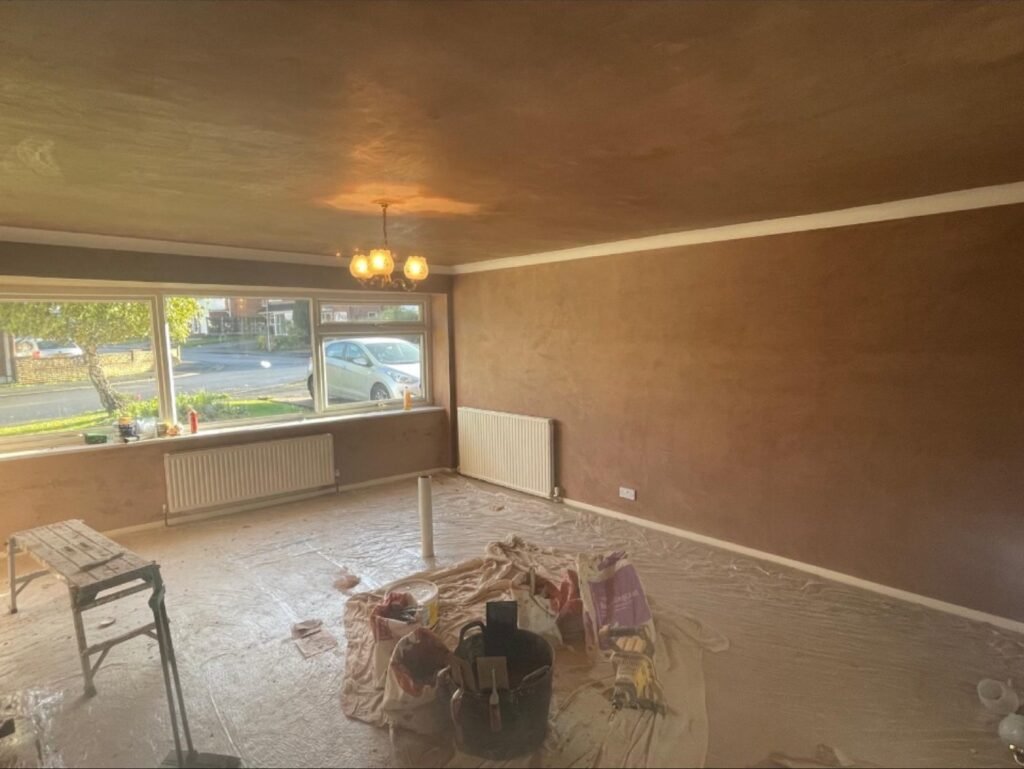
On this page we explain what each of our services involves and when you’d need it, the kinds of houses Shirley has and what they tend to need, the projects that come up most, how planning and building control work here, what happens on the day, how to look after new plaster, and how to choose a plasterer you can trust. There’s also a long list of questions at the end.
Plastering services in Shirley
Plastering
Plastering in the full sense means building up a wall or ceiling from a bare background, usually brick, block or plasterboard. On masonry, that’s a backing coat to level the wall, then a finish coat. On board, it’s usually a thin finish coat straight onto the boards. In Shirley, full plastering comes up most in extensions, in garage conversions where a new inner wall has been built, and on walls where the old plaster has been stripped after damp or a rewire.
Finishing plaster over existing walls
A finish coat is a thin layer of plaster, a few millimetres thick, applied over an existing wall or ceiling that’s sound but tired. It covers hairline cracks, old filler, ridges left by wallpaper, and the uneven patches you get after years of redecorating. It’s one of the most common jobs in Shirley’s semis, often a whole room at a time before new flooring and decorating. If the plaster underneath is loose, a finish coat won’t fix it, so we check first.
Re-plastering and patch repairs
When plaster has “blown”, meaning it has come away from the brick and sounds hollow when you tap it, the only lasting answer is to hack it off and start again. That’s re-plastering. It’s common on the ground floors of older houses after damp treatment, on chimney breasts, and around old window openings.
Patch repairs are smaller: filling the channels left by an electrician, making good after a new boiler flue or a moved radiator, or repairing a corner that’s been knocked. We build them up in layers and finish them flush so they vanish under paint.
Plastering over Artex
Plenty of Shirley houses still have textured ceilings from the 1970s and 80s, and some have textured walls too. We can seal the texture and plaster over it to a smooth finish, or over-board the ceiling with new plasterboard and plaster that, which is often better when the ceiling is also cracked or uneven. Either way, the original coating is covered over rather than disturbed. If it was applied before 2000, it may contain asbestos, so don’t sand or scrape it; have it tested if you’re unsure. Our guide to plastering over Artex explains more.
Dry lining and boarding
Dry lining means fixing plasterboard to walls or ceilings, either stuck to masonry with adhesive dabs or screwed to timber or metal studs, and then plastering it. It’s quick, clean and good for uneven walls, stud partitions, loft rooms and conversions. In Shirley, we board out a lot of garage conversions, loft rooms and new stud walls where a big room is being divided or a downstairs toilet added.
Free, no-obligation plastering quote in Shirley: WhatsApp me on 07453 614095 with a few photos, or send us a message.
Shirley’s houses and what they need
Shirley grew up along the Stratford Road, and its housing reflects that. Here’s how the main types tend to behave.
Interwar semis around the Stratford Road
The roads either side of the Stratford Road, around Shirley Park, Haslucks Green Road, Marshall Lake Road and towards Solihull Lodge and Hall Green, are full of 1920s and 1930s semis and short terraces. They’re solid, popular family houses, and most have been altered several times: rewired, re-plumbed, knocked through and extended.
Inside, the typical jobs are:
- plastering walls that are covered in old filler, ridges and lining paper ghosts
- over-boarding or plastering original ceilings with spidery cracks
- re-plastering chimney breasts and old fireplace openings
- plastering knock-throughs between front and back rooms
- making good after a rewire or new heating system
Some of the earliest have solid walls rather than cavities, and original lime plaster may survive in places, so we check what’s there before deciding how to repair it.
Post-war and 1960s housing
Further from the main road, and towards Shirley Heath and Hillfield, there are estates from the 1950s and 60s. These usually have cavity walls and a mix of plaster on masonry and early plasterboard. Common jobs are plastering tired walls, dealing with textured ceilings and smoothing over cracks along plasterboard joints.
Monkspath and Hillfield
Much of Monkspath and Hillfield was built in the 1970s, 80s and 90s, with detached and semi-detached family houses on cul-de-sacs. Interiors are mostly plasterboard, either dabbed onto blockwork or fixed to timber studs. The jobs here are typically:
- textured ceilings to plaster or over-board
- cracks along board joints and nail or screw pops
- garage conversions, which are very popular on these estates
- new stud walls and small extensions
- patching after kitchen and bathroom refits
Dickens Heath, Blythe Valley and newer homes
Dickens Heath was developed as a new village from the late 1990s onwards, and there are newer homes around Blythe Valley Park and on the edges of Shirley and Cheswick Green. Interiors are almost all plasterboard. Settlement cracks in the first few years, popped screws, damaged corners and loft or garage conversions are the main reasons people get in touch.
Bungalows and older cottages
Around Major’s Green, Tidbury Green and towards Cheswick Green, there are bungalows and a few older cottages. Bungalows are often straightforward to replaster, with no stairs or high landings to work around. Older cottages may have lime plaster and solid walls that need a gentler approach.
Neighbourhood by neighbourhood
Shirley isn’t one place so much as a cluster of neighbourhoods, and the work varies from one to the next.
- Around the Stratford Road and Parkgate. Interwar semis and terraces, flats above shops, and some commercial units. Lots of wall plastering, ceilings, knock-throughs and making good after refits.
- Solihull Lodge. Near the River Cole and the Birmingham boundary, with mainly interwar and post-war family housing. Ceiling repairs and chimney breasts are common.
- Shirley Heath and Shirley Park. Mixed housing from the 1920s to the 1960s. Extensions, knock-throughs and ceiling repairs come up often.
- Hillfield and Monkspath. Later 20th century estates with plasterboard interiors. Garage conversions, textured ceilings and board-joint cracks.
- Dickens Heath and Blythe Valley. Newer homes. Settlement cracks, loft rooms, garden rooms and damage repairs.
- The Stratford Road towards Hockley Heath. South of Monkspath, past the M42 and Blythe Valley Park, the houses thin out into larger detached homes and a few older properties. Plastering extensions, loft rooms and garage conversions are the typical jobs.
- Major’s Green and Cheswick Green. Bungalows, family houses and a few older properties. Replastering, ceilings and the odd lime plaster repair.
Your local plasterer in Shirley, Solihull
We know Shirley well. From our Birmingham base it’s a straight run out along the Stratford Road (the A34), so getting to you is easy. Here’s how we see the area, and the kind of plastering each part tends to need.
- Shirley High Street and the Stratford Road. Shirley’s high street is the Stratford Road itself, with the Parkgate shops, cafes and flats above shops. Behind it are streets of 1930s semis with old lime and gypsum plaster, cracked ceilings and chimney breasts.
- Around Shirley Park and Parkgate. Family homes close to the park and the shops. Knock-throughs, new kitchens and tired walls that need a fresh coat of plaster come up a lot here.
- Near Shirley station. The older roads around the station, on the line into Birmingham, have a mix of interwar semis and short rows. Patch repairs, ceilings and full room re-plasters are common.
- Hillfield and Hillfield Park. Later 20th century homes with plasterboard walls. Board joint cracks, Artex ceilings and garage conversions.
- Cranmore. Between Shirley and Solihull town, with family homes from the 1960s onward. Ceilings, stud walls and extensions.
- Monkspath. 1980s and 1990s estates. Garage conversions, loft rooms, textured ceilings and cracks along ceiling joints.
- Dickens Heath. The newer village by the Stratford-upon-Avon Canal, with flats and town houses. Settlement cracks, board damage and plastering new stud walls.
- Blythe Valley. The new homes near Blythe Valley Park and the M42. Snagging cracks, loft rooms and garden rooms.
Wherever you are in Shirley, the first step is the same: WhatsApp me on 07453 614095 or message the page with photos of the room, and tell us the road or postcode so we can plan the visit.
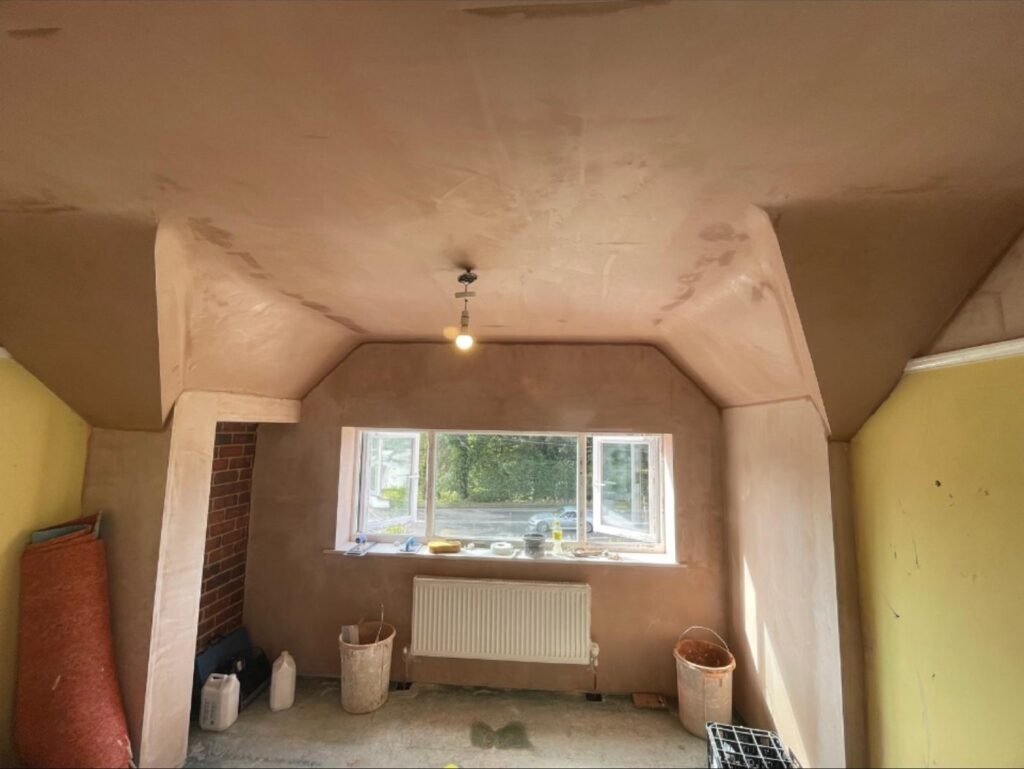
Why Shirley homeowners choose RCR Connections Ltd
- 62 years of combined experience across the team, on old houses and new builds.
- Birmingham based, covering the whole of the Midlands, with Shirley one of our regular areas.
- Free quotes from photos. WhatsApp me on 07453 614095 or message the page.
- Tidy work. Floors and doorways covered, waste taken away, and clear advice on when you can paint.
- Inside and out. Plastering indoors, and K-Rend monocouche and silicone render outside, see rendering in Shirley.
- Set hours. Monday to Friday 7am to 5pm and Saturday 7am to 1pm.
Projects that come up most in Shirley
Garage conversions
Turning an integral or attached garage into a study, playroom or extra bedroom is one of the most common Shirley projects, especially in Monkspath and Hillfield. Once your builder has blocked up the door opening, insulated the floor, walls and ceiling, and the electrician has done the first fix, we board and plaster the walls and ceiling, plaster any new blockwork, and finish around the window and door. A garage conversion normally needs building regulations approval, so make sure that’s in place before work starts.
Loft conversions
Loft rooms are mostly plasterboard on studs and rafters, with insulation behind. We board the slopes, ceilings and knee walls, tape or bead the corners and plaster the lot. Getting materials up through the house is part of the planning, so we’ll protect the stairs and landing.
Kitchen knock-throughs and open-plan living
Taking down the wall between a kitchen and dining room leaves a scar across the ceiling and the walls either side, plus a new steel beam to box in and plaster. We make all of it good, and often plaster the whole room so it looks like a single space rather than two rooms joined together.
Rear extensions
New single and two-storey rear extensions are everywhere in Shirley. Inside, we plaster or dry-line the new walls and ceilings and blend them into the original house.
Bathrooms and en-suites
New bathrooms need walls that are flat and sound for tiling, and ceilings that can cope with steam. We’ll board walls with a suitable board where they’re to be tiled, plaster the areas that are to be painted, and make good around new pipework and extractor fans.
Getting a house ready to sell or let
If you’re selling, smoothing out cracked ceilings and patched walls makes rooms photograph better. If you’re letting, the gap between tenants is short. Send photos and the date you need to be finished, and we’ll tell you whether it’s realistic once drying time is allowed for.
Damp, condensation and plaster
Not every stained or crumbly wall in Shirley is “rising damp”, and getting the cause right matters, because new plaster on a wall that’s still wet will fail again.
Signs to look for
- A tide mark low down on a ground-floor wall, with salts and flaky paint. This can be rising moisture, but it’s often a bridged damp course, a raised flowerbed or a path that’s higher than it should be outside.
- Patches around windows and in corners, sometimes with black mould. In many cases this is condensation, especially in bedrooms and bathrooms with little ventilation.
- A damp patch high up or on a chimney breast. Often a leak from a gutter, a flashing, a roof or the chimney itself.
- Brown staining on a ceiling. Usually a plumbing or roof leak above.
What we do
We’ll tell you what we see, but we won’t guess. If the cause isn’t obvious, it’s worth getting it properly diagnosed before plastering. Once the cause has been dealt with and the wall has had a chance to dry, we hack off the salt-contaminated plaster and re-plaster with a backing suited to the job, then a finish coat. On older solid walls, a breathable plaster may be the better choice.
Plastering over a damp problem to hide it isn’t something we’ll do. It wastes your money and the stains come back.
Ceilings: repair, over-board or replace?
Ceilings cause more questions than anything else, so here’s a quick way to think about it.
Plaster it if the ceiling is solid, reasonably flat and the only problem is fine cracking or a light texture.
Over-board it if it’s cracked in several places, has a deep texture, dips slightly or has been patched many times. New plasterboard is screwed through into the joists and plastered, giving a fresh, flat surface without the mess of pulling the old one down.
Replace it if it’s sagging badly, has come away from the joists, or has been badly damaged by a leak. The old ceiling comes down, new board goes up and is plastered.
We’ll check from below and, where we can, from the loft before recommending one.
Our page on wall and ceiling replastering in Shirley goes into ceilings and walls in more depth.
Planning and building control for plastering in Shirley
Shirley is part of Solihull Metropolitan Borough, so Solihull Council is the planning authority and also runs a building control service.
Do I need permission to plaster?
Almost never. Plastering inside a house doesn’t need planning permission. If the house is listed, though, listed building consent can be needed even for internal work.
Building regulations
Most plastering doesn’t need building regulations approval on its own, but it’s often part of work that does, such as garage conversions, loft conversions and extensions. You can use Solihull Council’s building control service or a registered building control approver.
Just over the boundary
Hall Green and Yardley Wood, to the north-west, are in Birmingham, so Birmingham City Council deals with planning there. Wythall and Hollywood, to the south-west, are in Bromsgrove District in Worcestershire. If you’re near the edge, check which council covers your address.
Working with your builder and other trades
Plastering sits in the middle of most building projects, so timing matters. On a typical Shirley extension or conversion, the order is:
- Your builder finishes the structure, roof, windows and doors.
- The electrician and plumber do their first fix, with cables and pipes run in the walls and ceilings.
- Insulation goes in and any inspections building control needs are done.
- We plaster, or board and plaster.
- Once it’s dry, the second fix happens: sockets, switches, radiators and fittings.
- Then come flooring, kitchen fitting and decorating.
If plastering is booked too early, cables get chased into fresh plaster and we have to come back to patch. Too late, and the whole job waits. We’re happy to talk to your builder directly to agree dates.
The materials we use
We choose materials to suit each wall rather than using one product for everything.
- Gypsum finishing plaster for finish coats on board and on sound backing coats.
- Gypsum backing plasters for levelling masonry walls before the finish coat.
- Bonding agents and primers so new plaster grips old surfaces, especially painted or very absorbent ones.
- Standard, moisture-resistant and fire-rated plasterboard, depending on the room and what building control requires.
- Lime plaster where an old solid wall needs to breathe.
- Beads and scrim tape for straight corners, crisp edges and strong joints.
Plastering terms in plain English
Plasterers use a lot of trade words. Here’s what the main ones mean, so you know what a plasterer in Shirley is talking about when they look at your walls.
- Backing coat (bonding or hardwall). A thicker first coat on brick or block. It fills hollows and gets the wall flat and straight before the finish goes on. Bonding suits smooth or low-suction walls, and hardwall suits ordinary brickwork.
- Finish coat. The thin, smooth top coat, about 2mm, that you paint onto. It goes on in two passes and is trowelled until it’s flat and glassy.
- Dot and dab. Plasterboard stuck straight onto a masonry wall with blobs of adhesive, then finished. It’s a quick, dry way to get a flat wall, and it’s common on newer houses in Monkspath and Dickens Heath.
- Over-boarding. Screwing new plasterboard over an old, cracked or Artexed ceiling and plastering the new board, instead of pulling the old ceiling down.
- Beads. Metal or plastic strips fixed on corners and edges, so they stay straight and don’t chip.
- Coving and cornice. The shaped strip where the wall meets the ceiling. Coving is usually a ready-made plaster or gypsum profile. Cornice is the older, more detailed run you find in some period homes. We can fit new coving, and patch or match short lengths of the old.
- Mist coat. The first coat of watered-down emulsion on new plaster, once it’s fully dry. It seals the surface so your paint grips.
How a plastering job runs in Shirley
Photos first. WhatsApp pictures of the room or wall to 07453 614095, with rough measurements and a note of what you’d like done.
A quote. Plenty of Shirley jobs can be priced from photos. For damp walls, sagging ceilings or anything we can’t judge properly from pictures, we’ll pop round.
Fixing a date. We’ll agree when we start and how long we’ll need, and tell you how long the plaster will take to dry before decorating. If other trades are involved, we’ll fit around them.
Protection. Floors, stairs and furniture are covered and doorways are sheeted to keep dust in the room.
Preparation. Loose plaster comes off, beads are fitted to corners, and walls are bonded or primed so the new plaster grips.
Plastering. Backing coats and finishing coats, or board and plaster, done neatly with clean edges at skirtings, sockets and frames.
Tidying up. Waste is bagged and taken away, the room is swept, and we’ll explain what to do while it dries.
Before we arrive
- Move small furniture, ornaments and anything fragile out of the room.
- Take down curtains, blinds, pictures and shelves.
- If sockets and switches need taking off the wall, arrange an electrician.
- Tell us about parking. On busy roads near the Stratford Road, a space on the drive helps.
Plastering through the year
Indoor plastering carries on all year, but the season still makes a difference. In winter, cold rooms slow drying down, and an unheated extension or garage conversion can take weeks to dry unless the heating is on. Frost can damage fresh plaster in a room that isn’t heated at all, so new extensions need to be weathertight and kept above freezing. In summer, plaster dries faster, but rooms in full sun or with the windows wide open can dry too quickly at the edges, so we keep an eye on the conditions and may ask you to close blinds for a day or two. Spring and autumn are the easiest times for drying, but they’re also busy, so if your project has a deadline, get in touch early.
Drying, decorating and aftercare
New plaster
How long plaster takes to dry depends on how thick it is, the temperature and the ventilation.
- A finish coat on plasterboard or sound plaster often dries within a few days in a warm, airy room.
- Backing coats and full re-plastering can take one to two weeks, longer in cold weather.
- Garage conversions and extensions with lots of new plaster, and rooms that were cold before, take longer still.
You’ll know it’s dry when the colour has changed from dark pink or brown to an even, pale pink everywhere, with no darker patches.
While it dries, keep a window slightly open and internal doors ajar, keep the heating steady and moderate, and don’t aim heaters or dehumidifiers straight at the wall at full power, because drying too fast can cause cracking. Don’t hang anything heavy or push furniture back against the wall until it’s dry.
When you decorate, start with a mist coat: matt emulsion thinned with water so it soaks into the plaster and seals it. After that, apply your normal emulsion. Avoid vinyl, silk or wipe-clean paints on brand-new plaster until it has completely dried out. Our guide on how long plaster takes to dry before painting goes into more detail.
Choosing a plasterer in Shirley
There’s no shortage of plasterers around Solihull, so how do you pick one? These are the things we’d look for ourselves.
- They look before they quote. A good plasterer wants to see photos or the room, and asks what’s under the surface.
- They talk about preparation. Beads, bonding, protection and making good should all come up.
- They know Shirley’s houses. They should understand the difference between a 1930s semi with old plaster and a Monkspath house with board.
- The quote is written. You should know what’s included, what isn’t, and how long the job will take.
- They’re insured. Public liability insurance is a must.
- They can show you their work. You’ll find examples of ours on our projects page.
- They explain aftercare. You should leave knowing when you can paint and how.
- They’re honest about what’s not for them. If a job needs a damp specialist, a structural engineer or a heritage expert, a good plasterer says so.
What shapes your plastering quote in Shirley
Every job is different, so every quote is too. These are the things that make the biggest difference to a Shirley quote:
- The size of the job. How many walls and ceilings, and how many rooms.
- Condition. Sound walls need less work than blown, cracked or damp-damaged ones.
- Ceilings. Plastering, over-boarding and replacing are very different amounts of work.
- Textured coatings. Artex needs sealing or boarding first, and asbestos testing is separate.
- Preparation. Stripping wallpaper, hacking off old plaster, boxing in.
- Access. Stairwells, high ceilings, loft rooms.
- Detail. Window reveals, arches, corners, beads and boxing around steels or pipes.
- Other trades. Whether the room is ready when we arrive, or we need to work in stages.
WhatsApp me on 07453 614095 or message the page with a few photos, and we’ll come back with a free quote.
Shirley streets we work on
We plaster homes all over B90. Here are some of the roads we know well, and the homes you find there.
- Stratford Road, Haslucks Green Road and Marshall Lake Road. 1920s and 1930s semis and short rows. Old plaster, cracked ceilings and chimney breasts.
- Solihull Road, Union Road and Longmore Road. Semis and family homes from between the wars and just after. Knock-throughs and ceilings come up a lot.
- Burman Road and Bills Lane. Mixed post-war homes. Tired walls, Artex ceilings and new stud walls.
- Tanworth Lane, Dog Kennel Lane and Monkspath Hall Road. 1970s to 1990s estates in Monkspath and Hillfield. Board joint cracks, garage conversions and loft rooms.
- Aqueduct Road and Peterbrook Road. Solihull Lodge and Major’s Green. Semis, bungalows and some older homes with lime plaster.
What a plastering job in Shirley involves
- You WhatsApp photos of the room. We come and look if we need to.
- We tell you what the wall needs: a finish coat, a full re-plaster, or new board.
- We cover floors, clear the area and sheet the doorways.
- Loose plaster comes off. Cracks are taped and beads go on the corners.
- Backing coat if it is needed, then the finish coat, smooth and flat.
- We clean up and tell you when it is safe to paint.
RCR Connections Ltd has 62 years of combined experience. Outside the house, we also fit K-Rend monocouche and silicone render, see rendering in Shirley and K-Rend in Shirley. Over the border in Bromsgrove District, see rendering in Bromsgrove.
Plastering quote in Shirley: WhatsApp me on 07453 614095 or message the page. Mon-Fri 7am-5pm, Sat 7am-1pm.
Nearby areas we cover
We work right across Shirley and the surrounding area. See all our plastering areas, or pick a page nearby:
- Dickens Heath, Cheswick Green and Tidbury Green
- Olton and Solihull town
- Hockley Heath along the Stratford Road
- Hall Green, Acocks Green and Kings Heath over the Birmingham boundary
- Wythall and Hollywood in Bromsgrove District, and rendering in Bromsgrove
More questions from Shirley homeowners
There are more answers on our Shirley plastering and rendering FAQs page.
Can you plaster over wallpaper?
No. Wallpaper, including lining paper, needs to come off first, because plaster won’t bond to it reliably. We can strip it for you, or you can do it before we arrive.
My 1930s ceiling has lots of fine cracks. Will new plaster last?
If the ceiling is solid and firmly fixed, a finish coat with scrim tape over any active cracks usually lasts well. If it’s loose or sagging, over-boarding is the better option. We’ll check before recommending one.
Can you plaster a garage conversion before the windows go in?
It’s best to wait until the window and door are fitted, so we can plaster neatly into the reveals. The insulation and first fix electrics also need to be done.
Do you plaster new stud walls?
Yes. Once the studs are up and the electrics and any pipes are in, we board and plaster them, or plaster boards your builder has already fitted.
Can I stay in the house while you work?
Usually, yes. We seal off the room we’re working in as best we can, and most people carry on as normal. Bathrooms and kitchens need a little planning.
My Monkspath house has cracks along the ceiling joints. Why?
Plasterboard ceilings often show cracks along the board joints as the house settles and the timber dries and moves. Taping the joints properly and plastering the ceiling usually solves it. If cracks keep reopening, the board may need extra fixings.
Can you plaster around a new steel beam?
Yes. Steels are usually boxed in with plasterboard or wrapped in mesh, then plastered. Your builder or building control may need a fire-resistant board around the steel, so check what’s specified.
Can you plaster a garden room or summer house?
Many garden rooms are lined with plasterboard and plastered like an indoor room, as long as they’re insulated and weathertight. We’ll check the structure first.
What’s the difference between a plasterer and a dry liner?
A plasterer puts on wet plaster; a dry liner fixes plasterboard. We do both, so one team can board a room and then plaster it.
How much dust will there be?
Mixing and applying plaster isn’t very dusty, but hacking off old plaster is. We sheet doorways and keep the work contained, and we leave the room swept.
Will you move my furniture?
We’d rather you cleared small items and fragile pieces. If something large can’t be moved, we’ll work around it and cover it carefully.
Do you take on small jobs?
Yes. A single ceiling, one wall or a handful of patch repairs are all fine. Send photos and we’ll tell you how soon we can fit it in.
What our customers say
Was amazed by the punctuality from them as far as tradesmen go and the experience was stress-free with a great finish to my maisonette.
James Tranter
We chose them for our home extension, and the transformation was amazing. Their work is top-notch, and I’d recommend them to anyone seeking both quality and luxury in construction.
Emma S
These guys were great lads, grafted hard, and was really happy with the price and the end result. Blimey, it was outstanding!
Michael T
Very impressed with the workmanship and attention to detail. The project was completed on time and exceeded my expectations!
Sophia Reynolds, Property Manager
Our services
More services: Plastering repairs · Plastering and coving · Plastering extensions and lofts.
Get a free plastering quote in Shirley
WhatsApp me on 07453 614095 or message the page, ideally with a few photos of the room or wall. You can also email rcrconnectionsltd@gmail.com or send us a message online. Quotes are free and there’s no obligation. Our office is at Studio 9, 50-54 St Paul’s Square, Birmingham B3 1QS.
Plasterer in Shirley: common questions
Are you a local plasterer for Shirley?
Yes. RCR Connections Ltd is Birmingham based, covering the whole of the Midlands, and Shirley is one of our regular areas. It’s a straight run out along the Stratford Road from our base, so a visit to look at the job is easy to arrange.
Which parts of Shirley do you cover?
All of it. That includes the Stratford Road and Parkgate, Shirley Park, Shirley Heath, Hillfield, Cranmore, Monkspath, Solihull Lodge, Major’s Green, Dickens Heath, Cheswick Green and Blythe Valley.
Do you plaster newer homes in Dickens Heath and Blythe Valley?
Yes. Newer homes are mostly plasterboard, and cracks along board joints and around doors are common as the house settles. We tape and fill them properly, or re-plaster the whole wall or ceiling if it needs it.
What should I send for a plastering quote?
Photos or a short video of each wall or ceiling, rough room sizes, what you’d like done, and your road or postcode in Shirley. WhatsApp them to 07453 614095 or message the page, and we’ll come back with a free quote.
Do you cover Shirley and the surrounding area?
Yes. RCR Connections Ltd is Birmingham based, covering the whole of the Midlands, and works across Shirley and Solihull and the surrounding villages. We also cover plastering in Solihull, plastering in Birmingham and, outside the house, rendering in Solihull. For the full list, see areas we cover.
How do I get a plastering quote in Shirley?
WhatsApp photos of the walls or ceilings to 07453 614095, with rough room sizes and what you would like done. We will come back with a free, no-obligation quote, or arrange a visit if the job needs a closer look.
How soon can I decorate after plastering?
A thin finish coat usually needs a few days to dry, and thicker backing coats need longer, depending on ventilation and the time of year. Wait until the plaster is an even pale colour all over, then start with a mist coat (watered-down emulsion).
Can you plaster over Artex?
Yes. We can plaster over Artex, or over-board and plaster ceilings that are cracked or uneven. If the Artex went up before 2000, have it tested for asbestos before anyone scrapes or sands it.
How long does it take to plaster a room?
It depends on the size of the room and what the walls need. A finish coat over sound walls in an ordinary bedroom is often done in a day. A full re-plaster with backing coats takes longer, because each coat has to firm up before the next goes on. We’ll tell you how long your job will take when we quote.
Do you fit or repair coving?
Yes. We can fit new coving when a ceiling is plastered or over-boarded, and patch or match short lengths of existing coving or cornice after a repair, so the room looks finished.
Can you plaster over a blocked-up doorway?
Yes. Once the opening has been filled with block, or framed and boarded, we plaster it so it blends in with the rest of the wall. Give it time to dry properly before you paint, as the new patch can take longer than the old wall around it.
Do you also cover Hockley Heath, Cheswick Green and Tidbury Green?
Yes. These villages sit just south of Shirley along the Stratford Road and the lanes off it, and we plaster there regularly. See our pages for a plasterer in Hockley Heath and a plasterer in Cheswick Green.
What hours do you work?
Monday to Friday 7am to 5pm and Saturday 7am to 1pm. We’re closed on Sundays.