
Lots of people ask us if they can have their house rendered in winter. The short answer is yes, on the right days. But cold, damp weather slows everything down, and frost can spoil fresh render. This short guide explains how long K-Rend monocouche and silicone render take to dry when it is cold, and how we plan winter jobs.
RCR Connections Ltd is Birmingham based, covering the whole of the Midlands. Our team has 62 years of combined experience with K-Rend monocouche and silicone render.
The 5°C rule
Most render makers say not to put render on when it is below about 5°C, or when it is likely to drop below that while the render sets. Cold slows the cement down. If the temperature falls too far, the water in the mix can freeze.
So in winter we look at the overnight low, not just the daytime high. A bright 8°C day is no good if there is a hard frost that night.
How long K-Rend monocouche takes to dry
K-Rend monocouche goes on thick and is scraped back once it has firmed up. In summer, that can be later the same day. In winter, it often takes much longer, and scraping may move to the next morning.
After scraping, it still has a lot of water to lose. In cold, damp weather, full drying can take a few weeks. Until then, the colour can look darker or patchy in places. That is normal, and it evens out as it dries.
How long silicone render takes to dry
Silicone render is a thin top coat over a base coat with mesh. Each coat needs time to dry before the next goes on. In warm weather that is often a day or two. In cold, damp weather it can take several days, so the job takes longer.
Fresh silicone render also needs keeping dry until it has set. Heavy rain too soon can mark the face.
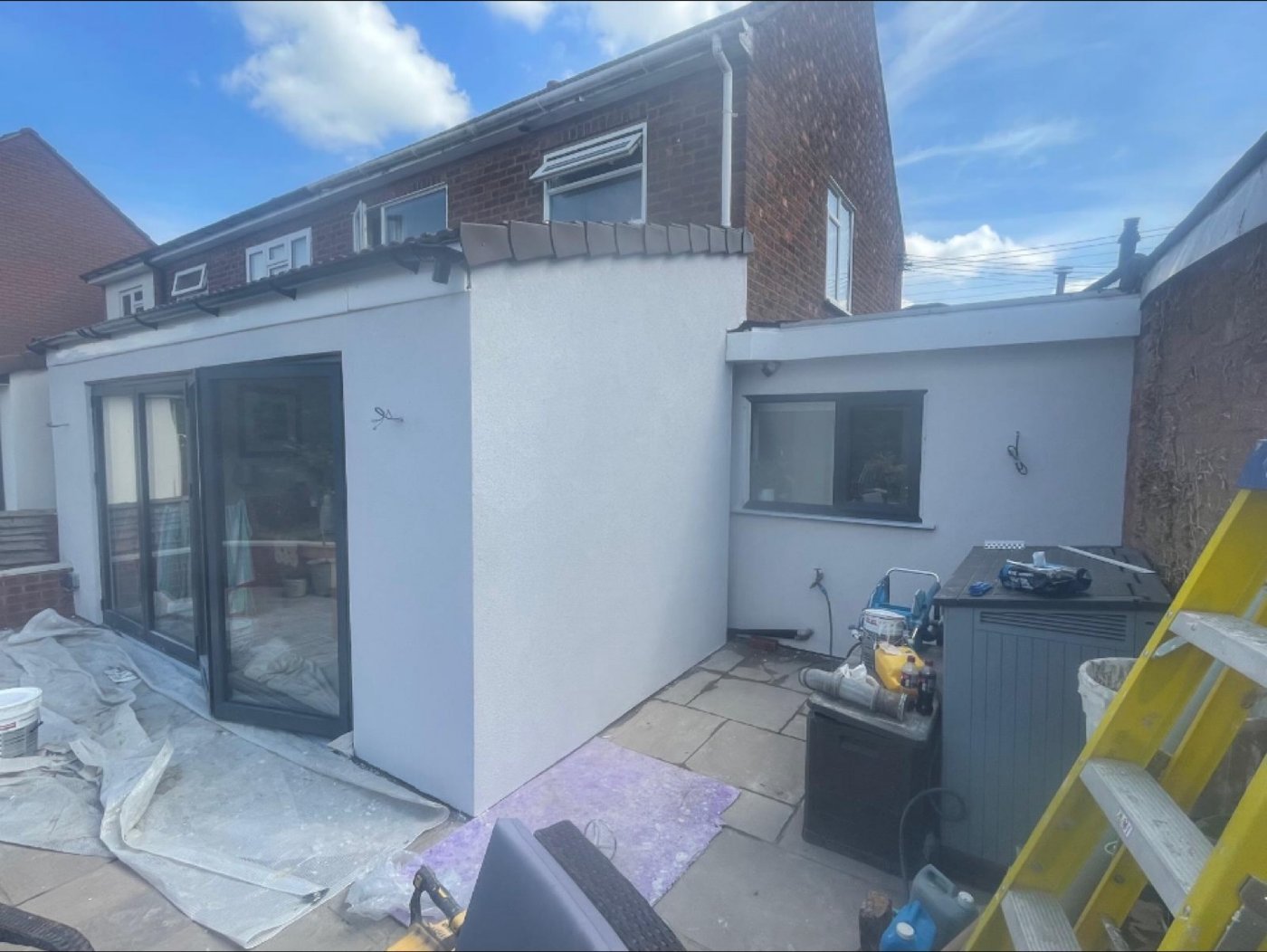
What can go wrong in the cold
- Frost damage. Frozen water in fresh render can make the face crumble or flake.
- Patchy colour. Uneven drying can leave light and dark patches on through-coloured render.
- White marks. Slow drying can bring salts to the face. These often weather off, but they can spoil the look for a while.
- Rain wash. Rain on soft render can mark the face or wash out the colour.
How we plan winter rendering
- We check the forecast for the whole week, including night lows and rain.
- We start later in the morning, once any frost has gone and the wall is dry.
- We aim to finish each wall in one go, so there are no joins.
- We cover fresh work with scaffold sheeting when needed, to keep off rain and wind.
- If the weather turns, we stop and wait. A few days lost is better than a bad finish.
Prep work, such as taking off loose render and fitting beads, can often go ahead on days that are too cold for render.
Should you wait until spring?
Not always. Many winter days in the Midlands are dry and mild enough. Booking in winter can also mean an earlier start date. If your wall is letting water in, getting it done sooner is often the better choice.
You can read more about the systems we use on our rendering in Birmingham page, and about local jobs on our rendering in Shirley page. Our guide to K-Rend monocouche vs silicone render compares the main options.
Get a rendering quote
Planning K-Rend and worried about winter drying?
RCR Connections Ltd is Birmingham based, covering the whole of the Midlands. Call or WhatsApp for a free quote — photos and your postcode are enough to start.
Related: K-Rend guide · Rendering in Birmingham · Rendering in Solihull
Common questions
Can you render in winter?
Yes, on the right days. It needs to be dry and above about 5°C, with no frost due while the render sets.
How long does K-Rend take to dry in winter?
It is slower than in summer. Scraping can move to the next day, and full drying can take a few weeks. The colour can look patchy until it has dried out.
What happens if render gets frost on it?
Frost can freeze the water in fresh render. The face can then crumble or flake and may need to come off and be done again.
Is it better to wait for spring?
Not always. Many winter days are fine. If the forecast is poor, we wait a few days rather than risk the finish.