
Lots of homeowners in Birmingham and Solihull ask us for “K-Rend”. K-Rend is a well-known brand of render. Most people use the name for any render with the colour mixed right through it. RCR Connections Ltd is Birmingham based, covering the whole of the Midlands. Our team has 62 years of combined experience, and we fit both K-Rend monocouche and silicone render.
This page is our full guide to K-Rend: what it is, how we put it on, colours and finishes, the houses it suits, how to look after it, and the problems we fix.
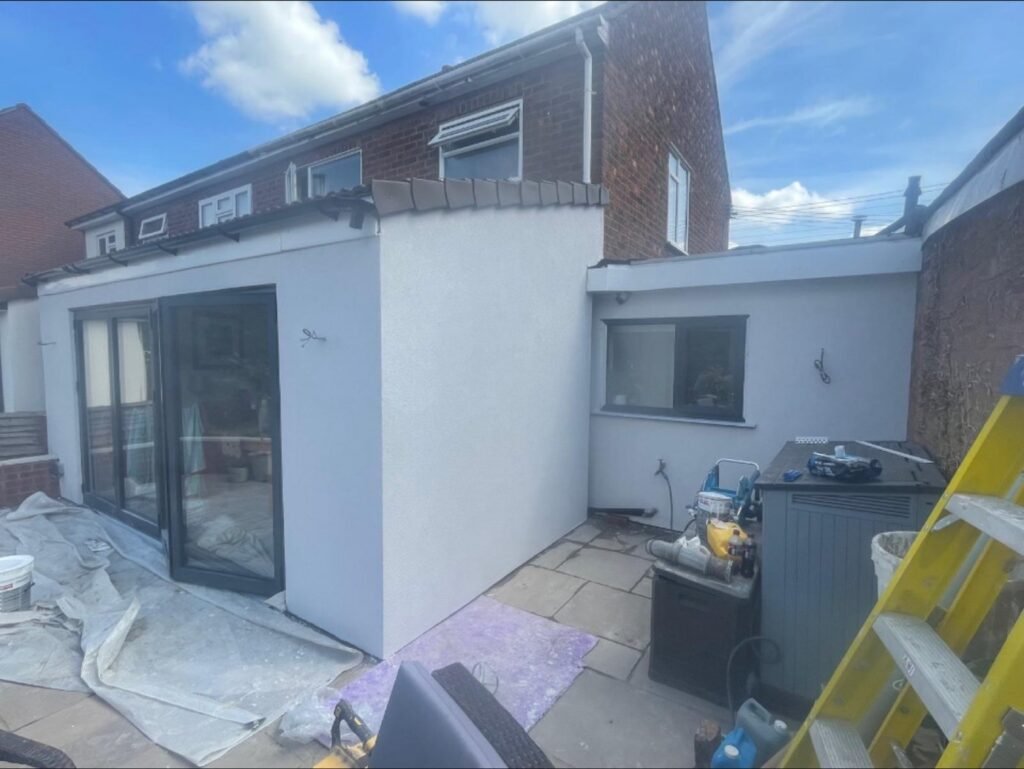
What is K-Rend monocouche?
Monocouche means “one coat”. It is a render made in a factory from cement, lime, sand, colour and other mixes. It comes in bags. We mix it on site with water and put it on thick, in one or two passes. Once it starts to set, we scrape back the face. This gives a soft, fine texture with no trowel marks.
The key point is that the colour runs right through the render. There is no paint on top. If it gets a small knock, you still see the same colour. It does not need painting, and there is no paint to fade or peel.
K-Rend Silicone FT is a good example. It is a through-coloured render with silicone mixed in, so rain runs off the face. It goes on as one thick coat straight onto block, or as a finish coat over a base coat.
What is silicone render?
Silicone render is a thin top coat. It comes ready mixed in a tub. It goes on over a base coat with mesh in it, and it is only a few millimetres thick. The face is rubbed up with a float to give an even grain.
K-Rend Silicone TC is the thin coat in the K-Rend range. It has no cement in it, so it can flex a little more. It sheds water well but still lets the wall breathe. It also has an additive that helps stop mould and algae taking hold. It comes in a wide range of colours. You can read more on our silicone render in Birmingham page.
What goes into a K-Rend system
A good render job is more than the coloured coat you see. Each layer has a job to do. This is what goes into a K-Rend monocouche and silicone system when we fit it.
Beads
Beads are thin metal or plastic strips. They go on corners, round windows and doors, and along the base of the render. They give straight lines and sharp edges, and they protect the corners from knocks. The base bead sits just above the damp-proof course, so the render stops in the right place.
Base coat
The base coat evens out the wall and gives the finish something firm to hold on to. On old or mixed walls it fills dips and hides patches. With silicone, it is the main body of the render, and the thin top coat sits on it.
Mesh
Mesh is a glass fibre net. We press it into the base coat while it is still wet. It spreads any stress across the wall, so small movement does not turn into a crack. We always add extra mesh at the corners of windows and doors, because that is where cracks like to start.
Primer
Before a silicone top coat goes on, we roll on a primer. It stops the base coat sucking water out of the top coat too fast, and it helps the colour come out even.
The coloured coat
This is the part you see. With K-Rend monocouche, it is a thick, through-coloured coat that we scrape back. With silicone, it is a thin coat that we rub up to a fine grain. Both are coloured all the way through, so there is no paint to keep up.
K-Rend monocouche or silicone: the difference
- Thickness: monocouche is thick: we put on about 18 mm and scrape it back to leave at least 15 mm. Silicone thin coat is a few millimetres over a base coat.
- Look: monocouche has a scraped, soft texture. Silicone has a crisp, even grain.
- Flex: silicone has no cement, so it copes a little better with small movement.
- Dirt and algae: both shed water. Silicone tends to stay clean for longer on damp, shaded walls.
- Colour: both are coloured right through. Silicone comes in more shades.
- Time: a thin coat needs the base coat to cure first, so there can be a gap between coats.
Neither one is right for every house. We look at the wall first, then tell you plainly which we would use and why. Our guide on K-Rend monocouche vs silicone render goes into more detail.
Which suits your house?
1930s semis
Many 1930s semis in Birmingham have old pebbledash or tired sand and cement on the top half. We check if the old coat is sound. If it is hollow or loose, it comes off. If it is firm, we can often render over it with a base coat and mesh, then a silicone or monocouche finish. Both work well here.
Victorian terraces
Old brick walls with soft lime mortar need care. They need to breathe, and damp must be able to get out. We look closely at the brick, the joints and any damp before we suggest a system. A breathable base and a silicone top coat is often a good fit.
New builds
New block walls are a good, even base. Monocouche can go straight onto block in one thick coat. It is quick and gives a clean, modern look. Silicone over a base coat also works well, if you want a crisp finish or a stronger colour.
Extensions
On an extension, the aim is often to match the house. We can match a colour from a sample card, or render the house and the extension at the same time so it all looks the same. Where block meets brick or old meets new, we fit mesh so the joint does not crack.
House types across Birmingham and the Midlands
We are Birmingham based, covering the whole of the Midlands, and we render all sorts of homes. Each type has its own quirks. This is what we tend to find, and what tends to work.
Victorian and Edwardian homes
You find these in Moseley, Kings Heath, Edgbaston, Handsworth and the older parts of the Black Country towns. The brick is often soft and the walls are solid, with no cavity. They need to breathe. We check the brick, the joints and any damp first, and we keep the DPC clear. Sometimes we will suggest a breathable base with a silicone top coat, and sometimes we will tell you to leave the brick on show.
1930s semis
Hall Green, Acocks Green, Erdington, Sheldon and Solihull are full of them. Many have pebbledash or old sand and cement on the top half and brick below. A common job is to take off the tired coat, or go over it if it is sound, and finish the top half in a clean white or cream. Rendering the whole house is popular too.
Post-war and council-built homes
Homes from the 1950s and 1960s in places like Kingstanding, Quinton, Chelmsley Wood and Castle Vale often have plain brick, painted render or panels. Some use concrete or other non-standard builds. We look closely at how the house is built before we suggest a system, as these walls can need a different base or extra mesh.
New town and 1970s to 1980s estates
Redditch, Tamworth and parts of Telford and Cannock were built fast. The homes often have tile hanging, timber panels or painted render that needs doing every few years. Once the panels are out and the gaps are built up, a K-Rend monocouche or silicone finish gives a fresh, low-care front.
Bungalows
Bungalows are some of the best homes to render. The walls are low, the scaffold is simple and the change from tired brick to clean render is big. We do a lot of them in Solihull, Sutton Coldfield and the towns around Birmingham.
Larger detached homes
Big homes in Four Oaks, Little Aston and Barnt Green have a lot of wall and tricky corners. We bring enough of the team so every wall is scraped at the same stage.

How we do the job, step by step
Every house is a bit different, but the order of work stays the same. This is how a K-Rend job runs from first look to final clean.
- Look at the walls. Before any work starts, we come out and look at the house. We tap the old render for hollow spots, check for damp at the base, look at the gutters and pipes, and find the damp-proof course. We then tell you plainly which system we would use and why.
- Scaffold. We put up safe scaffold so we can reach every part of the wall. We sheet it if the weather turns.
- Prep. We take off loose or hollow render, rake out bad joints and clean the wall. We cover windows, doors, paths and plants. Pipes, lights and fittings come off the wall so the render can run behind them.
- Beads. We fit beads to every corner, edge and window. A bellcast bead goes above the damp-proof course, so the render stops above it and does not let damp jump up. Stop beads go round doors and windows. Beads give straight, sharp lines.
- Base coat. We put on the base coat, such as K-Rend HP12 or HP14. This evens out the wall and gives the finish a firm grip.
- Mesh. We bed mesh into the base coat. It goes over the whole wall for a thin coat system, and always at weak points such as the corners of windows and doors. The mesh helps stop cracks.
- Top coat. For monocouche, we put on the thick coloured coat in two passes, building it up to about 18 mm. For silicone, we prime the base, then put on the thin coloured top coat.
- Scrape. We scrape the monocouche back by 2 to 3 mm once it has firmed up. This is usually somewhere between about 3 and 16 hours after it goes on, depending on the heat, the wind and the wall. At least 15 mm is left on the wall. Silicone is rubbed up with a float to an even grain instead.
- Protect. We only render when it is 5°C and rising, never in rain or strong wind. While it cures, we keep it out of rain, frost and strong sun for at least 48 hours, with sheets on the scaffold where needed.
- Finish. We put back pipes and fittings, clean up, take down the scaffold and walk round the job with you.
Why the scraping matters so much
Scraping is the step that makes or breaks a K-Rend monocouche job. When we scrape, we take off the top skin of the render. That skin is where the fine dust and lime rise to as it sets. Taking it off opens up the face and gives the soft, even texture people want.
The timing has to be right. Scrape too soon and the render drags and tears. Leave it too late and it is too hard, the face goes patchy, and you can see scratch marks. We test the wall with a finger and a scraper and only start when it is ready.
Every wall must be scraped at the same stage. If one wall is scraped soft and the next one hard, the colour and texture will not match, even though it is the same bag of render. On bigger houses we plan the order of the walls, and how many of us are on site, so each wall gets scraped at the right time.
The 18 mm and 15 mm rule
We build the monocouche up to about 18 mm, then scrape it back by 2 to 3 mm. That leaves at least 15 mm on the wall. If the render ends up too thin, it will not keep the rain out as well and it is more likely to crack. If it is far too thick in places, it can sag or dry unevenly. Keeping to the right depth across the whole wall is what gives you a finish that lasts.
Never bridge the damp-proof course
The damp-proof course, or DPC, is the layer near the bottom of the wall that stops damp rising up from the ground. If render runs down over it, damp can climb up through the render and get into the wall above. This is known as bridging the DPC, and we never do it.
That is why the base bead goes just above the DPC, with a drip edge so rain falls clear. We also make sure paths, soil and patios stay well below the render line. Our guide to render and the damp-proof course explains this in more detail.
A typical house front takes a few days on site, plus drying time. A full house can take a week or two. We give you a clear plan before we start.
Colours and finishes
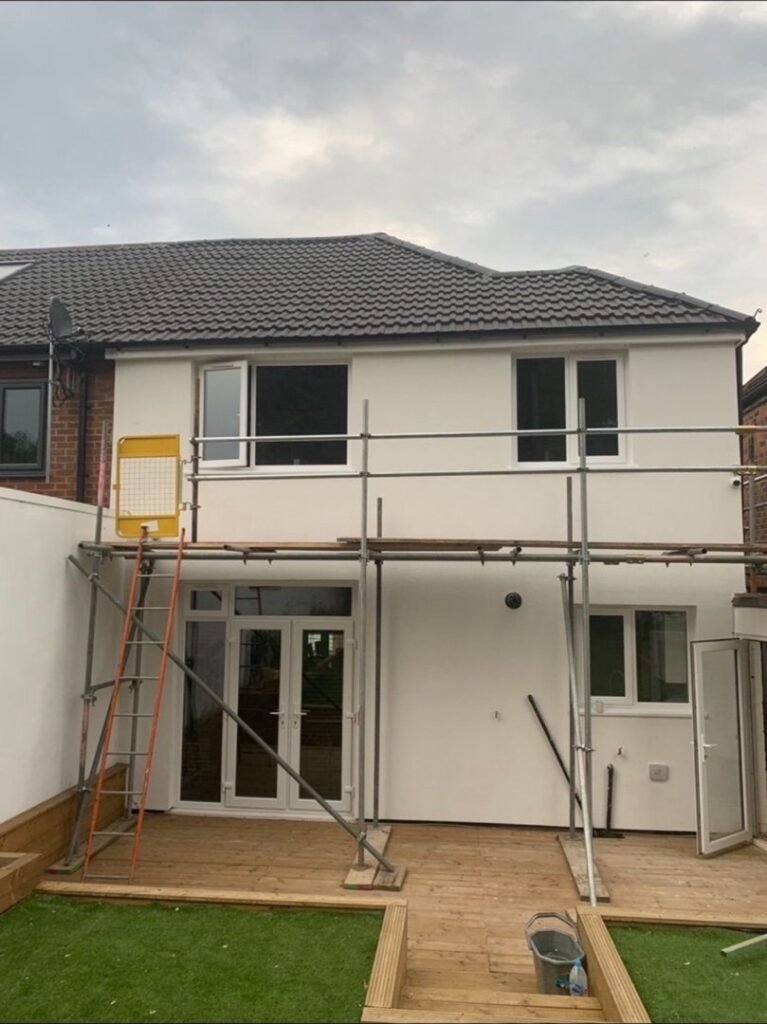
K-Rend comes in a wide range of colours. Whites and creams are the most popular in Birmingham, such as pure white, antique white and limestone white. Soft greys and stone shades are popular on new builds. The silicone thin coat range has even more shades, and can be mixed to a set colour code.
Colours look different on a sample card than on a full wall in daylight. We bring sample cards, and we suggest you look at them outside, on the wall, at different times of day. If you want a match to a house next door, send us a picture and we will help you find the nearest colour.
Scraped finish
This is the classic K-Rend monocouche look. It has a soft, fine texture, a bit like sandstone. It hides small marks well and looks the same from close up as it does from the road.
Silicone grain
Silicone top coats come in different grain sizes, often around 1 mm to 2 mm. A fine grain gives a smooth, modern look. A bigger grain gives a bit more texture and hides small bumps in the wall. We can show you a sample of each.
Mixing colours on one house
Some people like a white house with a grey base, or a band of a darker colour round the windows. We use beads to give a sharp line where one colour meets another. Two tones suit modern homes. On a period house, one soft colour often looks best.
Tips for picking a colour
- Bright white looks crisp, but on a busy road it shows dirt sooner. An off-white or cream can be easier to live with.
- Dark colours take more heat from the sun. On a south-facing wall, a lighter shade is the safer choice.
- Look at your roof, windows and brick. The render should sit well with all three.
Drying and weather
Render needs dry days and the right heat to cure well. We do not render in rain, frost or strong wind. We only start when it is 5°C and rising. Hot sun and strong wind can also dry it too fast, so we plan the order of the walls around the sun.
Monocouche needs to set enough to be scraped, usually about 3 to 16 hours after it goes on. A silicone top coat needs the base coat to cure first. That can take up to two weeks, so we plan the gap into the job. Once the top coat is on, it needs a few dry days to firm up, and we protect it for at least 48 hours.
We watch the forecast and move dates if we need to. Read our guide to rendering in winter to see how cold and wet weather affect drying.
Looking after K-Rend
K-Rend and silicone render need very little care. There is no paint to redo. A few simple things keep it looking good:
- Keep gutters and down pipes clear, so water does not pour down the wall.
- Look at the render once a year for cracks, mostly round windows and doors.
- If green or black marks show up, clean them with a soft brush and a render cleaner made for the job.
- Do not use a strong jet wash close up. It can mark or damage the face.
- Keep soil, plants and paths below the bead line, so the render stays dry at the base.
A simple yearly check
Once a year, ideally in spring, walk round the house. Look for fine cracks, loose beads, stains under window sills and damp patches near the ground. Check that gutters are not dripping on the wall. Our spring render check guide has a full list you can follow.
Cleaning
Most dirt comes off with a soft brush and clean water. For green or black growth, use a cleaner made for render and follow the label. Work from the bottom up and rinse from the top down, so you do not get streaks. A low-pressure hose is fine. Keep a jet wash well back, or do not use one at all.
With good prep and light care, a K-Rend or silicone finish can look good for many years.
Common problems we fix
Cracks
Fine cracks often start at the corners of windows and doors, where there was no mesh. Bigger cracks can come from movement in the wall. We find the cause first, then cut out and repair the crack and blend it in. Where needed, we add mesh so it does not come back.
Blown render
Blown render is render that has come away from the wall behind it. It sounds hollow when you tap it, and it may bulge. Water gets in behind it, and in frost it can fall off. We cut out the blown parts back to sound render, and patch with a base coat and a top coat to suit.
Staining and algae
Green, black or brown marks often show up on walls in shade, under drips, or where gutters leak. We clean the wall, treat it, and fix the cause where we can. On older, porous render, a new silicone finish can stop the problem coming back so soon.
Efflorescence (white salts)
Sometimes a white, powdery bloom shows up on new or old render. This is efflorescence. It is salt that comes out of the wall or the render as water dries out. It looks bad, but it is not usually harmful.
The fix is simple, in this order: stop the water getting in, let the wall dry, then brush the salts off with a dry, stiff brush. Do not wash it with water, as that can just pull more salt to the face. Check for leaking gutters, poor sills or a bridged DPC. Once the water is stopped, it usually goes away on its own. Read our efflorescence on render guide for more.
Patchy colour
Patchy colour on a monocouche wall most often comes from uneven scraping. If one part was scraped when the render was soft and another when it was hard, they will look different shades, even though it is the same render. It can also come from rain or hot sun on fresh render, or from mixing bags from different batches.
We stop this by scraping each wall at the same stage, using bags from the same batch, and protecting the render while it cures. If you already have patchy render, we can look at it and tell you whether a light re-scrape, a patch or a new silicone top coat is the best fix.
Damp at the base of the wall
Render that runs down to the ground, or over the DPC, can draw damp up into the wall. You may see a dark band, flaking or salts near the bottom. We cut the render back, fit a proper bead above the DPC and make sure the ground sits below it.

See our render repairs in Birmingham page for more on how we fix older render.
K-Rend across Solihull, area by area
Solihull’s housing changes a lot from one end of the borough to the other, and that changes which K-Rend system makes sense. This is a rough guide to what we find. For Shirley specifically, see our rendering in Shirley page.
North Solihull: B36 and B37
Castle Bromwich, Smith’s Wood, Kingshurst, Chelmsley Wood, Fordbridge and Marston Green have a lot of 1930s, post-war and 1960s to 1970s houses. Many have painted render or pebbledash panels that are failing. Where the old coating comes off cleanly, K-Rend monocouche on a sound background is a common choice. Where the walls are uneven or have a history of movement, a meshed base coat with a silicone top coat copes better. If you own a leasehold flat, check freeholder consent first.
Olton, Elmdon and the B91 and B92 suburbs
The inter-war semis around Olton, Lyndon and Elmdon often have pebbledash on bays and first floors. Over-rendering with a meshed base and silicone, or stripping and using monocouche, are the two usual routes. Inside the Olton conservation area, check with Solihull Council before changing the finish.
Knowle, Dorridge, Bentley Heath and B93
Larger detached houses, 1930s semis and many extensions. K-Rend silicone is popular on extensions here because it can be matched closely to the house. On older brick fronts, people often keep the brick and render only the side or rear.
The villages: B92 0, B94 and CV7
Hampton-in-Arden, Meriden, Balsall Common, Berkswell and Hockley Heath mix old solid-walled cottages with post-war and newer homes. K-Rend systems suit the cavity-walled houses. Old solid walls usually need a breathable lime render instead, and we’ll say so if that’s the case.
Whatever the house, Davey comes out to look at the walls himself and does the work on site with the lads. For the full guide to render across the borough, see rendering in Solihull. For inside work, see our plasterer in Solihull page. For a K-Rend quote, WhatsApp 07453 614095 or call 07453 614095 with photos of each side of the house.
Birmingham areas we cover
We are Birmingham based, covering the whole of the Midlands. We fit K-Rend and silicone render across the city, including Sutton Coldfield, Four Oaks, Walmley, Erdington, Castle Bromwich, Sheldon, Yardley, Acocks Green, Hall Green, Moseley, Kings Heath, Edgbaston, Harborne, Selly Oak, Bournville and Northfield.
We also work across Solihull, including Solihull town, Shirley, Olton and Balsall Common. For K-Rend in Shirley, see our page on rendering in Shirley, Solihull. See also rendering contractors in Birmingham, and K-Rend monocouche in the West Midlands for the wider region.
If your house is in Solihull and you are weighing up K-Rend against silicone or a traditional finish, our rendering in Solihull page is the area guide, with notes on house types, postcodes and planning across the borough.
Rendering areas across the Midlands
RCR Connections Ltd is Birmingham based, covering the whole of the Midlands. We fit K-Rend monocouche and silicone render in towns across the West Midlands, Warwickshire, Worcestershire and Staffordshire. See every town on our rendering areas page, or go straight to your town:
Aldridge, Bromsgrove, Cannock, Codsall, Coventry, Droitwich Spa, Dudley, Hagley, Halesowen, Hednesford, Hollywood, Kenilworth, Kidderminster, Kingswinford, Little Aston, Nuneaton, Oldbury, Polesworth, Redditch, Sedgley, Shirley, Smethwick, Solihull, Stourbridge, Stratford-upon-Avon, Streetly, Sutton Coldfield, Tamworth, Walsall, Water Orton, Wednesbury, West Bromwich, Wolverhampton, Wombourne, Yardley
If your town is not on the list, send us a message. If it is in the Midlands, the chances are we cover it.
Guides on rendering
We have written plain guides on the questions people ask us most. These are a good place to start:
- K-Rend monocouche vs silicone render
- White salts on render (efflorescence) explained
- Why render stops above the damp-proof course
- Rendering in wet weather
- How long K-Rend takes to dry in winter
- Getting your render ready after winter
- Rendering over pebbledash
- Signs your render needs repairing
You can find all of them on our guides page.
What does K-Rend cost?
The cost depends on the size of the walls, the scaffold, how much old render must come off, and the system you pick. Our rendering cost guide for Birmingham explains what affects the cost. For a quote on your own house, send us some pictures.
Common questions
Do you fit K-Rend in Birmingham and Solihull?
Yes. RCR Connections Ltd is Birmingham based, covering the whole of the Midlands. We fit K-Rend monocouche and silicone render.
Does K-Rend need painting?
No. The colour runs right through it. There is no paint to fade or peel.
Is K-Rend monocouche or silicone better?
It depends on the wall. Monocouche is thick and scraped, and suits sound block and brick. Silicone is a thin coat over a base coat with mesh, and suits mixed walls, old render and damp, shaded sides. We will tell you which we would use and why.
Can you render over pebbledash?
Often, yes. If the pebbledash is firm, we can put a base coat and mesh over it, then a coloured finish. If it is loose or hollow, it comes off first.
How long does the job take?
A house front often takes a few days on site, plus drying time. A full house can take a week or two. Weather can move the dates.
Can you render in winter?
Only on dry days when it is 5°C and rising, with no frost due. We plan the work around the forecast.
Can you fix cracked or blown render?
Yes. We cut out the bad parts, repair them, and blend them in. Where cracks keep coming back, we add mesh.
How thick is K-Rend monocouche?
We put it on at about 18 mm, then scrape it back by 2 to 3 mm. That leaves at least 15 mm on the wall, which is what it needs to keep the rain out.
When do you scrape K-Rend?
Once it has firmed up, usually somewhere between about 3 and 16 hours after it goes on. Heat, wind and the wall all change the timing, so we test it before we start.
Why must every wall be scraped at the same stage?
If one wall is scraped soft and another hard, the colour and texture will not match. We plan the job so each wall is scraped at the right time.
What is the white powder on my render?
It is likely efflorescence, which is salt left behind as water dries out. Stop the water getting in, let the wall dry, then brush the salts off with a dry brush.
Why does my K-Rend look patchy?
Most often it is uneven scraping, where parts were scraped at different stages. Rain or hot sun on fresh render can also cause it. We can look and tell you the best fix.
Can render go over the damp-proof course?
No. Render must stop above the DPC on a bead. If it bridges the DPC, damp can climb up into the wall.
How long does new render need protecting?
At least 48 hours from rain, frost and strong sun. We only render when it is 5°C and rising, and we sheet the scaffold when needed.
Do you render outside Birmingham?
Yes. RCR Connections Ltd is Birmingham based, covering the whole of the Midlands, including Walsall, Redditch, Tamworth, Coventry, Wolverhampton and many more towns.
How do I get a quote?
WhatsApp me on 07453 614095 or message the page. Send pictures or videos of each side of the house and your postcode.
More services: Rendering with sand and cement · Rendering new extensions.
Get a free quote
WhatsApp me on 07453 614095 or message the page.
Send pictures or videos via WhatsApp for a quick response, a free quote and advice. Show us each side of the house and tell us your postcode.
Opening hours: Monday to Friday 7am to 5pm, Saturday 7am to 1pm, Sunday closed.
See finished work on our projects page or browse all our services and areas.
Popular areas we cover
Plastering: Plasterer in Solihull, Plasterer in Birmingham, Plasterer in Sutton Coldfield, Plasterer in Shirley, Plasterer in Coventry, Plasterer in Tamworth, Plasterer in Wolverhampton.
Rendering: Rendering in Solihull, Rendering Contractors in Birmingham, Rendering in Tamworth, Rendering in Redditch, Rendering in Bromsgrove, Rendering in Walsall. See every town on our areas we cover page.