
Silicone render is the finish most homeowners ask me about now, and for good reason. It goes on thin, it comes in almost any colour, it sheds rain and dirt far better than old painted render, and it doesn’t need repainting every few years. RCR Connections Ltd is Birmingham based, covering the whole of the Midlands, and silicone systems make up a large share of the rendering we do, from single-storey kitchen extensions in Harborne to full re-renders of 1930s semis in Sutton Coldfield and Solihull.
For a free quote: WhatsApp me on 07453 614095 or message the page. A few photos of each side of the house and your postcode are enough to get started.
Who you’re dealing with
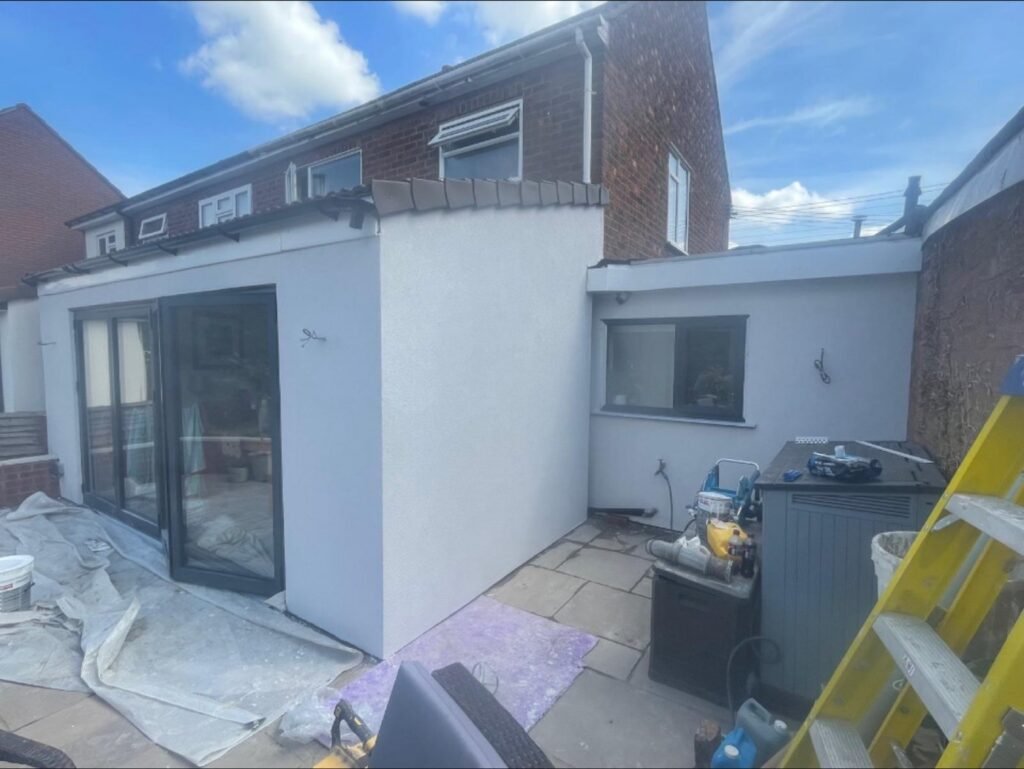
I’m David, and I’m a plasterer and renderer by trade. I still work on the tools. Between the team there are 62 years of combined experience, so when a render job turns up a problem behind the wall, such as a rotten lintel, a cracked sill or a leaking gutter, I’ll show you and it gets dealt with properly instead of being covered over.
That matters with silicone render more than with most finishes. The top coat is only a couple of millimetres thick. It looks superb on a sound, well-prepared wall, and it shows every shortcut on a badly prepared one. Most of the skill is in what happens before the coloured coat goes on.
What silicone render actually is
“Silicone render” is a bit of a shorthand. On a typical job it’s a system made up of several layers, each with its own job:
- Preparation and beads: loose material removed, the wall cleaned, and stainless or PVC beads fixed at corners, window and door reveals, and the bottom edge (the bellcast or starter bead). Beads give straight, crisp lines and protect the edges.
- Base coat: a polymer-modified base coat, usually trowelled on around 6 to 8 mm thick depending on the wall, which levels out the background.
- Reinforcing mesh: glass-fibre mesh bedded into the base coat over the whole wall, with extra diagonal patches at the corners of windows and doors where cracks like to start.
- Primer: a tinted primer that evens out the suction of the base coat and helps the finish go on evenly.
- Silicone top coat: a thin-coat textured finish, usually 1 to 2 mm grain, floated to an even texture. This is the coloured layer you see.
The silicone resin in the top coat is what gives the finish its character. It repels liquid water, so rain beads up and runs off, but it still lets water vapour out of the wall. That combination is what keeps the wall dry and the colour clean for longer.
Why people across the Midlands choose silicone
It stays cleaner
Painted sand and cement render soaks up water, and damp surfaces grow green algae and collect grime, especially on north-facing walls, under trees, and near busy roads. Silicone finishes are much more water-repellent, so they dry quickly after rain and give dirt less to cling to. No render stays perfectly white forever, but silicone stays presentable far longer than masonry paint.
No painting
The colour is in the top coat itself, so there is no paint to flake or fade in patches. Over ten or fifteen years, skipping two or three rounds of scaffold and masonry paint is a real saving.
It copes with movement
Silicone finishes and polymer base coats are more flexible than a rigid cement render. With mesh in the base coat, the system handles the small seasonal movement every house has, which is why hairline cracking is much less common than with traditional render.
It breathes
Older Birmingham houses, particularly Victorian and Edwardian terraces with solid brick walls, need moisture to be able to escape. A vapour-open finish lets the wall dry out, rather than trapping water behind a hard, sealed skin.
Colours and textures
There are dozens of standard shades and many more mixed to order: whites and off-whites, creams, warm stones, soft greys, through to darker greys and even anthracite on contemporary builds. Textures vary by grain size. A 1 mm grain gives a fine, almost smooth look; 1.5 mm and 2 mm grains give a slightly more textured finish that hides minor variations in the wall better.
Silicone or monocouche?
We apply both K-Rend monocouche and silicone systems, so there is no reason for me to push one over the other. They are different tools for different walls:
- Monocouche is a through-coloured, one-coat render applied thicker (typically around 15 mm or more) and scraped back to a textured finish. It’s very good on new blockwork and on walls that need a fair bit of building out.
- Silicone thin-coat goes over a base coat and mesh. It’s often the better choice over existing sound render, over painted surfaces once prepared, on insulated render systems, and where you want a finer texture or a stronger colour.
Some render systems pair a monocouche-style base with a silicone top coat, so the line between the two is not as sharp as it sounds. On a survey I’ll look at what the wall is made of, how flat it is, what’s on it already and how exposed it is, then explain which system I’d use and why. There’s a fuller comparison in our guide comparing monocouche, silicone and sand and cement render, and more on monocouche itself on our K-Rend monocouche and silicone page for Birmingham and Solihull.
What can silicone render go over?
- Brickwork: common on 1930s and post-war houses where the owner wants a cleaner, modern look. The brick needs to be sound, clean and free of loose pointing.
- New blockwork: extensions, garden rooms, garage conversions and new boundary walls.
- Existing render: if it is well bonded. We tap-test every wall. Hollow-sounding areas are cut out and made good first, because a thin coat over loose render simply inherits the problem.
- Pebble-dash: sometimes it can be prepared and rendered over; sometimes it has to come off. It depends on how well it’s stuck and how much it varies in thickness.
- Painted render: flaking paint has to be removed and the surface treated so the new system bonds properly.
- Insulated render: insulation boards fixed to the outside of solid walls, then base coat, mesh and a silicone finish. This is a bigger job with more planning, and the extra thickness affects sills, downpipes and meter boxes.
How a silicone render job runs, step by step
- Survey and quote. Photos on WhatsApp first, then a visit if needed. I check the walls, the access, any planning or boundary issues and anything that needs fixing before rendering. The quote sets out exactly what’s included.
- Scaffold and protection. On most two-storey houses we arrange scaffold. Windows, doors, paths, patios, plants and drains are sheeted and taped. Neighbours on semis and terraces are spoken to about access and the stop line at the boundary.
- Strip and repair. Loose render, failed pebble-dash or flaking paint comes off. Cracks and hollow areas are cut out and made good. Fittings such as lights, satellite dishes, cables and downpipes are taken off where possible.
- Beads. Corner, reveal and stop beads are fixed true and plumb. This is where straight lines and neat edges are won or lost.
- Base coat and mesh. The base coat goes on, mesh is bedded into it with overlaps, then a second pass levels everything. It’s left to cure for the time the system needs.
- Primer. Tinted to the finish colour.
- Silicone finish. Applied a full elevation at a time, wet edge to wet edge, so there are no joins or patchy areas. That’s why we plan the labour and the weather so a whole side can be done in one go.
- Refit and clear up. Fittings go back, masking comes off, and the site is left clean. You get a walk round before the scaffold comes down.
Weather and time of year
Silicone render needs dry weather and temperatures above about 5°C while it’s applied and for a day or two afterwards. Rain on a fresh finish can wash it, and frost can ruin it. In the Midlands that means the main season runs from spring to mid-autumn, with winter work only in mild, settled spells. We watch the forecast closely and will move a day rather than risk the finish. If you’re planning a spring job, getting a quote over the winter means you’re booked in before the busy period. Our guide to rendering in winter explains more.
What affects the cost
Every house is different, so I don’t publish a price list. The main things that move the price are:
- the total wall area and how many elevations are being done;
- scaffold, which depends on height, access and whether it has to go over a conservatory or neighbour’s land;
- how much stripping and repair is needed first;
- the number of windows, doors and corners, because each one needs beads and detailing;
- whether it’s a straight render or an insulated system;
- colour choice, as some deeper shades cost more.
The quote is free and itemised, so you can see where the money goes. Our rendering cost guide gives more detail.
Looking after silicone render
There isn’t much to it. Keep gutters and downpipes clear so water doesn’t pour down one patch of wall. Cut back plants that rub against the render. If algae does appear over the years on a shaded wall, a gentle clean with a suitable masonry cleaner and a soft brush usually brings it back. Avoid pressure-washing on a high setting, which can damage any render finish.
Silicone render alongside other work
A lot of our render work happens alongside other jobs: a new extension, replacement windows, a new roof, or a full house renovation. The order matters: windows should go in before the beads, and roofline work should be finished before the top coat. Inside, rooms can be boarded and skimmed while the render is going on. See our skimming and re-skimming page for the plastering side.
Our work
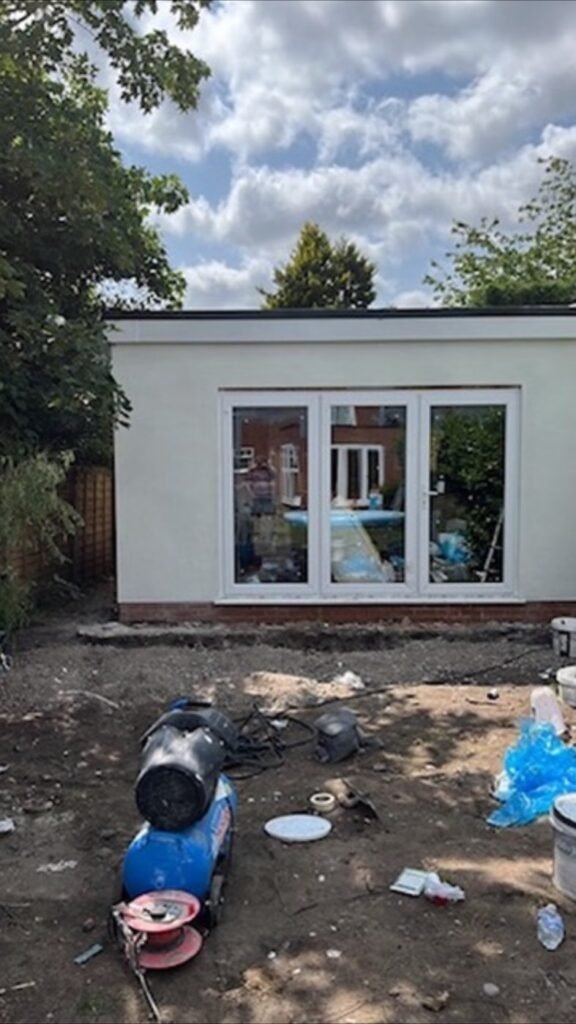
More finished jobs are on our projects page.
Silicone render in Solihull
Silicone render comes up often in Solihull when a house already has a coating that cannot simply be stripped for a monocouche, or when a new extension needs a thin, flexible finish that can be coloured to sit next to older brick or render. It is a thin-coat system: a meshed base, then a through-coloured silicone top coat. The colour is mixed into the finish, so you are not relying on masonry paint, and the surface sheds water while still letting the wall dry out. That helps on weather-facing elevations and on tree-lined roads in the older parts of B91 and B92, where walls stay damp for longer and pick up dirt more readily.
It is also the usual choice over insulation, and over painted or slightly uneven backgrounds that would not take a scraped monocouche cleanly. On two-storey fronts, a low-maintenance finish matters because any later decorating would mean scaffold again. It is not automatically better than K-Rend monocouche: on a sound, even wall a scraped through-coloured render can be the simpler route. Davey looks at the existing coating, the exposure and any insulation before recommending one or the other.
Neighbourhood detail, including north Solihull and the villages, is on our rendering in Solihull page. For how the two systems compare, see K-Rend monocouche and our comparison guide. Shirley work is covered on rendering in Shirley. Davey comes out himself and does the work with the lads. Send photos of each side of the house and your postcode on WhatsApp 07453 614095, or call 07453 614095.
Where we work
We’re Birmingham based, covering the whole of the Midlands. Silicone render jobs regularly take us to Solihull, Sutton Coldfield, Coventry, Tamworth, Lichfield, Walsall, Wolverhampton, Dudley, Stourbridge, Halesowen, Redditch, Bromsgrove, Kidderminster and Worcester, as well as every part of Birmingham itself. Local pages: Rendering in Birmingham · Rendering in Solihull · Rendering in Shirley · Rendering in Tamworth · Rendering in Walsall · Rendering in Bromsgrove. All our services are on the plastering and rendering services page.
Related services: ceiling plastering and repairs · plasterboarding and dry lining · Artex covering · all services.
Silicone render questions
How long does silicone render last?
Applied properly on a well-prepared wall, a silicone render system should give decades of service. The finish itself is very stable; the usual causes of trouble are water getting in from a leaking gutter or sill, or a background problem that wasn’t dealt with first.
Can you render over my existing render?
Often, yes, as long as it’s sound and well bonded. We tap-test it all. Hollow or cracked areas are cut out and repaired first, and if most of it is loose it needs to come off. If yours needs repairs rather than a full re-render, see our render repairs page.
Will silicone render stop damp?
It helps with damp caused by rain soaking into the wall, because it sheds water while letting the wall breathe. It won’t fix rising damp, a bridged cavity, leaking gutters or condensation inside, so those are checked and dealt with first.
Does it crack?
Silicone systems with mesh are far less prone to cracking than rigid cement render. Movement joints are put in where the building needs them, for example where an extension meets the main house.
Do I need planning permission?
Rendering is often permitted development, but conservation areas, listed buildings and some estates have extra rules. Check with your council before committing; I can point you in the right direction.
How long does a job take?
A single-storey extension can be a few days. A full two-storey semi is usually one to two weeks of working days, depending on preparation and the weather.
More services: Rendering with sand and cement · Rendering new extensions.
Get a free silicone render quote
WhatsApp me on 07453 614095 or message the page. Send photos of each side of the house, a rough idea of what you’d like, and your postcode. You can also use our contact page. RCR Connections Ltd, Birmingham based, covering the whole of the Midlands.