
Artex ceilings and textured walls were in nearly every home for years: swirls, stipples, peaks and fan shapes. Now most people want them gone and a smooth, modern finish in their place. RCR Connections Ltd is Birmingham based, covering the whole of the Midlands. Plastering over Artex is one of the jobs we are asked to do most, from one hall ceiling to every room in the house.
For a free quote: WhatsApp me on 07453 614095 or message the page. Send pictures or videos via WhatsApp for a quick response, a free quote and advice. A close photo of the texture, a photo of the whole ceiling, the rough room size and your postcode are perfect.
Plasterers by trade
I’m David, a plasterer and renderer by trade, and I still work on the tools. Across the team there are 62 years of combined experience. Getting a textured ceiling truly flat takes more care than a plain one. The pattern has to be filled first, and any ridge shows the moment a light goes on. We take that time.
What is Artex?
Artex is a brand name, but most people use it for any textured coating on a ceiling or wall. It was put on wet, then shaped with a brush, comb or sponge to make a pattern. It was popular because it hid cracks and uneven boards, and it was quick to put on.
The trouble is that it gathers dust and cobwebs, it is hard to clean, and it makes a room look dated. Patching it is hard too. If a part gets damaged, it is very hard to match the old pattern.
Common Artex patterns
- Stipple. Small, even bumps made with a stipple brush. Often the easiest to cover.
- Swirl. Round, swirling arcs across the ceiling. Needs a fill coat first.
- Fan or shell. Half circles in rows. Often quite deep.
- Peaks. Sharp points pulled out of the wet coating. These are the deepest, and the tips need care.
- Bark or comb. Lines dragged through the coating. Common on walls as well as ceilings.
Safety first: testing for asbestos
Some older textured coatings have a small amount of asbestos in them. You cannot tell by looking. So before anything else:
- Do not sand, scrape, drill or knock off the peaks until you know what is in it. Disturbing it is what lets fibres out.
- Get a sample tested by a testing service or a UKAS-accredited lab. It is often quick, and the Health and Safety Executive (HSE) website has advice on textured coatings.
- Covering is often the safest choice. Plastering or over-boarding seals the old coating in place instead of disturbing it.
- Taking it off is a separate job. If you want the coating removed rather than covered, that must follow HSE advice, and may need a specialist.
I will ask about testing before I quote, and we will not start knocking anything back until we know it is safe. Our guide on plastering over Artex goes into more detail.
Your options for covering Artex
1. Plaster straight over it
If the coating is sound and well stuck, it can be plastered over. A light stipple may only need two normal coats of finish plaster. A deep swirl or peaked pattern often needs a first coat to fill the texture, then a finish coat to get it flat. This is the quickest choice, and it keeps the ceiling height the same.
2. Over-board and plaster
New plasterboard is screwed through the old ceiling into the joists, the joints are taped, and the whole lot is plastered. This is often the better choice when the ceiling is cracked or sagging, when large parts of the texture are loose, when the pattern is very deep, or when there are old water stains that would show through. You get a brand-new flat surface without pulling the old ceiling down. Our plastering ceilings and repairs and plasterboarding and dry lining pages explain more.
3. Textured walls
Artex on walls is covered the same way. On walls we also have to think about sockets, switches, radiators, door frames and skirting, because the new plaster adds a little thickness. Walls are seen up close, so the prep matters even more.
Which option suits your room?
Here is a rough guide. We will always look first and tell you plainly.
- Light stipple, firm ceiling: plaster straight over.
- Deep swirl or peaks, firm ceiling: fill coat, then finish coat.
- Cracked, saggy or stained ceiling: over-board, then plaster.
- Old lath and plaster under the Artex: often over-board, as the ceiling may be weak.
- Loose or flaking texture: fix the loose parts or over-board. Do not plaster over loose coating.
How we cover an Artex ceiling
- Check and test. We look at the state of the ceiling and check if the coating has been tested.
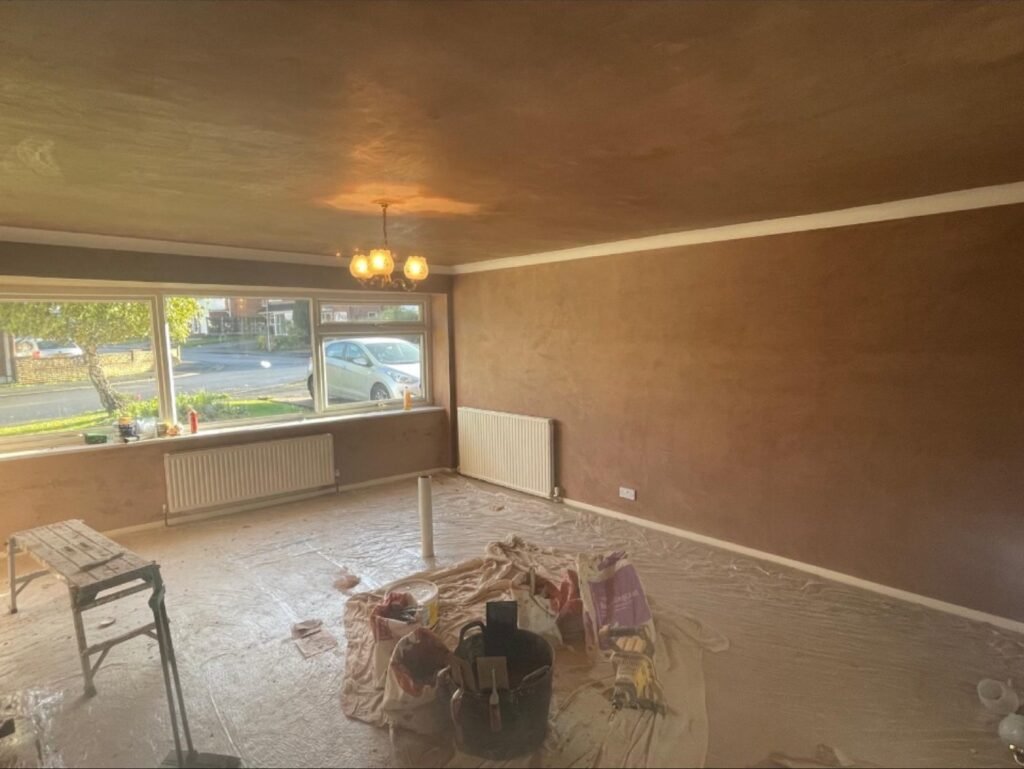
- Protection. Floors are sheeted, furniture is moved out or covered, and the doorway is taped off. Light fittings and smoke alarms are taken down or loosened by a qualified person where needed.
- Prep. Loose parts are made firm or the ceiling is over-boarded. Dust, grease and cobwebs are cleaned off, which matters most in kitchens.
- Priming. A bonding primer gives the new plaster something to grip.
- Filling the pattern. On heavier textures, a first coat fills the swirls and stipples.
- Finishing. A finish coat is laid on and trowelled up as it sets, for a smooth, flat surface.
- Clean up. Edges are cut in neatly at the walls and coving, and the room is left swept.
Artex in kitchens, bathrooms and halls
Kitchens and bathrooms need a little more care. Grease from cooking and steam from showers sit on the texture for years. If it is not cleaned off, the new plaster will not grip well. We wash the ceiling down and let it dry before we prime it. In a bathroom, a fan or an open window helps the new plaster dry well.
Halls and landings are often the hardest rooms. The ceiling over the stairs is high, so we set up a safe work platform first. These ceilings are also lit from the side by the window on the stairs, which shows every flaw. We take extra time here so it looks flat from every angle.
Living at home while we work
Most people stay at home while we plaster over Artex. We work one room at a time, so the rest of the house stays in use. We keep the doors shut and the floors sheeted, and we clean up at the end of each day. If you have pets or young children, tell us and we will plan the day around them.
How long does it take?
Most single Artex ceilings take one day to plaster over. A deep pattern that needs a fill coat can take a little longer, as each coat needs time to firm up. Over-boarding and plastering a room often takes one to two days. A whole house can take a week or more, room by room.
Coving and light fittings
Many Artex ceilings have old coving. It can stay, be repaired, or be replaced with new plaster coving while the ceiling is being done. Light fittings, smoke alarms and spotlights need to be thought about, mainly if the ceiling is over-boarded, so ask your electrician before the work starts. We can plan the job around them.
Painting afterwards
Once the new plaster is dry, treat it like any other new plaster. It goes from dark pink to an even light pink. Then put on a mist coat of watered-down white emulsion, then your normal paint. Our guide on how long plaster takes to dry before painting explains how to tell when it is ready.
What goes into your quote
Every ceiling is different, so we quote each job on its own. The main things that change the quote are:
- How deep the pattern is. A light stipple is quicker than heavy swirls or peaks.
- Whether we plaster straight over or over-board first.
- The size of the room, the height of the ceiling and any stairwells.
- Coving, light fittings and how much furniture needs moving.
Quotes are free and written, so you know what is included before any work starts.
Where we work
We are Birmingham based, covering the whole of the Midlands. Artex jobs take us all over Birmingham and out to Sutton Coldfield, Erdington, Kings Heath, Northfield, Coventry, Nuneaton, Tamworth, Dudley, Stourbridge and Worcester. Local pages: plastering in Birmingham · plastering in Erdington · plastering in Kings Heath · plastering in Coventry · plastering in Dudley. See all towns on our areas we cover page.
We also do rendering, including K-Rend monocouche and silicone. See our rendering in Birmingham page if the outside of your house needs work too.
Related services: plastering walls and ceilings · plastering ceilings and repairs · plasterboarding and dry lining · all services · plastering and rendering services.
Artex questions
Do you plaster over Artex in Birmingham?
Yes. RCR Connections Ltd is Birmingham based, covering the whole of the Midlands. We plaster over Artex ceilings and textured walls, or over-board them first.
Can you plaster straight over Artex?
Yes, in most cases, as long as the coating is sound and well stuck. It is cleaned, primed and plastered. Deep patterns need an extra coat to fill them first.
Does my Artex contain asbestos?
You cannot tell by looking. If it is old and you do not know when it went on, get a sample tested before anyone sands, scrapes or drills it.
Is it better to plaster over or over-board?
Plastering over is quicker if the ceiling is sound. Over-boarding is better if the ceiling is cracked, sagging, patched or has a very deep pattern. We will tell you which we would use after seeing it.
Will the ceiling be lower afterwards?
Only very slightly. Plaster adds a few millimetres. Over-boarding adds the board as well, which you will not notice in most rooms.
Is it messy?
Plastering is a wet job and makes little dust. We sheet the floors and keep the mess to the room we are working in.
How long does it take?
Most single ceilings take one day. Deep patterns or over-boarding can take one to two days.
What are your hours?
Monday to Friday 7am to 5pm, Saturday 7am to 1pm. Closed on Sundays.
How do I get a quote?
WhatsApp me on 07453 614095 or message the page. Send pictures or videos of the ceiling, a close photo of the texture and your postcode.
More services: Plastering repairs · Plastering and coving · Plastering extensions and lofts.
Get a free quote for plastering over Artex
WhatsApp me on 07453 614095 or message the page.
Send pictures or videos via WhatsApp for a quick response, a free quote and advice. Send a close photo of the texture, the whole ceiling and your postcode.
Opening hours: Monday to Friday 7am to 5pm, Saturday 7am to 1pm, Sunday closed.
See finished work on our projects page, or use our contact page. RCR Connections Ltd, Birmingham based, covering the whole of the Midlands.