

Most plaster does not fail all at once. It starts with a crack by a door, a patch that sounds hollow, a hole where a socket used to be, or a bulge low down on a wall. Left alone, small faults grow. Caught early, most are quick to put right. RCR Connections Ltd (Regal Colour Rendering) is Birmingham based, covering the whole of the Midlands. We repair plaster in homes of every age, and we finish the repair so it blends in.
For a free quote: WhatsApp me on 07453 614095 or message the page. Send pictures or videos via WhatsApp for a quick response, a free quote and advice. A close photo and one from a step back are enough to start.
Plasterers by trade
I’m David. I am a plasterer and renderer by trade, and I still work on the tools. Across the team there are 62 years of combined experience. Repairs are a test of a plasterer. Plastering a whole wall is one thing. Making a patch sit flat and blend in with old plaster around it takes care and practice. That is the part we are good at.
Common plaster faults we repair
- Cracks by doors and windows, at the corners of rooms and along the top of walls.
- Blown plaster that sounds hollow when you tap it and may bulge or crumble. Our blown plaster guide explains the signs.
- Holes from old fixings, door handles, removed shelves or a knock with furniture.
- Chases cut by electricians for new cables and sockets.
- Damage round pipes after a plumber has moved a radiator or run new pipes.
- Damaged corners where a wall corner has been knocked and broken.
- Loose and crumbling plaster low down on walls, often after old damp.
- Chimney breasts where old plaster has stained, cracked or come loose.
Why plaster fails
Knowing why plaster failed tells us how to fix it so it lasts. The main causes are:
- Age. Old lime plaster can lose its grip on the wall after a hundred years or more.
- Damp. Water from a leak, a gutter or a damp wall softens plaster and breaks its bond.
- Movement. All houses move a little. Cracks often show where two materials meet, like a wall and a door frame.
- Knocks. Corners and walls by doors take a lot of wear.
- Poor past repairs. Filler pushed into a crack with no tape, or a patch put on dusty plaster, will often fail again.
If damp is the cause, it needs fixing first. We will tell you plainly if we think that is the case. There is no point putting new plaster on a wet wall.
How we repair plaster, step by step
- Find the edges. We tap the wall to find where the plaster is loose. The damage is often bigger than it looks.
- Protect the room. Floors and furniture are covered. Repairs can make dust, so we keep it to the area we are working on.
- Cut back. Loose plaster is cut out back to firm plaster, with clean, neat edges.
- Prepare the wall. The wall behind is brushed down and treated, so the new plaster grips.
- Tape or mesh. On cracks and joints, tape or mesh goes in to help stop the crack coming back.
- Build it up. Deep holes are filled in layers with an undercoat, so the repair is solid and flat.
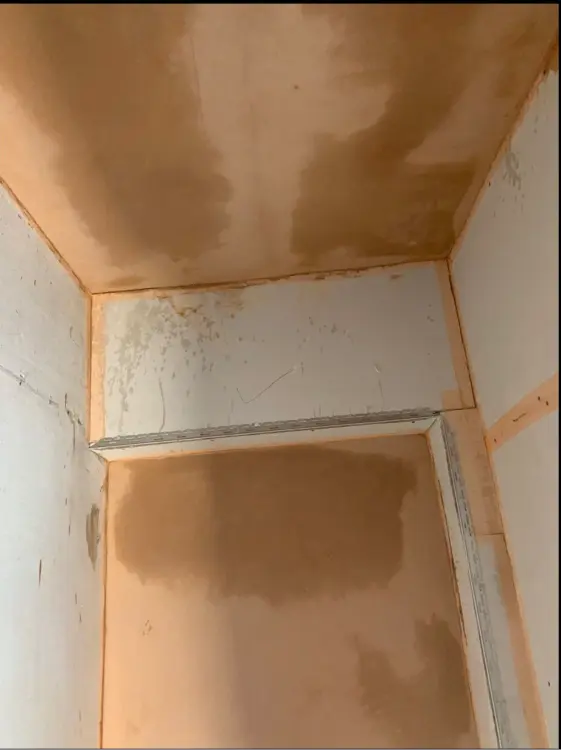
- Finish. A finish coat goes on and is trowelled flush with the wall around it.
- Clean up. We tidy up and leave the repair ready to dry.
Patch it or plaster the whole wall?
This is the question we are asked most. The honest answer depends on how much of the wall is bad.
- Patch it when the damage is in one or two small areas and the rest of the wall is sound.
- Plaster the whole wall when there are lots of patches, lots of cracks, or the old plaster is rough and uneven. A full new coat looks better and lasts longer than a wall of patches.
A patch on an old wall can sometimes show in strong side light, for example near a big window. If that matters to you, ask us. We will tell you which way gives the best result for your wall. Our page on plastering walls and ceilings covers full plastering.
Making good after other trades
A lot of our repair work comes after other trades. An electrician runs new cables. A plumber moves a radiator. A new kitchen goes in and leaves gaps round the units. Each one leaves holes and chases in the walls.
We come in after them and make it good. We fill the chases, plaster round sockets and pipes, and build up any holes. You get walls that are ready to paint. We are happy to work round other trades, so tell us when they are due to finish.
Old houses and lime plaster
Many older houses in Birmingham, Coventry and the Black Country have lime plaster on solid brick walls. Lime plaster lets the wall breathe. Modern gypsum plaster does not breathe in the same way.
When we repair an old wall, we look at what is on it first. On some walls a modern repair is fine. On others, a more breathable mix is better, so the wall does not trap damp. We will tell you what we find and what we think is best.
Ceilings
Ceilings fail in their own ways: cracks along board joints, sagging lath and plaster, and water damage from leaks above. We have a separate page on ceiling plastering and repairs with more on this.
How long repairs take
- A few small holes or cracks: a few hours.
- Making good after a rewire in one room: about a day.
- A large patch of blown plaster: one to two days, as deep repairs are built up in layers.
Then the plaster needs to dry. Small repairs may be dry in a few days. Deep repairs can take a week or more. Wait until the repair is an even light pink with no dark patches before you paint.
Painting your repair
On new plaster, always start with a mist coat. That is white emulsion mixed with some water. It soaks into the plaster and gives the next coats something to grip. Then paint as normal. If you paint too soon, or skip the mist coat, the paint may peel.
If the repair is on a wall with old paint, you may want to paint the whole wall, not just the patch. That way the colour and sheen all match.
Reading a crack: what the shape tells us
Not every crack means the same thing. Before we touch a crack, we look at where it runs, how wide it is and whether it has come back after an earlier repair. That tells us whether it is a plaster problem we can sort, or a sign of something bigger that needs another trade first.
Hairline cracks in a newer finish
Very fine cracks that run in random directions across a fresh skim are often from the plaster drying too fast, for example with the heating turned up straight after plastering. They are on the surface only. A light fill and a good mist coat usually hides them, or a fresh skim if there are lots.
Straight cracks along board joints
On ceilings and walls lined with plasterboard, a long straight crack usually follows the edge of a board. It means the joint was not taped, the tape has failed, or the boards are moving because the screws have lost their grip. The fix is to open the joint, re-fix any loose board, tape it properly and plaster over.
Diagonal cracks from the corners of doors and windows
These are the most common cracks in older houses. The corner of an opening is where the wall is weakest, and normal seasonal movement shows up there first. Most are small and settle down once repaired with mesh. If a diagonal crack is wide, wider at one end than the other, or growing, it is worth having the structure looked at before plastering over it.
Cracks where the wall meets the ceiling
A crack running along the top of a wall, where it meets the ceiling, often comes from the ceiling joists flexing as people walk about upstairs. It can open and close with the seasons. Coving is one neat way to hide it for good, because it bridges the joint; see our plastering and coving page.
Cracks that keep coming back in the same place
If a crack has been filled more than once and keeps returning, something is still moving. We cut it out wider, check what is behind it, set in mesh or a flexible joint, and talk to you about whether another trade should have a look first.
Blown plaster in more detail
Blown plaster is plaster that has come away from the wall behind it but has not yet fallen off. You can often find it by tapping with your knuckles. Sound plaster gives a dull, solid knock. Blown plaster sounds hollow, like tapping a box.
The usual causes are:
- old lime plaster losing its key on soft brick,
- a past leak or damp that has softened the plaster and broken its bond,
- a skim coat put over a dusty or shiny surface that it never gripped,
- heavy knocks, such as a door handle hitting the same spot every day,
- salts coming out of old brickwork, which push the plaster off from behind.
The fix is always the same in principle: cut out everything that is hollow, back to a firm edge, and build it back up. The size of the hollow area decides how big the job is. On an old wall it is common to tap a small bulge and find the loose area is several times bigger than it looked. That is why we tap the whole wall before we price, not just the part you can see.
Damp and plaster
Many plaster repairs are really damp repairs in disguise. Plaster stains, softens, bubbles and crumbles when water gets to it. If the water is still getting in, new plaster will fail in the same way.
Signs that damp is behind the damage
- tide marks or brown stains on the wall,
- paint bubbling or flaking,
- a white, fluffy or crystal deposit on the surface (salts),
- plaster that is soft and powdery when you press it,
- a musty smell, or black mould in corners.
Common sources of damp we see
- blocked or leaking gutters and downpipes,
- a leaking pipe inside the wall or under the floor,
- outside ground or paths built up higher than the inside floor,
- cracked render or pointing letting rain into the wall,
- condensation in rooms that are cold and badly aired, such as bathrooms and back bedrooms.
We are plasterers and renderers, not damp surveyors. We will tell you what we see and what we think is likely, and if the cause is outside, such as cracked render, we can often fix that too. Where the problem needs a specialist, we will say so plainly before we plaster.
Plastering after a leak
After a burst pipe or a leak from a bathroom above, the wall or ceiling needs to dry out fully before it is repaired. Plaster that has been soaked often looks fine once dry, but it can be soft or hollow. We check it once it has dried, cut out anything that has failed and repair the rest. If an insurer is involved, we can give you photos and a written description of the work for your claim.
Making good after a rewire
A full rewire is one of the messiest jobs a house can go through. The electrician needs to get new cables to every socket, switch and light, which means chases cut into the walls, holes in ceilings and boxes cut out. Most rewires leave every room needing some plaster work.
Here is what we do after a rewire:
- Check that every chase has its cable fixed in and covered as the electrician needs.
- Damp down the chase so the plaster does not dry too quickly at the edges.
- Fill each chase with an undercoat, flush to just below the surface.
- Finish over with a thin coat, feathered out so it does not show as a line.
- Plaster neatly up to each back box, so sockets sit flat.
- Patch any holes in ceilings where cables were pulled through.
On older walls with a lot of chasing, it can be quicker and better to skim the whole room once the chases are filled. We will tell you which way makes most sense.
Making good after a new kitchen or bathroom
Pulling out an old kitchen or bathroom usually brings plaster away with it. Tiles take a layer of plaster off when they come away. Old wall cupboards leave fixing holes. Boxing and pipe runs leave gaps. Before the new kitchen or bathroom goes in, the walls need to be flat and sound.
- Where tiles are going back on, the wall needs to be flat, strong and dry, but it does not need a perfect polished finish.
- Where the wall will be painted, it needs a smooth finish to match the rest of the room.
- Round the bath and shower, we use the right board or backing for wet areas.
Timing matters here. Tiles should not go on plaster until it is fully dry, so leave time in your plans between us finishing and the fitter tiling.
Fireplaces and chimney breasts
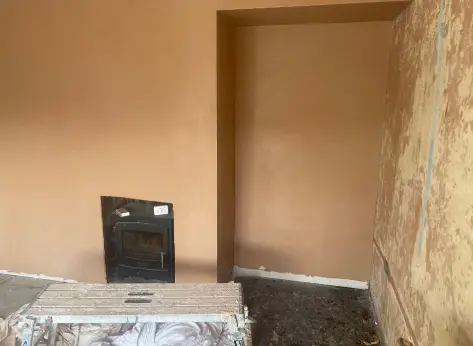
Chimney breasts are one of the most common places we repair in older Midlands houses. Fireplaces are opened up, closed off, or have a new stove fitted, and each change leaves the plaster round the breast patched or damaged. Old chimneys can also bring soot staining and salts through the plaster, which show as brown or yellow marks that bleed through paint.
Opening up a fireplace
When an old fireplace is opened up, the plaster round the new opening needs making good, often with new corner beads or a neat square return into the opening. If a stove is going in, the inside of the opening is usually left as brick or lined to suit the stove, so we plaster up to the edge.
Closing off a fireplace
A closed fireplace needs to be blocked or boarded, with a small vent left so the chimney can breathe. We plaster over the new section so it matches the breast. Leaving a vent stops damp building up inside the old flue.
Staining and salts
Brown staining on a chimney breast comes from old soot and moisture in the flue. Painting over it rarely works for long. The stained plaster may need cutting out and replacing with a backing that resists salts, then finishing as normal. If the chimney is still letting in water at the top, that needs sorting first.
Damaged corners and edges
Outside corners take a hammering, especially in hallways, on stairs and by kitchen doors. Old corners in older houses often have no bead at all, so once a chunk breaks off, the corner keeps crumbling.
We cut back the damaged corner, fit a new bead that is set dead straight, and plaster up to it on both faces. The new corner is much tougher than the old one. If you have small children, a dog or a busy hallway, it can be worth doing every outside corner in that area at once.
Repairs in different ages of house
The plaster in your house depends on when it was built, and that changes how we repair it.
Victorian and Edwardian houses
Terraces and villas in areas like Moseley, Kings Heath, Edgbaston, Handsworth and parts of Coventry and Wolverhampton usually have lime plaster on solid brick, and lath and plaster ceilings. Lime is soft and lets moisture pass through. We look at each wall and use a repair mix that suits it, rather than putting a hard, sealed patch in the middle of a breathable wall.
1920s and 1930s houses
Many of the semis across south and east Birmingham, Solihull and the Black Country were built between the wars. These often have a sand and cement or early gypsum backing with a thin finish coat, and many have had cavity walls from new. Repairs on these walls are usually straightforward, though blown areas on outside walls are common.
Post-war and 1960s to 1980s houses
From the 1950s onwards, plasterboard ceilings became normal, and many walls were plastered with gypsum backing and finish coats. Typical faults are cracks along board joints, Artex ceilings that need covering, and damage from later rewiring and new kitchens.
Newer houses
Most houses built since the 1990s have plasterboard on walls and ceilings, either on dabs or on studs. Repairs here are usually about cracks at joints, nail or screw pops, and holes. Settling cracks in the first couple of seasons after a new house is built are common and normally easy to sort.
Artex and textured ceilings
Many homes still have textured Artex on ceilings or walls. When a textured ceiling is damaged, matching the pattern on a patch is almost impossible, so the usual answer is to plaster over the whole ceiling to give a smooth finish.
Older textured coatings can contain asbestos. It is safe left alone, but it should not be sanded or scraped. Before we work on an old textured ceiling, we will ask whether it has been tested. If it has not, a simple test can be done first, and we plaster over it without disturbing it.
When a repair becomes a bigger job
Sometimes what starts as a small repair turns out to be larger once the loose plaster is cut out. We always tell you before we carry on, so there are no surprises. The usual reasons a job grows are:
- the blown area is bigger than it looked from the surface,
- there is old damp behind the plaster that has not been fixed,
- the old surface is too weak to take a skim and needs a backing coat,
- a lath and plaster ceiling turns out to be loose over a wider area.
In each case we will show you what we have found, explain the choices, and let you decide.
Small jobs are welcome
Some plasterers turn down small repairs because they are not worth the trip. We take them on, because a small repair done well stops it turning into a big one. If you have a few small jobs round the house, such as a crack on the landing, a hole behind a door and a patch where a radiator was moved, it makes sense to put them together into one visit.
Repairs for landlords and letting agents
Between tenants, rental homes often need a round of plaster repairs before the decorator can go in: holes from fixings, knocked corners, cracks and the odd damp patch. We work with landlords and agents to get these done quickly, so the property is not empty for longer than it needs to be. Photos of each room are enough for us to quote, and we can work with a key left at the agent’s office.
Repairs before you sell
Buyers notice cracks, stains and patches, and a survey will often flag them. A round of plaster repairs and fresh paint before you list a house can help it show at its best. We can also make good any damp staining once the cause has been dealt with, so it does not raise questions later.
What you can do before we arrive
- Clear the area near the repair, or tell us what furniture needs moving.
- Take down pictures, shelves and curtains near the work.
- Let us know if any damp, leak or roof problem has been fixed, and when.
- If other trades are working, tell us when they will be done.
- Have a power socket and water nearby that we can use.
Holes of every size
Holes in plaster come in all sizes, and each size has its own fix.
Small fixing holes
Holes left by screws, plugs and picture hooks are the simplest repair. Old plugs are pulled out, the hole is cleaned and filled, and the surface is sanded or trowelled flush. On their own they are a job for filler, but when there are dozens across a house, such as after a tenant moves out, it is quicker and neater to have them all done in one go before decorating.
Door handle holes
A door that swings back without a stop will punch a round hole in the wall behind it. On a plasterboard wall the board behind is often broken through. We cut a neat square round the hole, fit a new piece of board with a backing behind it, tape the edges and plaster over. Then fit a door stop, or it will happen again.
Large holes in plasterboard
Bigger holes in stud walls, such as where a cupboard was ripped out or a pipe was accessed, are cut back to the nearest studs either side. A new piece of board is screwed in, the joints are taped, and the whole patch is skimmed and feathered out into the wall around it.
Deep holes in solid walls
On brick and block walls, a deep hole is built up in layers. Each layer of backing coat goes on no thicker than it can hold, and is scratched so the next layer grips. Trying to fill a deep hole in one go leads to sagging and cracking. Once the backing is firm, a finish coat is trowelled flush.
Repairs on stairs and landings
Stairwells are awkward. The walls are tall, the floor slopes, and there is often a long drop over the banister. Damage on a stairwell is common because people carry furniture up and down and scrape the walls. Cracks over the stairs are also common where the stair structure meets the wall.
To work safely, we use a proper stair platform or small scaffold rather than balancing a ladder on a step. That takes a little more setting up, but it means we can reach every part of the wall and make the repair properly. If the stairwell needs several repairs, it is often worth plastering the whole wall, as long walls with patches tend to show in the light from the landing window.
Matching the finish
A good repair should disappear once it is painted. That depends on matching three things.
- Level. The repair has to sit exactly flush with the wall around it. Too high and it shows as a bump, too low as a dip.
- Texture. A smooth modern finish and a slightly rougher old lime finish look different under paint. We finish to suit the wall.
- Edges. The edge of the patch is feathered out thinly, so there is no hard line where new meets old.
Even with all of this, a patch can sometimes be seen when strong light skims across the wall, because the old wall itself is not perfectly flat. We will tell you honestly if we think a patch will show, and whether a full skim is the better answer for that wall.
Repairs to outside walls from the inside
Damp and blown plaster are often worst on the inside face of outside walls, especially on the side of the house that takes the weather. If the outside render or pointing is cracked, rain can soak into the wall and work its way through to the plaster inside.
Because we also render, we can look at both sides of the wall. Sometimes the right answer is to repair the render outside first, give the wall time to dry, then repair the plaster inside. Our render repairs page explains more about the outside.
Questions to ask any plasterer about a repair
- What do you think caused the damage?
- Will you cut back to sound plaster, or fill over the top?
- Will you use tape or mesh on cracks?
- What will you use on an old lime wall?
- How long should I leave it before painting?
- Will you protect the floors and furniture?
Any good plasterer should be happy to answer these. If the answer to the second one is “fill over the top” for a hollow or loose area, the repair is unlikely to last.
Tools and materials we use for repairs
People sometimes ask why a plasterer is needed for a repair when filler is sold in every shop. Filler is fine for a screw hole. For anything larger, the right materials make the difference between a repair that lasts and one that cracks again.
- Backing coats build up deep areas in layers and give a firm base.
- Finish plaster gives the smooth surface that takes paint.
- Bonding agents and primers help new plaster grip old surfaces, especially shiny or very absorbent ones.
- Scrim tape and mesh bridge cracks and joints so movement does not break through.
- Beads give strong, straight edges on corners and round openings.
- Breathable mixes for old solid walls where a hard, sealed patch would trap moisture.
We carry what we need for most repairs, so we can deal with what we find once the loose plaster is out, rather than leaving and coming back.
Keeping dust down in a lived-in home
Most repairs happen in homes where people are living, often with children and pets about. Cutting out old plaster makes dust, and nobody wants it through the whole house. We sheet the floor and furniture in the work area, close doors to other rooms where we can, and clean up as we go. Plastering itself is a wet job, so once the cutting out is done the dust drops right down. We leave the room swept and tidy at the end of each day.
Plaster repairs and heating
New plaster needs to dry slowly and evenly. In winter, people are understandably keen to get the heating back on. Gentle background heat is fine and helps drying. What causes trouble is a radiator on full right under the repair, or a fan heater pointed at the wall. That dries the surface too fast and can make the patch crack or come away at the edges. Keep the room warm, keep some air moving, and let the repair dry in its own time.
Ceiling roses, cornices and old detail
Older houses often have plaster detail worth keeping: a ceiling rose in the middle of the front room, a run of cornice round the top of the walls, or a decorative arch in the hallway. When the wall or ceiling next to them is damaged, the repair has to stop neatly at the edge of the detail without harming it. We work carefully up to the old mouldings, clean back any loose paint built up over the decades, and fill small chips so the detail reads crisply again. Where a section of cornice is missing, a matching length can often be made or found, and we can fit it as part of the repair.
Why choose RCR Connections Ltd
- We are plasterers by trade, with 62 years of combined experience across the team.
- We find out why the plaster failed, so the repair lasts.
- We tell you plainly whether a patch will do or the wall needs more.
- We keep the dust and mess to the area we are working in.
- We are Birmingham based, covering the whole of the Midlands.
What to send us
- a close photo of the damage,
- a photo from a step back, so we can see the size,
- a note of any leak or damp you know about,
- the room it is in and your postcode.
A short video where you tap the wall is very useful. We can hear if the plaster is hollow.
Where we repair plaster
We repair plaster in homes all over Birmingham and the Midlands, from old terraces to newer estate houses. Each age of house has its own plaster, so we match the repair to what is on your walls.
Popular towns for this work: Coventry, Wolverhampton, Selly Oak, Edgbaston, Northfield.
See every town we cover on our plastering areas page.
Plastering repair questions
Do you do small plastering repairs?
Yes. We repair cracks, holes and loose plaster, and we make good after other trades. RCR Connections Ltd is Birmingham based, covering the whole of the Midlands.
What is blown plaster?
Blown plaster is plaster that has lost its grip on the wall behind it. It sounds hollow when you tap it. It may bulge, crack or come away. It needs cutting out and putting back.
Can you patch just one part of a wall?
Yes. We cut back the bad part to firm plaster, build it back up and finish it flush. In strong side light a patch can sometimes show, so on a wall with lots of damage it can be better to plaster the whole wall.
Why does my crack keep coming back?
Filler on its own often fails because the crack moves a little or the plaster behind it is loose. The crack needs opening up, any loose plaster cut out, and tape or mesh set in before it is plastered.
Can you make good after an electrician or plumber?
Yes. This is one of our most common jobs. We fill chases, plaster round new sockets and pipes, and patch holes so the wall is ready to paint.
Do I need to fix damp before a plaster repair?
Yes. If the plaster failed because of damp, the cause needs fixing first. Otherwise the new plaster will fail too. We will tell you if we think damp is the cause.
How long does a plaster repair take?
Most small repairs take a few hours to a day. Bigger patches may need two visits, one to build up the wall and one to finish it.
When can I paint a repair?
Wait until the plaster is an even light pink with no dark patches. Small repairs may be ready in a few days. Bigger ones can take a week or more. Use a mist coat first.
What are your working hours?
Monday to Friday 7am to 5pm, Saturday 7am to 1pm. We are closed on Sundays.
How do I get a quote?
WhatsApp me on 07453 614095 or message the page. Send pictures or videos of the damage, close up and from a step back.
Get a free plastering repair quote
WhatsApp me on 07453 614095 or message the page.
Send pictures or videos via WhatsApp for a quick response, a free quote and advice. Show us the damage up close and from a step back, so we can see the size. Tell us the room and your postcode.
Opening hours: Monday to Friday 7am to 5pm, Saturday 7am to 1pm, Sunday closed.
See finished work on our projects page, or use our contact page. RCR Connections Ltd (Regal Colour Rendering), Birmingham based, covering the whole of the Midlands.