
Few cities have as many different walls as Birmingham. A single postcode can hold a Victorian terrace with soft red brick, a 1930s semi under grey pebbledash, a 1960s block of maisonettes and a brand-new townhouse. Each one needs a different approach to render, and choosing the wrong system is the quickest way to cracking, staining or damp. RCR Connections Ltd is a Birmingham based plastering and rendering company covering the whole of the Midlands with an office in the Jewellery Quarter, and between us we have 62 years of combined experience. Our rendering work covers homes, extensions, boundary walls and small commercial premises all over the city, from Erdington, Kingstanding and Castle Vale to Moseley, Kings Heath, Harborne, Selly Oak, Northfield, Hall Green, Yardley and Sheldon.
What follows is a practical guide to rendering in Birmingham: the systems we use and what each is good and bad at, how the city’s main types of housing take render, choosing a colour and texture, the preparation that decides whether render lasts, working with the weather, and the planning rules set by Birmingham City Council, including its conservation areas and Article 4 Directions.
The render systems, compared
RCR Connections Ltd fits K-Rend monocouche and silicone render, sand and cement render and insulated render, and we repair old render of all kinds. Below is what each one is, and where it works best on Birmingham homes.
K-Rend monocouche render
Monocouche simply means “one coat”. It’s a factory-blended render with the colour already in it, and K-Rend monocouche is the brand name most people know. Because the pigment runs right through, the finished wall never needs painting, and a knock or scratch shows the same colour underneath.
We apply it by machine or by hand in two passes that bond together as a single layer, then leave it to stiffen before scraping the surface back. That scraping removes the cement-rich skin and leaves the slightly open, even texture you see on so many new houses. It works best on sound, reasonably flat backgrounds such as new blockwork or well-prepared brick. On a wall that has been painted, patched with different materials or is badly out of line, it usually needs a base coat first, or another system altogether.
Across Birmingham it’s a favourite for rear extensions, side returns and complete makeovers of 1950s to 1970s houses. Find out more on our K-Rend monocouche page or our page on K-Rend monocouche in Birmingham and Solihull.
Silicone render
Most of our Birmingham rendering is a thin-coat silicone system. It starts with a polymer-modified base coat, with glass-fibre mesh trowelled into it to spread stresses and resist cracking. When that’s cured, a primer goes on, followed by the silicone finish, which is only as thick as its largest grain.
Silicone has three big advantages in a city. It’s water-repellent, so rain beads off and carries surface dirt with it. It’s vapour-permeable, so moisture in the wall can still escape. And it’s flexible, so it copes with the small movements that older houses and mixed backgrounds go through. That makes it well suited to busy roads where traffic dirt builds up, to tree-lined avenues in Edgbaston, Moseley and Hall Green, and to walls made up of different materials after decades of alterations. It’s also the usual finish on insulated render.
Sand and cement render
Traditional sand and cement is still the backbone of Birmingham’s rendered housing, especially on interwar council estates and older private semis. It’s applied in a scratch coat and a top coat, then painted with masonry paint once it’s fully cured. It’s hard-wearing and simple to repair, which makes it the natural fit when only part of an existing painted render needs replacing, or for garden walls, plinths and garages.
Its weakness is that it’s rigid and relatively impermeable. On a Victorian terrace with soft brick and lime mortar, a strong cement render can trap moisture, leading to damp inside and bricks spalling behind the render. We look closely at what the wall is made of before we recommend it.
Insulated render
Insulated render bonds and fixes insulation boards to the outside of the wall, then finishes them with a mesh-reinforced base coat and a decorative render. It’s mainly used on solid-walled homes, which in Birmingham means many pre-1920s terraces and villas, along with some post-war houses built with non-traditional construction.
It’s the most involved rendering job we take on. Window sills need extending, rainwater pipes and cables moved, and the roof edge checked so it still oversails the thicker wall. On a terrace, the junction with next door needs careful detailing, and on a narrow passage between houses the extra thickness can matter. It always needs building regulations approval, and in a conservation area or where it changes the look of the house, planning permission too.
Render repairs
A lot of Birmingham render doesn’t need replacing, just repairing properly. We see cracked and blown render on bay fronts, render that has come away around old window openings, failed patches where pipes have been moved, and bases that have crumbled because the render was taken down over the damp-proof course.
Repairs start with the cause. Then we cut back to sound edges, replace corroded beads, and rebuild the patch in layers to match the original thickness and texture. Painted render can be made to disappear with a fresh coat across the whole elevation. Older through-coloured render is harder to match because it has faded, so we’ll tell you honestly what to expect. Our article on signs your render needs repairing before winter explains the warning signs.
Pebbledash cover-overs
Lots of Birmingham semis still have their old grey pebbledash. If it is firm and well stuck, we can often render over it rather than hack it all off, which saves mess and time. First we tap the whole wall. Any hollow or loose parts come off and are filled back flush. Then a base coat goes on with mesh bedded in, to give a flat, even face, and the finish goes on top. That can be K-Rend monocouche and silicone, or a painted sand and cement finish. If most of the pebbledash is hollow, it is better to strip it and start again, and we will tell you which it is.
Beads and mesh
Beads and mesh are small parts, but they decide how long a render job lasts.
- Bellcast bead at the base, above the damp-proof course, so rain drips off and the render never touches the ground.
- Corner beads on every outside corner, for straight lines that do not chip.
- Stop beads round windows and doors, and at the line with next door.
- Movement beads where the wall could move, such as where an extension meets the house.
- Mesh in the base coat across joins between different materials, over lintels and at the corners of windows and doors, where cracks most often start.
We fit beads straight and true, and in a colour to suit the finish. See our pages on render repairs in Birmingham and silicone render in Birmingham for more.
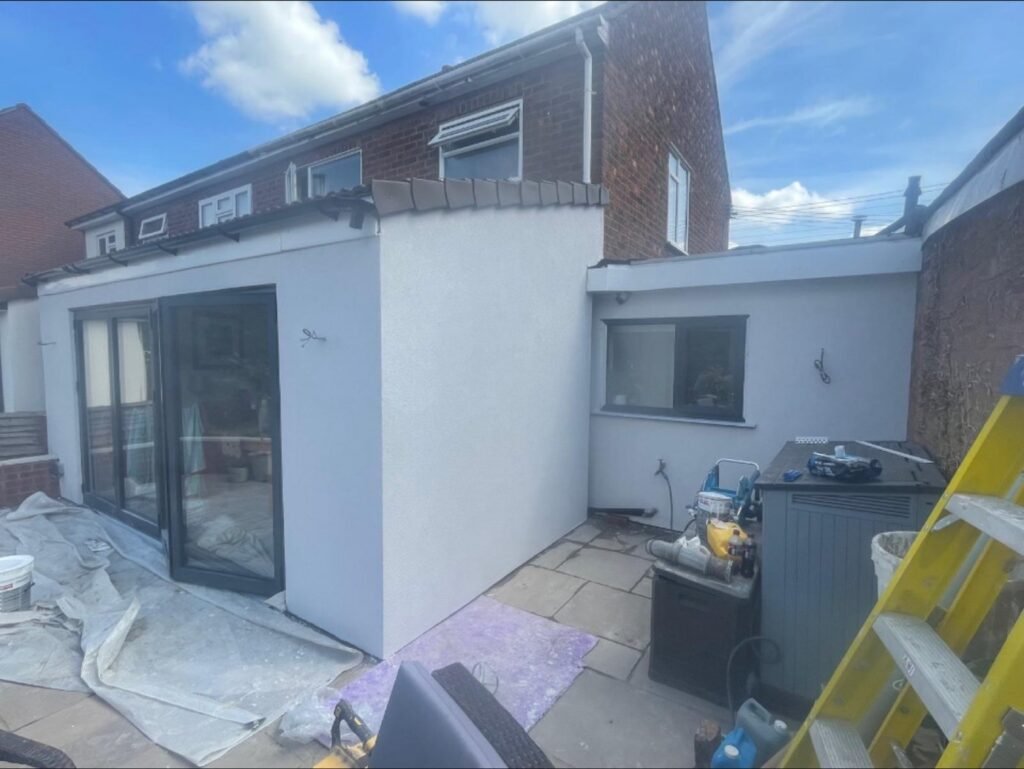
Lime render on older buildings
Some of Birmingham’s oldest houses, and many listed and conservation area buildings, were built to breathe, with soft brick and lime mortar. On those, a lime render is often the right answer, because it lets moisture move out of the wall and is soft enough not to damage the masonry. If a job needs a specialist heritage contractor, we’ll say so.
Free, no-obligation quote in Birmingham: Call 07453 614095 or WhatsApp me on 07453 614095 or message the page. A few photos of each wall help.
K-Rend in Birmingham: where we fit it across the city
K-Rend monocouche and silicone render is what most Birmingham homeowners ask us about, and it suits a large share of the city’s houses, as long as the wall underneath is right for it. RCR Connections Ltd is Birmingham based, covering the whole of the Midlands, from our office in the Jewellery Quarter, so a visit to look at your walls anywhere in the city is easy to arrange. These are the areas we work in most, the houses you find there and the K-Rend jobs they usually need.
- Kingstanding, Perry Common, Erdington and Castle Vale. Interwar council semis and short terraces, many under old grey pebbledash, plus post-war homes on Castle Vale. Covering or replacing failed pebbledash with K-Rend monocouche is the classic job here. Further north, our page on rendering in Sutton Coldfield covers Walmley, Boldmere and Four Oaks.
- Hall Green, Acocks Green, Yardley and Sheldon. 1930s semis with a rendered or pebbledashed upper storey above brick, and plenty of side and rear extensions. A full front in K-Rend, or K-Rend on the top half with the brick kept below, are both common.
- Moseley, Kings Heath, Stirchley and Selly Oak. Victorian and Edwardian terraces with solid walls. The fronts usually stay as brick, while rear outriggers and back walls get a breathable silicone system or lime, chosen after we have checked the wall.
- Harborne, Edgbaston and Handsworth Wood. Larger villas and older detached houses, some in conservation areas. Here the work is often careful render repairs and silicone finishes on side and rear walls, with planning checked first.
- Northfield, Kings Norton, Longbridge and Rubery. 1930s to 1960s semis and newer homes around Longbridge that were rendered from new. We re-coat faded render, repair cracks and finish extensions in K-Rend. Over the city edge, see our page on rendering in Bromsgrove.
- Bartley Green, Druids Heath and Quinton. Post-war estates, some with non-traditional construction. We find out how the house was built before choosing between K-Rend monocouche and silicone.
- The Jewellery Quarter and the city centre. Townhouses and apartment blocks that already have monocouche or silicone render. Repairs here are about matching the existing system, with the freeholder’s approval.
Wherever you are in the city, the first step is the same: Call 07453 614095 or WhatsApp me on 07453 614095 or message the page with a photo of each side of the house and your road or postcode. Between us we have 62 years of combined experience, and we work Monday to Friday 7am to 5pm and Saturday 7am to 1pm.
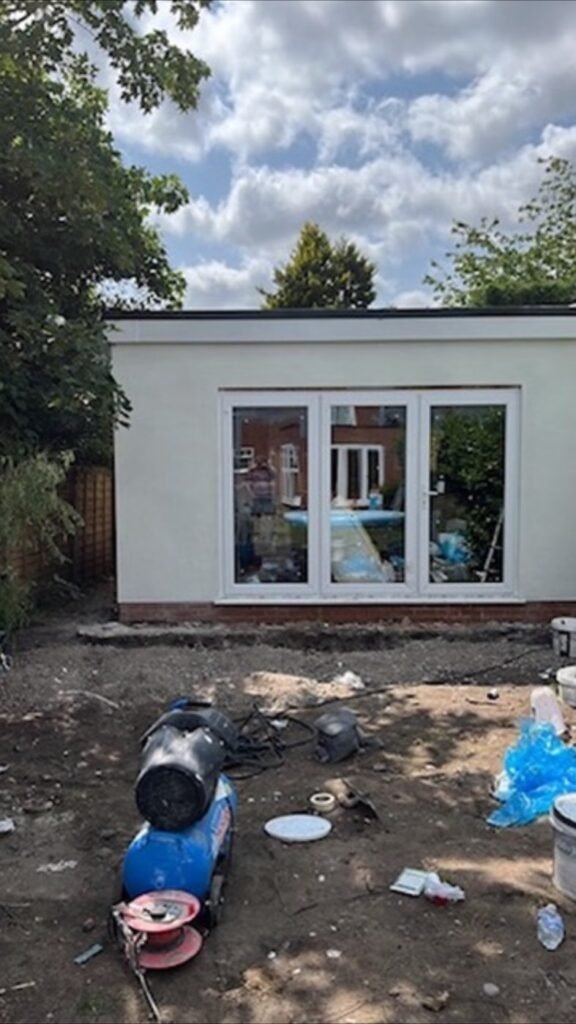
Birmingham houses and how they take render
Victorian and Edwardian terraces
Balsall Heath, Sparkbrook, Small Heath, Bordesley Green, Handsworth, Aston, Lozells, Selly Oak, Stirchley, Kings Heath and Moseley all have long streets of terraces from the late 19th and early 20th century. Most fronts are bare brick, often with decorative bands, and are better left that way, especially in conservation areas. The backs, though, are frequently rendered, and rear wings and outriggers are some of our most common Birmingham jobs. These walls are usually solid, nine inches thick, built in soft brick with lime mortar, so the choice of render matters. A breathable system, sometimes lime, protects the wall without trapping damp.
Access is often the biggest practical challenge: narrow entries, shared passages and small yards. We plan scaffold and material storage around that from the start.
Larger villas
Edgbaston, Moseley, parts of Harborne and Handsworth Wood have big Victorian and Edwardian villas, many in conservation areas. Some were rendered from new, with stucco detailing, mouldings and quoins. Repairs on these need to respect the original finish, and changes to the look almost always need planning permission.
Interwar estates
Kingstanding, Perry Common, Weoley Castle, Fox Hollies, Acocks Green and much of Hall Green were built between the wars, by the council and private builders. Many of these semis and short terraces were pebbledashed or rendered from new. Typical work is replacing pebbledash that has cracked and come away, re-rendering a whole elevation, and rendering an extension to match. Cavity walls are common on the later ones, solid walls on some of the earlier ones, so we check.
Suburban semis and detached houses in the outer city
Further out, in Hall Green, Yardley Wood, Billesley, Kings Norton, Northfield, Erdington, Sutton Coldfield, Walmley and Sheldon, there are miles of 1930s to 1960s semis and detached houses, many with a rendered or pebbledashed upper storey above brick. They’re usually cavity-walled and relatively straightforward to re-render. Typical decisions are whether to render the whole front or keep the brick lower half, what colour to choose next to neighbours who’ve kept the original finish, and whether to tidy up a garage or side extension at the same time.
Post-war and system-built homes
Castle Vale, parts of Druids Heath, Bartley Green and many other estates contain houses and maisonettes from the 1950s to the 1970s, some of them built with concrete panels, steel frames or other non-traditional methods. Rendering or insulating these needs care. The right system depends on exactly how the house was built, and some types have known structural issues that must be assessed first. If yours is one of these, tell us what you know about it.
New homes and city apartments
Newer houses across the city and apartments in the centre and the Jewellery Quarter are often already rendered, usually with silicone or monocouche. Repairs here are about matching an existing system, which is easier if you know the original product. Flats and apartment blocks normally need the freeholder’s or managing agent’s approval for any work on the outside.
Commercial and mixed-use buildings
Shops with flats above along the high streets of Erdington, Kings Heath, Harborne and Northfield often have rendered upper floors or rears. We take on small commercial rendering where it suits our team.
Across the wider Midlands
RCR Connections Ltd is Birmingham based, covering the whole of the Midlands, and we see the same mix of homes well beyond the city. The Black Country, from Dudley to Wolverhampton and West Bromwich, has rows of Victorian terraces with rendered backs, and many interwar semis under old pebbledash. Coventry has lots of post-war homes with rendered panels. Solihull and Sutton Coldfield have 1930s semis and larger detached houses, where K-Rend monocouche and silicone are popular for a fresh, clean front. Warwickshire towns such as Warwick, Leamington Spa and Kenilworth have older town houses that often need a softer, breathable render, while newer estates round Tamworth and Lichfield are mostly block with render from new.

Render and damp in older Birmingham houses
Damp is the question we’re asked about most on the city’s older housing, and render sits right in the middle of it.
A solid nine-inch brick wall built before the First World War has no cavity and no membrane to stop water. It manages moisture by absorbing rain on the outside and letting it evaporate away again in dry weather, with lime mortar acting as a soft, porous path. Problems start when that balance is upset. A hard cement render applied in the 1970s, a layer of plastic paint, or ground levels raised by a new patio can all hold water in the wall. Inside, that shows up as damp patches at skirting level, salts on the plaster and musty-smelling rooms.
So on these houses, we look at render as part of the whole wall:
- Is the existing render trapping moisture? If old cement render is cracked, it lets water in through the cracks but stops it drying out. Taking it off can be the first step to a drier house.
- What should replace it? A breathable system, either lime or a vapour-permeable silicone over a suitable base, lets the wall dry outwards while keeping driving rain out.
- Where does it stop? Render should finish above the damp-proof course with a bellcast bead, so it doesn’t draw ground moisture up into the wall.
- Are other faults involved? Leaking gutters, defective chimneys and blocked air bricks often play a bigger part than the render itself. We’ll point them out if we see them.
We aren’t damp surveyors, and if the problem looks structural or the cause isn’t clear, we’ll recommend you get independent advice. What we can do is make sure the render helps rather than hinders.
Outriggers, extensions and garden walls
Some of our most frequent Birmingham jobs are the smaller ones at the back of the house.
Outriggers and rear wings. The narrow two-storey back extensions on Victorian and Edwardian terraces were often rendered decades ago, and that render is now cracked or hollow. Access is through a narrow entry or a shared passage, and scaffold needs to fit in a small yard, sometimes over a neighbour’s wall. We plan it carefully, agree access with you and your neighbours, and keep materials tidy in a small space.
New extensions. Single and two-storey extensions built in block are ideal backgrounds for silicone or monocouche. If the main house is brick, a rendered extension can make a deliberate contrast. If the main house is rendered, we can match it, or re-coat everything so it all reads as one.
Garden and boundary walls. A rendered block wall, properly capped so rain is thrown clear, looks clean and lasts well. Walls between properties are often shared, so check with your neighbour before work starts.
Chimney stacks and parapets. These catch the worst of the weather. Cracked render high up on a stack lets water straight down into the house. Repairing it needs proper access, which we’ll arrange.
Render faults we come across in the city
Bay fronts coming away
The curved and angled bays of interwar semis are hard to render well, and the mouldings around them often trap water. Cracking along the top of the bay or around the window frames is common. Repairs need careful beading and drip details so the problem doesn’t return.
Patchwork elevations
After decades of new windows, boiler flues, satellite dishes and moved soil pipes, many rear walls are a mixture of old render, new patches and bare brick. Re-coating the whole elevation in one system usually gives a far better and longer-lasting result than more patches.
Render too close to the ground
On many Birmingham terraces, yard surfaces have been raised over the years until they sit above the damp-proof course. Render taken down to meet them stays wet, frosts and crumbles. The fix is to lower the ground where possible and cut the render back to a proper bead.
Staining from traffic and trees
Walls on main roads such as the Stratford Road, Bristol Road or Soho Road pick up a grey film from traffic, while tree-lined roads in Edgbaston, Moseley and Selly Park turn green. Silicone finishes resist both better than porous paint.
Efflorescence (white salts)
White, powdery marks on new or old render are usually efflorescence. Water soaks into the wall, picks up salts, and leaves them on the face as it dries out. It looks bad but does not harm the render. The fix is simple: stop the water getting in, let the wall dry out, then brush the salts off with a dry, stiff brush. Do not wash them off, as that only puts more water back in. Our guide to efflorescence on render goes into more detail.
Cracks
Fine hairline cracks can come from render drying too fast in sun or wind. Wider cracks often follow a joint between materials, run from the corner of a window, or show the wall itself is moving. We find out why first. Then we cut out the crack, add mesh where it is needed and patch it in the same render, or re-coat the wall if the cracks are all over. A hollow sound when you tap near a crack means the render has let go and needs to come off.
Patchy colour
Through-coloured render can look patchy if walls were scraped at different stages, if rain hit it before it set, or if one part dried much faster than the rest. It can also show where a repair was done years later. On new work we stop it by scraping every wall at the same stage and keeping fresh render out of the rain. On old patchy render, a silicone finish or a coat of the right paint across the whole wall gives one even colour.

Colours, textures and how they look in the city
Birmingham’s air is cleaner than it was, but walls next to busy roads still collect traffic grime, and walls under trees still turn green. Both are worth thinking about when you choose a finish.
- Light, warm neutrals such as off-white, ivory and soft stone hide dirt better than brilliant white and sit comfortably next to red brick.
- Pale and mid greys are popular on extensions and modern homes. They’re forgiving of dust.
- Charcoal and dark grey look smart on modern extensions but take more heat from the sun and can show fading over time on south and west faces.
- Texture: a fine scraped monocouche, a fine or medium grain silicone, or a smooth or textured sand and cement that’s then painted. Coarser grains hide minor unevenness better on older walls.
- Beads and trims can be colour-matched or contrasting, and bands, plinths and window surrounds can pick out details.
On a terrace or in a road with a strong shared character, your choice affects the street, and if planning permission is needed, the council will look at how it fits in. Ask us for larger samples before you commit, because a small card in your hand never looks quite like a whole wall in daylight.
Finishes we offer
- Scraped finish. The usual K-Rend monocouche look: an even, slightly open face, with the colour all the way through, so it never needs painting.
- Fine grain silicone. A thin, tight finish with small grains, about 1 to 1.5 mm. It looks crisp on modern homes and keeps cleaner for longer.
- Textured silicone. A slightly bigger grain that hides small dips and bumps on older walls.
- Smooth or float finish sand and cement. The classic look, painted with a breathable masonry paint once dry.
- Two-tone. One colour on the walls and another on bands, plinths or round windows, to pick out details.
On most homes we suggest one colour across the whole house, so walls done on different days still match. Ask for a larger sample to hold up on your own wall in daylight.
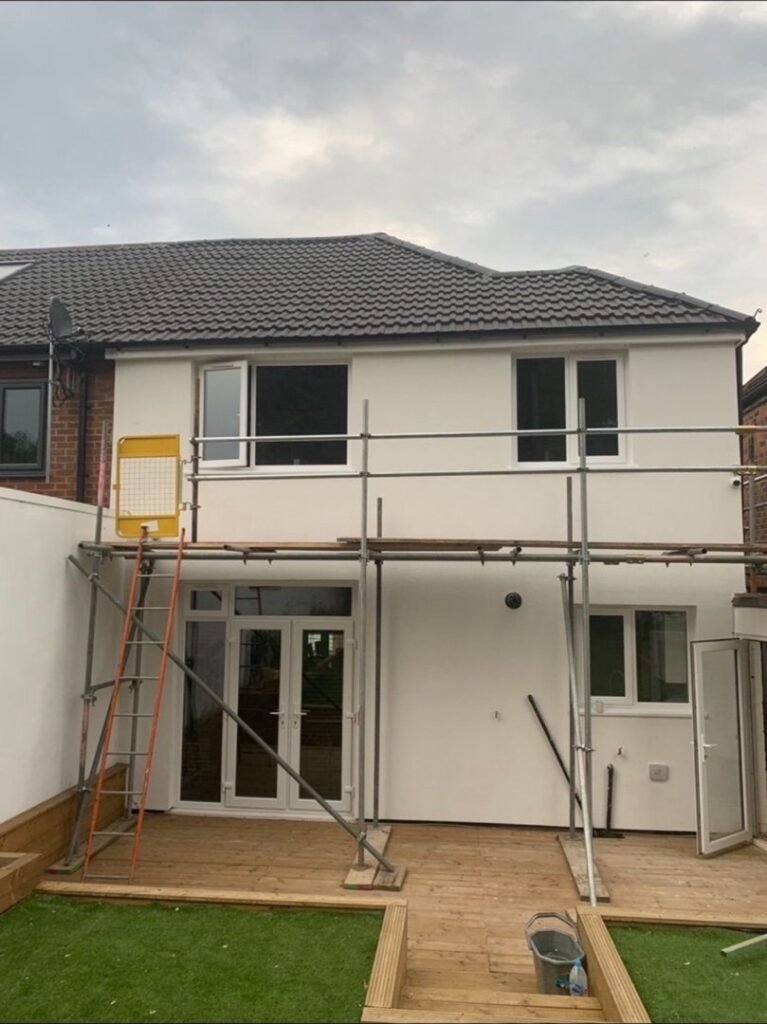
Preparation, stage by stage
Good render is mostly good preparation. On a Birmingham house, this is what we look at and do before the finish coat.
- Find out what the wall is. Solid brick, cavity brick, block, concrete panel, previously rendered, painted or pebbledashed. The answer decides the system.
- Tap the whole surface. Hollow areas show up as a dull, drummy sound. They come off, however sound the surface looks.
- Deal with water first. Repair gutters, downpipes, flashings and sills, and check the damp-proof course isn’t bridged by render, ground levels or paving.
- Repair the masonry. Rebuild loose brick, fill cracks and replace any failed lintels before any render goes on.
- Clean the surface. Remove dust, loose paint, salts and organic growth.
- Treat the background. Prime, apply a bonding or levelling coat, or dampen the wall, depending on the system and the masonry.
- Fit beads. Corners, edges, stops at the neighbour’s side and a bellcast bead at the base, all fixed straight and true. They define the lines of the finished job.
- Protect the rest. Sheet windows, doors, conservatories, paths and drives, and next door’s property.
Step by step: how we render a house
This is the order we follow on a typical K-Rend monocouche job. Silicone and sand and cement jobs follow the same steps up to the render coats.
- Protect. We sheet windows, doors, paths, drives and plants, and mask anything that is not being rendered.
- Strip and repair. Loose or hollow render comes off. Cracks in the brick or block are filled, and any loose brick is rebuilt.
- Fit the beads. Bellcast bead at the base, above the damp-proof course, then corner beads and stop beads, all set straight.
- Mesh the weak spots. Mesh goes over joins between materials, over lintels and at the corners of openings.
- Prepare the wall. Walls that soak up water fast are damped down or primed, so the render does not dry out too fast.
- Put the render on. K-Rend goes on in two passes, wet on wet, to about 18 mm in total, then is ruled flat with a straight edge.
- Wait for the right stage. The render is left to firm up. Each wall is tested with a thumb until it is ready to scrape, often about 3 to 16 hours, depending on the weather.
- Scrape it back. We scrape off 2 to 3 mm with a scraper, leaving at least 15 mm of render on the wall. This takes off the skin and gives the even, open finish.
- Brush and clean. Loose bits are brushed off, beads are cleaned, and masking comes off.
- Protect while it cures. Fresh render is kept safe from frost, heavy rain and hot sun for at least 48 hours.
- Clear up. Waste is bagged and taken away, and we walk round the job with you.
On a silicone job, the base coat goes on with mesh bedded in, and once that has dried, a primer and then the thin silicone finish go on. On sand and cement, a scratch coat goes on first, then a top coat, and the wall is painted once it has fully dried.
Weather, seasons and timing
Render is a wet trade that relies on curing, so the weather decides the programme. Most products have a minimum application temperature, usually around 5°C, and need protection from frost, heavy rain and fierce sun while they cure. Get it wrong and you can see cracks, powdery surfaces, colour patches or render that simply fails to bond.
In practice, late spring to early autumn is the most reliable rendering window in Birmingham. We do work outside that period when conditions and products allow, often on sheltered rear walls or with scaffold sheeting, but we won’t apply render when frost is forecast. In midsummer, we keep fresh render out of direct sun where we can and work around the hottest part of the day. On a big job, we plan which elevation to do on which day to make the most of the conditions, and if the weather turns, we’ll move the date rather than compromise the finish.
If you’d like work done in the warmer months, it pays to arrange quotes, any planning and the scaffold early in the year. Our guide to rendering in winter has more.
Our weather rules
These are the rules we stick to on every rendering job:
- 5°C and rising. We only render when it is at least 5°C and getting warmer, not falling, and there is no frost due while the render sets.
- Protect for 48 hours. Fresh render is kept safe from frost, heavy rain and strong sun for at least 48 hours, with scaffold sheets if needed.
- About 18 mm on, scraped 2 to 3 mm. K-Rend goes on at about 18 mm and is scraped back by 2 to 3 mm within about 3 to 16 hours, leaving at least 15 mm on the wall.
- Every wall scraped at the same stage. If one wall is scraped early and the next one late, the colour and texture will not match. We test each wall and scrape them all at the same stage.
- Never bridge the damp-proof course. Render always stops at a bead above the damp-proof course, and never runs down to the ground or onto paving.
- Each coat no stronger than the one below. A hard coat on a soft wall, or on a soft first coat, pulls away and cracks. Each coat should be the same strength as the one under it, or weaker.
- No rain on the way. We do not start a wall if heavy rain is due before the render has firmed up, and we do not render a wall that is soaked or frozen.
Our guide to rendering in wet weather explains what rain does to fresh render, and our render and damp-proof course guide shows where render should stop.
Planning and building regulations for render in Birmingham
Birmingham City Council is the planning authority for the whole city, including Sutton Coldfield. Royal Sutton Coldfield Town Council comments on applications in its area but doesn’t decide them. Please treat this section as a general guide and check the council’s pages for your own address.
When re-rendering is permitted development
Houses have permitted development rights that flats and maisonettes don’t. Under those rights, new materials on the outside of a house should be similar in appearance to the existing ones. Replacing render with similar render is normally fine without an application. Rendering bare brick for the first time, swapping pebbledash for a smooth finish or changing the colour significantly can need permission. A Lawful Development Certificate from the council gives you formal confirmation if you want it.
Conservation areas and Article 4 Directions
In a conservation area, cladding any part of the outside of a house with render isn’t permitted development, so you’ll need planning permission. On top of that, an Article 4 Direction can remove further permitted development rights, which can bring things like painting, new windows and doors within planning control.
Birmingham City Council lists 29 conservation areas. Grouped roughly by part of the city, with the Article 4 Directions the council notes against them, they are:
- Sutton Coldfield: Anchorage Road; Four Oaks; High Street (Article 4(2)).
- Edgbaston: Edgbaston (Article 4(2)); Barnsley Road; Lee Crescent; Ryland Road; St Augustines.
- Harborne: Harborne Old Village; Greenfield Road (Article 4(2)); Moor Pool (Article 4(2)).
- South Birmingham: Moseley (Article 4(2)); St Agnes, Moseley (Article 4(2)); Selly Park (Article 4(2)); Selly Park Avenues (Article 4(2)); Bournville Village (Article 4(2)); Bournville Tenants; Kings Norton; Northfield Old Village; Austin Village (Article 4(2)); School Road, Hall Green.
- City centre and inner city: Colmore Row and Environs; Jewellery Quarter; Steelhouse; Digbeth, Deritend and Bordesley High Streets; Warwick Bar; Aston Hall and Church; Lozells and Soho Hill.
- East Birmingham: Old Yardley (Article 4(1)).
The council publishes maps and appraisals for each one. Listed buildings, which are scattered right across the city, need listed building consent for works affecting their character, including most rendering.
Bournville
Bournville has an extra layer. The Bournville Village Trust runs a Scheme of Management over its estate, so a rendering project there can need the Trust’s agreement as well as the council’s. See our Bournville page for the details.
Building regulations
Building control looks at render from an energy point of view. Approved Document L counts two things as work on a thermal element: putting a new render on the outside of a wall, and taking a wall back to bare masonry before building it up again. Once that covers over 50% of a single wall, or over 25% of the house’s total envelope, the regulations expect that wall’s insulation to be improved too, unless doing so isn’t technically, functionally or economically feasible. On an old solid-walled terrace, that question is worth asking before the scaffold goes up. Insulated render needs building regulations approval every time. Either Birmingham City Council’s own building control team or a registered building control approver can handle it.
Scaffold on the pavement
On many terraced streets, scaffold has to stand on the footway. That needs a licence from the council as highway authority, which the scaffolding firm usually applies for. Build that into the timescale.
Landlords, letting agents and rental property
A large share of Birmingham’s housing is privately rented, and render is often low on the list until something goes wrong. Water coming through a cracked rear wall, a damp patch reported by a tenant, or render falling onto a shared path all need dealing with quickly.
We can survey and quote from photos and a visit arranged with your agent, work while tenants are living there, and give you clear notes on what was found and what was done. Where the house is let to several tenants, we’ll agree access, parking and where materials are stored, so the job causes as little disruption as possible. If the problem is a symptom of something bigger, such as a failed gutter or a leaking flat roof, we’ll tell you, so it can be fixed in the same visit.
A rendering job from start to finish
- Send photos. WhatsApp pictures of each side of the property to 07453 614095, with your postcode and what you’re hoping for.
- Site visit. We’ll come and look, tap-test the walls, check the details and talk through the systems that would suit.
- Written quote. You’ll get the system, preparation, beads, scaffold and exclusions in writing.
- Approvals. Planning, building control, Bournville Village Trust consent or freeholder approval are sorted before dates are fixed.
- Scaffold and protection. Scaffold goes up, and everything that isn’t being rendered is masked.
- Strip and repair. Old render comes off where needed, and the wall is repaired, cleaned and primed.
- Render. Beads, base coat and mesh, then the finish, each in suitable weather and with the right curing time.
- Handover. Masking off, fittings back, site cleared and a walk-round with you before the scaffold comes down.
Aftercare for city render
- Keep gutters and downpipes clear. In leafy roads, that might mean twice a year.
- Fix leaks and overflows quickly. A dripping overflow pipe will stain and saturate render in one spot.
- Keep soil, paving and bin stores off the bottom of the render.
- Clean traffic dirt or algae gently with a soft brush and a cleaner suited to the render. Avoid close-range pressure washing.
- Seal any new fixings for lights, cameras, cables and brackets.
- Repaint painted render with a breathable masonry paint before the old coat fails.
- Get cracks checked before winter, while they’re still small.
How to choose a rendering contractor in Birmingham
- Ask what system they’ll use and why. A good answer refers to your wall, not just the product they always use.
- Ask about the wall underneath. On an old terrace, a contractor should talk about breathability and damp.
- Check the quote covers preparation. Removal, repairs, beads and priming should be spelled out.
- Ask about scaffold and licences. Who arranges it, and where will it stand?
- Ask how weather is handled. They should mention temperature limits and frost.
- Check insurance. Public liability insurance should be in place.
- Look at finished work. Ours is on our projects page.
- Expect planning to come up. If you’re in one of the 29 conservation areas or changing the look of the house, a good contractor will tell you to check.
What shapes your rendering quote in Birmingham
Each job is different, so every quote is too. These are the factors we look at:
- Size and number of elevations.
- What’s on the wall now, and how much has to come off and be disposed of.
- The condition of the masonry behind it.
- The system chosen, from sand and cement to silicone, monocouche, lime or insulated render.
- Scaffold, including pavement licences, tight entries, conservatories and height.
- Detail work around bays, windows, doors, sills and corners.
- Moving fittings, particularly for insulated render.
- Approvals, including any drawings or product information needed.
Our guide to rendering quotes in Birmingham explains more.
Call 07453 614095 or WhatsApp me on 07453 614095 or message the page with photos of each side of the property, and we’ll set everything out in a free written quote.
Where we render in and around Birmingham
We work across the city. These pages cover specific areas in more detail:
- North: Sutton Coldfield, Four Oaks, Mere Green, Walmley and Erdington
- South: Moseley, Kings Heath, Bournville, Selly Oak and Northfield
- West: Edgbaston and Harborne, with Smethwick, Oldbury and Halesowen beyond the city boundary
- East: Hall Green, Acocks Green, Yardley, Sheldon and Hay Mills
- Neighbouring boroughs: rendering in Solihull, Water Orton and Walsall
For inside work, see our plasterer in Birmingham page.
Further out, we render homes right across the Midlands. See every town on our rendering areas page.
Rendering advice for Birmingham homeowners
Rendering the back of a terrace and leaving the front as brick
Yes, and it’s one of our most common jobs. Rendering rear walls and outriggers is normally permitted development if similar materials are already there, but check first in a conservation area or if the back is visible from a road.
Cracked pebbledash: repair or replace
If the cracks are few and the rest is firmly bonded, repair or rendering over it may be fine. If large areas sound hollow, it’s better to remove it and start again. We’ll tap-test the whole wall and explain.
Maisonettes and flats
Yes, where the freeholder or management company has approved the work. Flats don’t have permitted development rights for changes to the outside, so planning may also be needed.
Render and warmth
Ordinary render adds very little insulation. Insulated render does, because it adds a layer of insulation boards. If warmth is the main aim, that’s the system to discuss.
The party wall line with your neighbour
We finish at a neat stop bead on the boundary. If scaffold needs to go on their side, we’ll need their agreement first. For some work near the boundary, the Party Wall etc. Act may apply.
Render and damp patches
Render won’t cure damp on its own. We find and fix the cause first, then choose a system that lets the wall dry out.
How long a rendering job takes
It depends on the size, how much has to come off, the system and the weather. We’ll give you a realistic estimate in the quote and keep you updated if the forecast changes things.
Matching a new extension to existing render
Usually. Painted render is easy to match by repainting both. Through-coloured render that has weathered is harder, so we might suggest a deliberate contrast or re-coating the whole house.
Old cement render on Victorian houses
Often, if it’s cracked, hollow or trapping damp. Removing it lets the wall dry, and a breathable render can then protect it. If the old render is sound and the wall is dry, it may be better left alone. We’ll give you an honest view after a survey.
Chimney stacks
Yes, with proper access such as scaffold. We’ll also check the flashings and the top of the stack, since water getting in there is often the real cause of damp below.
Telling your neighbours before the scaffold goes up
It’s always a good idea. On terraced streets, scaffold often stands in front of or beside next door, materials are carried past their windows, and there may be some noise and dust when old render comes off. A friendly word in advance, with an idea of dates, saves a lot of trouble. If the scaffold or any work has to be on their land, you need their permission.
If we find a problem once the old render is off
It happens on older houses: a cracked lintel, loose brickwork or an old opening filled with rubble. We’ll stop, show you, and explain what’s needed before we carry on, so nothing is added without your agreement.
When K-Rend is scraped back
It depends on the weather. K-Rend goes on at about 18 mm and is scraped back 2 to 3 mm within about 3 to 16 hours, leaving at least 15 mm. We test each wall and scrape them all at the same stage.
Why render can look patchy
Through-coloured render can look patchy if walls were scraped at different stages, if rain hit it before it set, or if repairs were done later. A silicone finish or the right paint across the whole wall can even it out.
Why render stops above the damp-proof course
If render runs down past the damp-proof course, it can carry ground water up into the wall. We stop it at a bellcast bead above the damp-proof course, so it never bridges it.
Beads and mesh on every job
Yes, on every job. Beads give straight edges and a drip at the base, and mesh in the base coat helps stop cracks at joins, lintels and the corners of windows and doors.
More services: Rendering with sand and cement · Rendering new extensions.
Rendering guides
These guides answer the questions we get asked most. They are short and plain, and you can read them before we visit.
- Rendering in wet weather: what rain does to fresh render and how we plan round it.
- Spring render check: what to look for on your render after winter.
- Render and the damp-proof course: why render must stop above it.
- Efflorescence on render: white salts, what causes them and how to get rid of them.
- K-Rend monocouche and silicone in Birmingham and Solihull: how it works and where it suits.
- Render beads and stop ends: corners, edges and drips explained.
- Cleaning silicone render: how to clean silicone render and K-Rend safely.
- SBR, PVA and primers: what goes on the wall before render.
For more, see all our plastering and rendering guides.
Get a free rendering quote in Birmingham
Call 07453 614095 or WhatsApp me on 07453 614095 or message the page, with photos of each side of the house. We’ll arrange a free, no-obligation survey and quote. We work Monday to Friday 7am to 5pm and Saturday 7am to 1pm, and our office is Studio 9, 50-54 St Paul’s Square, Birmingham B3 1QS.
Rendering in Birmingham: common questions
Do you cover Birmingham and the surrounding area?
Yes. RCR Connections Ltd is Birmingham based, covering the whole of the Midlands, and works across Birmingham and the surrounding area. We also cover plastering in Birmingham, Sutton Coldfield and Four Oaks. For the full list, see areas we cover.
How do I get a rendering quote in Birmingham?
WhatsApp photos of each side of the house to 07453 614095 and tell us what finish you have in mind. We will come back with a free, no-obligation quote, or arrange a visit to look at the walls first.
Which render is right for my house?
It depends on the wall, the house and the look you want. We work with sand and cement, silicone, through-coloured monocouche (such as K-Rend monocouche) and insulated render, and we will recommend one after seeing the wall. Our guide K-Rend monocouche vs silicone vs sand and cement render explains the differences.
Do you do K-Rend in Birmingham?
Yes. K-Rend monocouche and silicone render is our main rendering system, and we fit it on houses, extensions, garage conversions and garden walls all over Birmingham, from Kingstanding and Erdington to Hall Green, Northfield and Harborne. Call 07453 614095 or WhatsApp me on 07453 614095 or message the page with photos for a free quote.
Can you render over pebbledash?
Often, yes. If the pebbledash is firm, we take off any hollow parts, put on a base coat with mesh to give a flat face, then the finish coat. If most of it is hollow, it is better to strip it off and start again.
Can you render in winter?
Yes, on the right days. We only render when it is at least 5°C and rising, with no frost due, and we protect fresh render for at least 48 hours.
What are the white marks on my render?
That is usually efflorescence, salts left on the face as water dries out of the wall. Stop the water getting in, let the wall dry, then brush the salts off with a dry brush.
Does K-Rend monocouche and silicone render need painting?
No. K-Rend monocouche has the colour all the way through, and silicone finishes come tinted, so neither needs paint. Sand and cement render is painted once it has dried.
What hours do you work?
Monday to Friday 7am to 5pm and Saturday 7am to 1pm.
Popular areas we cover
Plastering: Plasterer in Solihull, Plasterer in Birmingham, Plasterer in Sutton Coldfield, Plasterer in Shirley, Plasterer in Coventry, Plasterer in Tamworth, Plasterer in Wolverhampton.
Rendering: Rendering in Solihull, Rendering in Tamworth, Rendering in Redditch, Rendering in Bromsgrove, Rendering in Walsall. See every town on our areas we cover page.
More rendering towns
We also render homes in Aldridge, Cannock, Codsall, Droitwich Spa, Hagley, Hednesford, Hollywood, Kidderminster, Kingswinford, Little Aston, Nuneaton, Polesworth, Rugby, Sedgley, Shirley, Stourbridge, Stratford-upon-Avon, Streetly, Wednesbury, West Bromwich, Wombourne, Worcester, Heath Hayes.
See every rendering town on our rendering areas page, or every plastering town on our plastering areas page.