
Nuneaton is the biggest town in Warwickshire, and it was built on coal, clay and cloth. Walk from the town centre out along the Coton Road, the Queens Road or the Leicester Road and you pass every kind of house: Victorian terraces in Abbey Green and Attleborough, bay-fronted semis in Weddington and Manor Court, big post-war estates at Camp Hill, and the private estates of the 1960s and 1970s at St Nicolas Park and Whitestone. Plenty of those homes have render or pebbledash, and plenty of it is now cracked, stained or blown.
RCR Connections Ltd renders, re-renders and repairs homes all over Nuneaton, and in Bedworth, Galley Common, Hartshill and Bulkington too. We’re Birmingham based, covering the whole of the Midlands, and the M6 and the A444 bring us to Nuneaton quickly. The team has 62 years of combined experience.
This page covers rendering only. If you need walls or ceilings done inside, see our page for a plasterer in Nuneaton.
Rendering quotes in Nuneaton: WhatsApp me on 07453 614095 or message the page. We work Monday to Friday 7am to 5pm and Saturday 7am to 1pm, and we’re closed on Sundays.
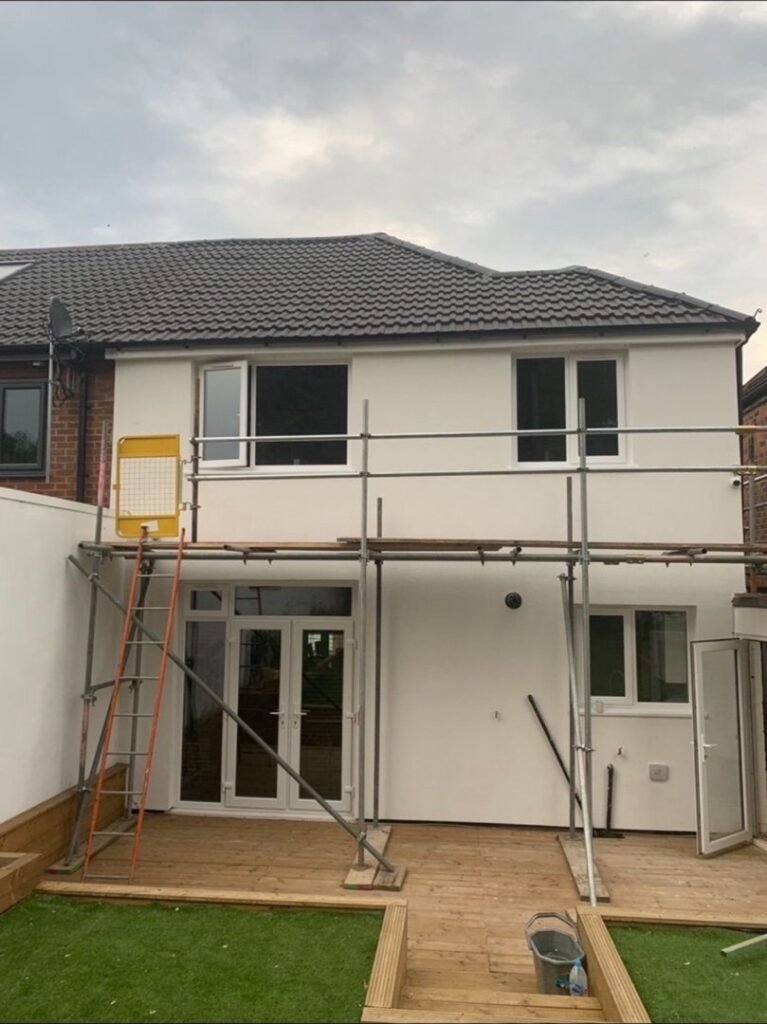
K-Rend monocouche and silicone render in Nuneaton
Nearly all the new render we put on in Nuneaton is one of two systems: K-Rend monocouche or silicone. Both come in a wide choice of colours. Both keep the rain out well. And both last a long time when the wall is prepared properly first.
K-Rend monocouche
Monocouche means “one coat”. It goes on thick, in a single pass or two passes close together, and the colour runs right through. When it has firmed up, we scrape the face back with a toothed tool to take off the skin. That leaves a fine, even texture. There is no paint on top, so nothing peels or fades, and a knock or scuff shows the same colour under it.
K-Rend monocouche works well on:
- Pebbledashed inter-war semis in Weddington, Attleborough and off the Hinckley Road.
- Block-built rear extensions, side builds and garage conversions.
- Gables on St Nicolas Park and Whitestone homes where old panels have failed.
- Rented homes, where the owner wants a finish that never needs painting.
Silicone render
Silicone render is a thin finish coat that goes over a base coat with mesh set in it. The silicone makes rain bead up and run off the face, while damp inside the wall can still escape as vapour. It also keeps cleaner than most finishes, so it suits homes on busy routes like the Leicester Road, the Hinckley Road, the Coton Road and the A444, or near the railway lines that cross the town.
Silicone render works well on:
- Homes on main roads, where traffic dirt builds up.
- Houses near Riversley Park, the Anker, the canal or under big trees, where green growth is common.
- Some older solid walls, where a breathable system is the safer choice.
- Sound old render that just looks tired.
Which is right for you?
Once we have seen the wall, we will tell you plainly. On a lot of Nuneaton semis either system would be a good choice, and it comes down to taste. On old solid walls, or post-war homes built in non-standard ways, the wall often decides. Our guide K-Rend monocouche vs silicone vs sand and cement render explains the main differences in plain words.
Nuneaton’s story, told in its houses
Abbey, market and weaving
Nuneaton takes its name from the nuns of the abbey founded here in the 1100s. Only parts of it are left, by the church on Manor Court Road. For centuries it was a small market town on the River Anker. In the 1700s and 1800s many families wove ribbons at home on hand looms, and later the town had mills for worsted and elastic web, while hat making grew up nearby in Atherstone.
Coal, clay and bricks
The town sits on the edge of the Warwickshire coalfield. Pits opened at Griff, Stockingford, Haunchwood, Exhall and Bedworth, with Galley Common and Chapel End growing up as mining villages on the hills to the west. The same ground had good clay, and big brick and tile works grew up at Stockingford and along the canal. Nuneaton bricks and tiles went all over the country. That is why so many older homes here are built of hard, red local brick.
Bermuda village, just south of the town, was built by the Newdigate family of Arbury Hall for their miners. Arbury itself is where George Eliot was born in 1819, at South Farm on the estate, and she grew up at Griff House nearby. Many of the places in her books are based on Nuneaton and Chilvers Coton.
Old mine workings
As in other coalfield towns, some ground round Nuneaton has settled over old workings. It shows as long cracks in render, stepped cracks in brickwork, or a wall slightly out of line. That does not mean a house is unsafe. It does mean we look at every crack before we cover it, and we use mesh and movement joints where they are needed.
War damage and rebuilding
In May 1941 a heavy air raid hit Nuneaton. Hundreds of homes were destroyed or damaged, and Chilvers Coton church was badly hit. It was later rebuilt, partly by German prisoners of war. After the war, the council built large new estates, with Camp Hill the biggest. More homes followed at Caldwell and on the edges of Stockingford. Some of these were built with concrete or steel instead of brick, and many were rendered from new.
Private estates from the 1960s on
From the 1960s, Nuneaton grew fast as people moved out from Coventry and Birmingham. St Nicolas Park, Whitestone, Weddington and parts of Attleborough filled with private estates. More came later at Horeston Grange, The Long Shoot, Camp Hill’s new streets, and the big sites off the Hinckley Road and Lutterworth Road.
The homes we render most in Nuneaton
Victorian and Edwardian terraces
Abbey Green, Chilvers Coton, Attleborough, Stockingford and the streets off the Coton Road, Edward Street and Queens Road have plenty of these. Most are red brick with solid walls, often with a narrow back outrigger for the kitchen and bathroom.
Common faults:
- Hard cement render on the back that has cracked and now holds water in the wall.
- Render down to the yard, bridging the damp course.
- Patches where pipes and windows were moved.
- Painted render, blistering on the wettest side.
On these walls, we often take the old cement render off and use a breathable system. Silicone over a breathable base is a strong choice. On some back walls, K-Rend monocouche works well once we know the wall is dry and sound. We always stop render above the damp course with a base bead.
1920s and 1930s semis
You find these along the Weddington Road, the Hinckley Road, the Leicester Road, the Lutterworth Road, in Manor Court and through parts of Attleborough and Whitestone. Most have early cavity walls and a front bay. Many have pebbledash or roughcast upstairs, or all over.
After 90 years, that pebbledash is often:
- Hollow in places, sounding dull when tapped.
- Cracked at the corners and round the bay.
- Stained below the sills.
- Patched in odd colours after old repairs.
Post-war council homes
Camp Hill, Caldwell and parts of Stockingford and Bedworth have a lot of post-war homes. Many are brick, but some are built of poured concrete, concrete panels or steel frames. Camp Hill in particular has seen lots of new building in recent years, with older homes alongside.
If you are not sure what your home is built from, send us photos and your postcode. Some of these house types have special rules for mortgages and repairs. We will tell you what we see, and if a specialist survey is needed first, we will say so before you spend anything.
On sound homes we usually:
- Tap every wall and mark hollow areas.
- Take loose render back to a firm base.
- Fix cracks and set mesh across joins and weak spots.
- Put on a base coat, then K-Rend monocouche or a silicone finish.
1960s and 1970s estates
St Nicolas Park, Whitestone and Weddington are full of homes from this time. Most have cavity walls with brick, but many have tile hanging, timber boards or render panels under the windows and on gables. Over the years, those panels rot, crack or look dated.
A popular job here is to take off old boards or tiles from the panels and replace them with K-Rend monocouche or silicone render. It makes a 1970s house look much more up to date, and it ends the cycle of painting and repairs.
Newer homes
Horeston Grange, The Long Shoot and the newer estates off the Hinckley Road and the Lutterworth Road often have render panels from new. Some crack, stain or go green within a few years, usually because there was no mesh where needed, no movement joints, or the render runs too close to the ground. We repair or redo panels so they blend in with the rest.
Bungalows
There are lots of bungalows round Whitestone, Weddington, Galley Common and Hartshill. Low walls mean towers rather than full scaffold in many cases. Dormer bungalows have tall gables, and those are where render most often fails.
Common render faults in Nuneaton
Cracks over old workings
Long cracks from window corners or stepped cracks in the brick joints can come from old mine workings or clay ground that shrinks in dry summers. We fill and mesh old, stable cracks. We don’t cover cracks that are still moving.
Clay ground and dry summers
Much of the town sits on clay. In a long dry summer, clay shrinks, especially near big trees, and the ground under a wall can drop a little. When it rains again, it swells. That movement shows first in render. Mesh in the base coat and movement joints in long walls help new render cope.
Hollow pebbledash
Tap the wall. A dull sound means the dash has come away. Water gets in behind, freezes, and pushes more off every winter.
Grime and green growth
Homes on main roads pick up dark streaks from traffic. Homes near Riversley Park, the Pingles, the Anker and the canal, or under trees, go green on the shady side. Silicone render resists both better than most finishes.
Render too close to the ground
Yards and drives get raised over the years, and render ends up running into the paving. That bridges the damp course and pulls water up. We cut it back and fit a base bead at the right height.
Paint failure
A lot of old render here has been painted again and again. Thick paint traps damp and peels. K-Rend monocouche or silicone render ends that for good.
Pebbledash: keep it, cover it or strip it?
This is one of the questions we get most in Nuneaton. Here is how we decide.
- Keep and patch if only small areas are loose, the rest is sound, and you like the look.
- Cover if the pebbledash is still stuck on well across most of the wall. We put on a base coat with mesh, then the finish. This saves the mess of stripping.
- Strip if large areas are hollow, there are lots of old patches, or we need to see the wall behind.
We tap every wall before we give advice. We never cover dash that is coming away, as the new render would come away with it.
Preparing the wall
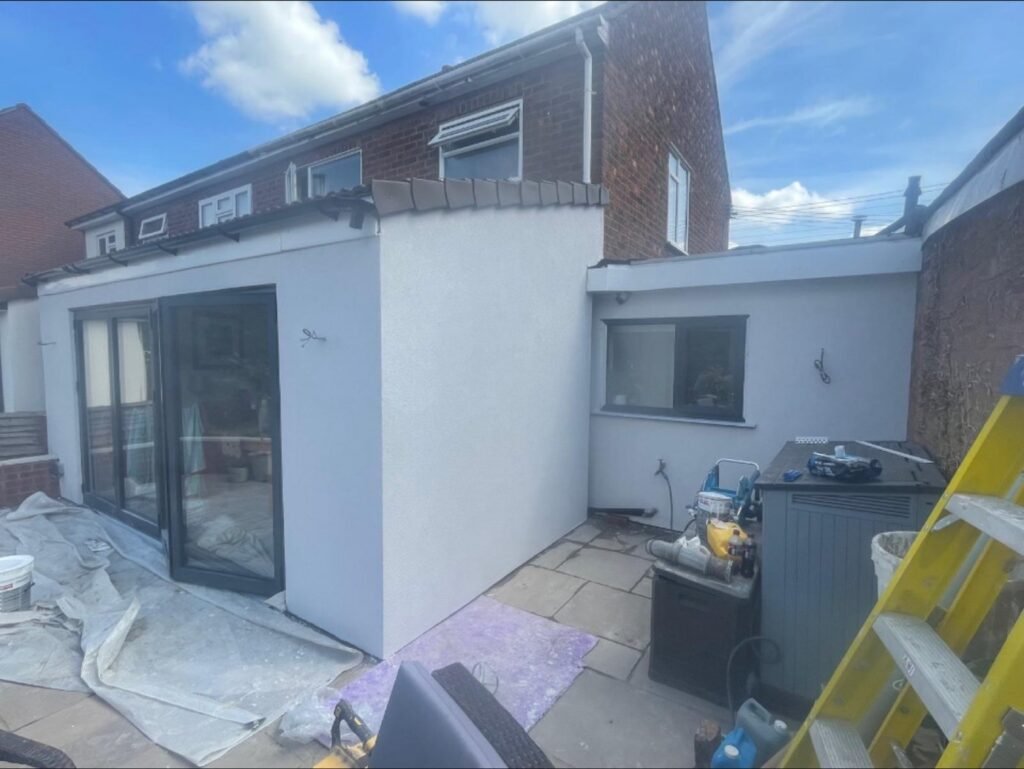
Good render is mostly about good preparation. On every Nuneaton job we:
- Put up scaffold or towers and cover paths, drives, plants and sills.
- Mask windows, doors, gutters and anything we don’t want render on.
- Take off old render, loose dash and paint where needed.
- Fix cracks, rake out and repoint bad joints, and treat any rusted steel.
- Fix beads at corners, edges, window reveals and the base.
- Set mesh where the wall needs it, such as over joins between brick and block.
- Put on the base coat, then the K-Rend monocouche or silicone finish.
Beads, mesh and movement joints
You don’t see these when the job is done, but they matter most.
- Base beads keep the render off the ground and give a clean line.
- Corner beads give strong, straight corners that don’t chip.
- Stop beads finish neatly at windows, doors and where render meets brick.
- Mesh in the base coat stops cracks, which matters on clay and old mining ground.
- Movement joints let long walls move without cracking.
Colours that suit Nuneaton homes
K-Rend and silicone render come in many colours. Most Nuneaton customers pick white, off-white, cream or soft grey. Some tips:
- On a semi, think about next door. A colour that works with theirs looks far better.
- Bright white shows dirt more on busy roads. Off-white hides it better.
- Mid and dark greys look sharp on 1970s homes and new extensions.
- On red-brick terraces, a warm off-white or cream often sits best with the brick.
- We can send colour charts and sample boards before you choose.
Extensions, garage conversions and garden rooms
Nuneaton has lots of rear extensions, side builds and garage conversions, many in block. Render is the neatest way to finish them. We can match the house or go for a contrast. We also render garden rooms, garden walls and outbuildings.
Landlords and rented homes
The town has a big rental market, from terraces near the town centre and the station to family homes on the estates. Landlords tend to want:
- A finish that lasts with little upkeep.
- Work done quickly between tenants, or with tenants in.
- Photos and a short note of what was done.
K-Rend monocouche is often best here, as it never needs painting.
Shops and flats above shops
In the town centre, on Abbey Street, Queens Road, Bond Gate and Church Street, and on local parades in Attleborough and Stockingford, many buildings have shops below and flats above. Upper floors are often rendered and often in poor shape. We can render them while the shop stays open, working from scaffold with a covered walkway where needed.
When we render in Nuneaton
Render needs dry, mild weather to cure well. We don’t apply it in frost, heavy rain, strong wind or hot sun on the wall. Spring, summer and early autumn are best. In winter we still do repairs and small jobs on mild, dry days, and we plan bigger jobs around the forecast.
Looking after your render
- Keep gutters and downpipes clear so water doesn’t run down the wall.
- Keep soil and paving below the base bead.
- Cut back plants so they don’t rub the wall or keep it wet.
- Fix small cracks early before water gets in.
- If it goes green, clean it gently with a soft brush and the right cleaner. Don’t use a hard jet wash close to the wall.
Questions to ask any renderer
- What system will you use and why?
- Will you take off the old render or go over it?
- Will you fit base beads above the damp course?
- Where will you use mesh?
- How will you deal with cracks from ground movement?
- Who will do the work, and how long have they been rendering?
- Can I see finished jobs?
We are glad to answer all of these before you decide.
How a Nuneaton rendering job runs
First contact
You WhatsApp me photos of each side of the house and your postcode. A short video walking round the house helps even more.
The visit
We come out, look at the walls, tap them for hollow areas, check any cracks, and talk through what you want.
The quote
You get a clear written quote setting out what we will do, which system we will use and how long it should take.
On site
Scaffold goes up, the house is protected, old render comes off where needed, and the new render goes on.
Finishing up
We take the scaffold down, clean up, and walk round with you so you can see every wall.
Damp inside a rendered house
Not every damp patch is the render’s fault, but it often plays a part. Signs to look for:
- Damp or flaking paint low on inside walls, just above the skirting.
- Damp that gets worse after heavy rain, not after cooking or showers.
- Cracked or hollow render on the outside of the same wall.
- Render running down to the path or into the soil.
If it is condensation, new render won’t fix it. If rain is getting in through cracks, or render is bridging the damp course, putting the render right usually helps a lot. We tell you what we think is going on before suggesting any work.
Nuneaton weather and your render
Nuneaton is a long way from the sea, so it gets less rain than towns to the west. But its winters are cold, with plenty of frost, and the high ground at Galley Common, Hartshill and Ansley catches the wind. Water that gets into a crack freezes, swells and pushes render off a bit more each year. Fixing cracks early, and using mesh in new render, stops the cycle.
Working safely around your home
We use proper scaffold or towers for every job that needs them, and keep the site tidy. On terraced streets with no front garden, we plan the scaffold so the pavement stays open where it can. We tell you each morning what is happening that day. If you have children or pets, we talk through how to keep them clear of the work. Tools and materials are put away at the end of each day.
What a good render job looks like
When the scaffold comes down, you should see:
- Straight, clean lines at every corner and edge.
- An even colour and texture on each wall.
- A neat gap at the base, above the damp course.
- Clean windows, sills, doors and paths.
- Tidy finishes round pipes, vents and fixings.
If anything is not right, tell us on the walk round and we will sort it.
Planning and conservation in Nuneaton
Re-rendering a house that is already rendered, in a similar finish, is usually fine without planning. Rendering a brick front for the first time can be different, and parts of the town centre and some older areas are conservation areas. Listed buildings need consent for most changes. If you are not sure, check with Nuneaton and Bedworth Borough Council before work starts. We can help with photos and product details.
Corner houses and end-terraces
End-terraces and corner houses have a long side wall that takes the worst of the weather. In Nuneaton that side wall is often rendered while the front is brick, and it is often the worst wall on the house. We often render just that wall, matched to the rest, and it can make a big difference to damp inside.
Chimneys and gables
Old chimney stacks are often rendered, and they are hard to see from the ground. Cracked render on a stack lets water into the loft and down the chimney breast. With scaffold up, it is a good time to look at it. Gables on semis, bungalows and 1970s homes are another weak point.
If you’ve just moved in
Many people buy a terrace or a 1930s semi in Nuneaton that needs outside work. If your survey flagged cracked render, hollow pebbledash or damp:
- Sort the outside before you decorate inside, so damp has time to dry out.
- Fix gutters, downpipes and roof leaks first.
- Send us the survey notes with your photos, and we will tell you what matters most.
Miners’ cottages in Galley Common, Chapel End and Bermuda
The old mining villages on the west side of the town have their own kind of home. Short rows of brick cottages, often two up and two down, line the roads in Galley Common, Chapel End, Robinson’s End and Bermuda. Many have been rendered at some point, front or back, and some have had three or four coats of paint on top.
These cottages have solid walls, and some were built with soft lime mortar. Hard cement render traps damp in them, and you often see it as damp patches low down inside and black mould in the corners of back rooms. When we re-render these cottages, we take the hard render off, let the wall breathe, and use a breathable system. If the cottage is part of a row, we think about how the colour will sit next to the homes on either side.
Red brick fronts: render or leave alone?
A lot of Nuneaton homes have good red brick fronts made from local clay. Many owners ask if they should render over them. Our honest view:
- If the brick is sound, the pointing is good and the wall is dry, there is often no need to render. Good brick lasts for a very long time.
- If the brick is spalling, badly patched or very mixed after old changes, render can give a clean, even look.
- If you are in a conservation area, or the house is in a row of matching brick fronts, rendering just one may not be allowed, and it can look out of place.
We will tell you what we think, even if the answer is to leave it alone.
Detached homes in Weddington and the edge of town
Weddington, the top end of St Nicolas Park, and the roads off the Higham Lane and The Long Shoot have more detached homes. They have more walls, more corners, and often a mix of brick, render and tile hanging. On these jobs we plan the work wall by wall, and some owners do the worst side first and the rest later. We can match the system and colour so the second stage blends in with the first.
Detached homes also tend to have bigger gables, chimneys on the side wall, and porches or bays on the front. Each of these needs its own beads and stop ends to look crisp.
Homes near the railway and the A444
Nuneaton is a railway town, with the West Coast Main Line running through and lines branching off to Birmingham, Coventry and Leicester. Homes near the tracks, and near the A444, the A5 and the A47, pick up more dirt and more shaking from passing traffic. Silicone render keeps cleaner on these homes, and mesh in the base coat helps it cope with small, constant movement.
Porches, bays and small details
On a 1930s semi, the bay and porch are what you see first. They are also where render fails first, as the bay has its own small roof and lots of joins. We pay close attention to the bay: stop beads under the bay roof, corner beads at every angle, and neat edges round the windows. Getting these small areas right makes the whole house look finished.
Garden walls and boundary walls
Many Nuneaton homes have old brick garden walls or block walls round the back yard. Over time these crack, lean or lose their pointing. Rendering a sound garden wall in K-Rend monocouche or silicone can tidy up a garden and tie it in with the house. We check that the wall is stable first, fit a coping or a drip on top so rain runs off, and keep the render clear of the soil at the base. A wall that is leaning or cracked right through needs rebuilding first, and we will say so.
Areas we cover around Nuneaton
We render homes all over the town, including Abbey Green, Attleborough, Chilvers Coton, Stockingford, Camp Hill, Caldwell, Whitestone, St Nicolas Park, Weddington, Horeston Grange, Galley Common, Chapel End, Robinson’s End, Arbury, Griff and Bermuda. We also cover Bedworth, Exhall, Bulkington, Hartshill, Ansley, Atherstone and the villages round the town.
Nearby pages include plastering in Nuneaton, plastering in Bedworth, plastering in Atherstone, rendering in Coventry, plastering in Rugby, rendering in Tamworth and rendering in Polesworth. See every town on our rendering areas page.
What our customers say
Was amazed by the punctuality from them as far as tradesmen go and the experience was stress-free with a great finish to my maisonette.
James Tranter
We chose them for our home extension, and the transformation was amazing. Their work is top-notch, and I’d recommend them to anyone seeking both quality and luxury in construction.
Emma S
These guys were great lads, grafted hard, and was really happy with the price and the end result. Blimey, it was outstanding!
Michael T
Very impressed with the workmanship and attention to detail. The project was completed on time and exceeded my expectations!
Sophia Reynolds, Property Manager
Our services
More services: Rendering with sand and cement · Rendering new extensions.
Get a rendering quote in Nuneaton
WhatsApp me on 07453 614095 or message the page. Send pictures or videos via WhatsApp for a quick response, a free quote and advice. Send a photo of each side of the house and your postcode.
Opening hours: Monday to Friday 7am to 5pm, Saturday 7am to 1pm, Sunday closed.
You can also email rcrconnectionsltd@gmail.com or use our contact page. See finished jobs on our projects page.
Rendering in Nuneaton: common questions
Do you cover Nuneaton and the surrounding area?
Yes. RCR Connections Ltd is Birmingham based, covering the whole of the Midlands, and works across Nuneaton, from Attleborough and Chilvers Coton to Weddington, Whitestone and Galley Common, as well as Bedworth. See rendering areas for the full list.
How do I get a rendering quote in Nuneaton?
WhatsApp me on 07453 614095 or message the page. Send photos of each side of the house and your postcode. We will come back with a free quote, or arrange a visit to look at the walls first.
Do you fit K-Rend in Nuneaton?
Yes. We fit K-Rend monocouche and silicone render across the town, on terraces, semis, post-war homes, 1970s houses, extensions and new builds.
Can you replace the old panels on my 1970s house with render?
Yes. On many St Nicolas Park, Whitestone and Weddington homes we take off old boards or tiles from the panels and replace them with K-Rend monocouche or silicone render. We check the panel behind first.
Can you render over pebbledash?
Yes, if it is stuck on well. We tap the wall, take off loose parts, put on a base coat with mesh, then the finish. If most of it is loose, it comes off first.
What hours do you work?
Monday to Friday 7am to 5pm and Saturday 7am to 1pm. Sunday closed.