
Plasterboarding, often known as dry lining, is how most new walls and ceilings are built today. It is also a quick way to give old, uneven walls a fresh, flat face. RCR Connections Ltd is Birmingham based, covering the whole of the Midlands. We fix plasterboard to walls and ceilings in extensions, loft rooms, garage conversions and older houses, then tape and plaster it ready to paint.
For a free quote: WhatsApp me on 07453 614095 or message the page. Send pictures or videos via WhatsApp for a quick response, a free quote and advice. Photos of the rooms, rough sizes and your postcode are all I need to start.
Plasterers by trade
I’m David, a plasterer and renderer by trade, and I still work on the tools. Across the team there are 62 years of combined experience. Boarding looks simple, but how well the boards are fixed decides how good the wall looks and whether it cracks later. We do the boarding and the plastering ourselves, so one team looks after the whole finish.
Dry lining near Streetly and Four Oaks
We get dry lining and plasterboarding searches from Streetly and Four Oaks as well as central Birmingham. For dry lining and plasterboarding in Streetly, see our Streetly dry lining and plasterboarding page. We also cover neighbouring Four Oaks, on the north side of Sutton Park. Photos of the room, rough sizes and your postcode are enough for a free quote.
What is dry lining?
“Dry lining” just means lining a wall or ceiling with plasterboard, instead of putting wet plaster straight onto the brick or block. There are a few ways to do it:
- Dot and dab. Blobs of adhesive go on the wall, and the boards are pressed onto them and lined up. It is common on brick and block walls and can level out an uneven wall.
- Timber or metal battens. Boards are screwed to battens fixed to the wall. This is useful where the wall is very uneven, or where cables and pipes need to run behind.
- Stud walls. New walls are built from timber or metal studs and boarded on both sides.
- Ceilings. Boards are screwed up into the joists, on new ceilings or over an old one (over-boarding).
After boarding, the joints are taped and the boards get a thin coat of finish plaster. That gives the same smooth, hard face as a wall plastered the old way.
When plasterboarding makes sense
- Extensions and new builds, where walls and ceilings are boarded and plastered once the first fix wiring and pipes are in.
- Loft rooms and garage conversions, which are often boarded on the walls and sloping ceilings.
- Old lath and plaster ceilings that are cracked or a little saggy, where over-boarding avoids pulling the whole ceiling down. See our plastering ceilings and repairs page.
- Uneven or patched walls, where boarding can be quicker and cleaner than hacking off and plastering again.
- New stud walls, to split a room or build a cupboard or en-suite.
- Textured ceilings, where over-boarding gives a flat new face. See plastering over Artex.
Boarding or wet plaster?
Both give a good result. Boarding is often quicker, less wet, and can be painted sooner. Wet plaster onto brick or block, with a backing coat and a finish coat, gives a very solid wall. It is often better for repairs on older houses where only part of a wall needs doing.
When we visit, we look at the walls and tell you which suits your house. If the old plaster is sound and just looks tired, a new finish coat may be all you need. See our page on plastering and re-plastering walls and ceilings.
Plasterboarding in older Birmingham homes
Many Victorian and 1930s homes in Birmingham have walls that are far from flat. Old plaster may be blown, patched many times, or cracked where the house has moved. Hacking it all off and plastering again is slow and very messy. Dry lining with dot and dab or battens can give a flat new wall in less time.
On walls that may be damp, we look for the cause first. Boarding over a damp wall will not fix it, and the damp can come through later. We will tell you plainly if a wall needs other work before we board it.
Types of plasterboard
Different boards are made for different rooms. We use the right one for each job:
- Standard board for most walls and ceilings.
- Moisture-resistant board for kitchens, bathrooms and utility rooms. For parts that get soaked, like inside a shower, a tile backer board is the better choice.
- Fire-rated board where Building Regulations need it, such as some garage walls and ceilings, and loft conversions.
- Sound board for walls between bedrooms or next to a neighbour.
- Insulated board, with insulation bonded to the back. It is often used on cold walls and sloping loft ceilings.
If your job is part of a loft conversion or extension, your building control officer or designer will often say which boards are needed. We follow the drawings.
Stud walls
A stud wall is a light wall built from a frame of timber or metal. It is a quick way to split a big bedroom in two, make a walk-in wardrobe, or box in an en-suite. The frame is fixed to the floor, ceiling and side walls. Then it is boarded on both sides and plastered.
We can add sound insulation inside the frame, so you hear less from the next room. If you want to hang a TV, shelves or a sink on the wall later, tell us before the boards go up. We can fit extra timber in the right place.
Loft rooms and garage conversions
Loft rooms have lots of angles: sloping ceilings, dormers, knee walls and small corners. Each cut has to be neat, and each joint must be taped well, or cracks show along the slopes. We take our time with the setting out so the lines run true.
Garage conversions often need new walls lined, a new ceiling, and the old door opening built in and boarded. Fire-rated and insulated boards are common here. We work to the plans and the building control notes.
Extensions and new builds
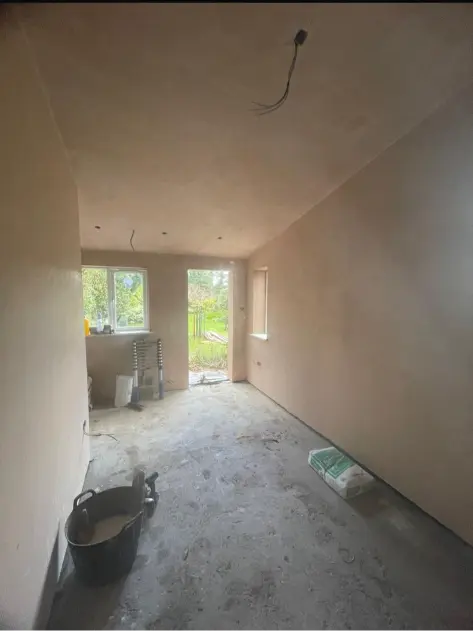
On an extension, we come in once the roof is on, the windows are in and the first fix wiring and pipes are done. We board the ceilings first, then the walls. Then we tape, bead and plaster everything. Once it is dry, your other trades can do the second fix and the decorator can start.
If you are working with a builder, we are happy to fit in with their plan. Just tell us the dates and we will book the work in.
How we board and plaster a room
- Protection. Floors are sheeted and the room is cleared or the furniture covered.
- Setting out. We check the walls and ceiling for level and mark the joists or studs.
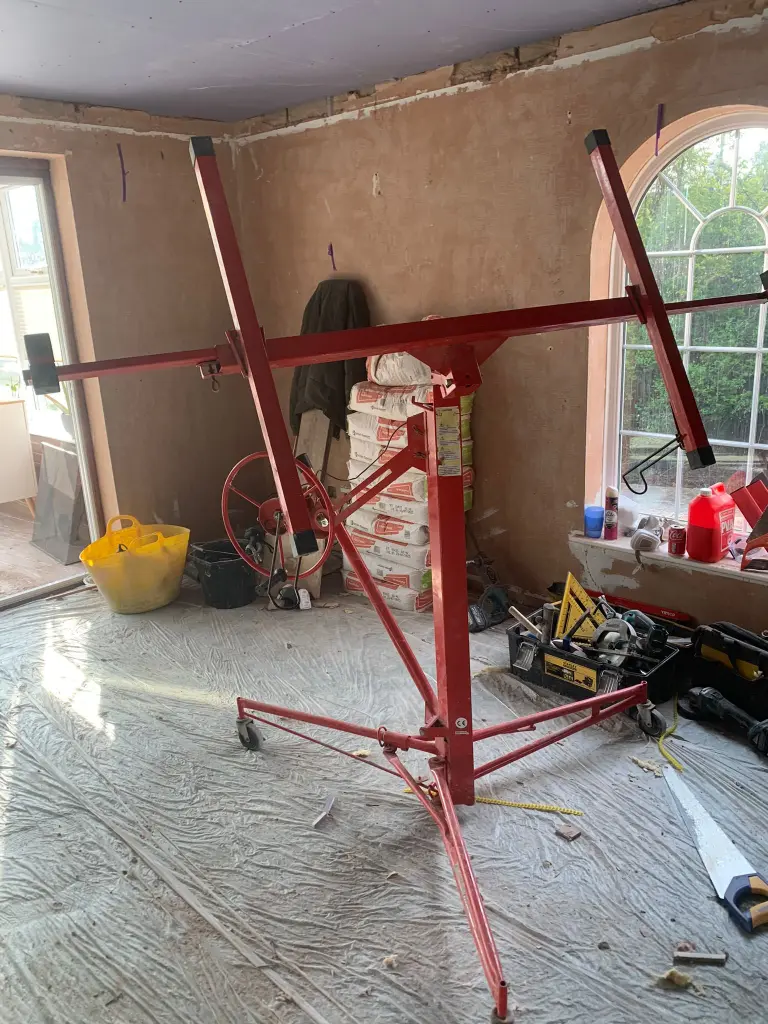
- Boarding. Boards are cut to fit around windows, doors and sockets, and fixed with the right screws or adhesive. Ceilings go up first, using a board lifter in bigger rooms.
- Beads and tape. Angle beads go on outside corners, and every joint gets scrim tape.
- Plastering. Two thin coats of finish plaster, trowelled smooth as it sets.
- Clean up. Offcuts are cleared, edges are cut in neatly and the room is left swept.
How long does it take?
A normal room can often be boarded in a day and plastered the next. A new stud wall can be framed, boarded and plastered in two to three days. A whole loft room or extension can take a week or more, based on its size and shape.
Drying and painting
A thin coat over new plasterboard dries faster than wet plaster on brick. In a warm room with fresh air, it might be ready for a mist coat in a few days. Wait until it is an even light pink, then put on a coat of watered-down white emulsion before you paint. Our guide on how long plaster takes to dry before painting explains what to look for.
What goes into your quote
Every job is different, so we quote each one on its own. The main things that change the quote are the size of the area, the type of board, whether walls need battens or are straight enough to dot and dab, how many windows, doors and corners there are, and access. Quotes are free and written.
Dry lining and plasterboarding in Solihull
A lot of the Solihull boarding work we see is in rooms that did not exist when the house was built: rear extensions, loft conversions, garage conversions and new stud walls that split a through room or make a home office. That is especially common in Knowle, Dorridge, Bentley Heath, Dickens Heath, Tidbury Green and the later parts of Shirley, where families are adding space rather than moving. Dry lining is also the practical route when an old ceiling is too uneven or fragile to skim, or when a wall’s plaster has failed in patches and over-boarding will be cleaner than a series of repairs.
On the older B91 and B92 streets the existing walls are often a mix of solid plaster and later patches, so we board the new work, make the junctions tidy, and skim so the new and old paint as one. In north Solihull, in places such as Chelmsley Wood, Kingshurst, Smith’s Wood, Marston Green and Castle Bromwich, boarding often comes with a wider refresh of a room or a whole floor, including ceilings between floors in houses that have already been altered. We can board only, or board and skim, and we will say which is needed once we have seen the rooms. If the house is leasehold, check any consent you need before walls or ceilings are changed.
For skimming over board or over sound plaster, see plastering and re-plastering. Area notes for the borough are on the plasterer in Solihull page, and Shirley is covered at plasterer in Shirley. Davey looks at the rooms himself and works on site with the lads. WhatsApp photos, rough sizes and your postcode to 07453 614095 or call 07453 614095 for a written quote.
Where we work
We are Birmingham based, covering the whole of the Midlands, including Birmingham, Sutton Coldfield, Coventry, Tamworth, Lichfield, Wolverhampton, Dudley, Stourbridge and Worcester. Local pages: plastering in Birmingham · plastering in Coventry · plastering in Wolverhampton · plastering in Lichfield · plastering in Shirley. Every town is on our areas we cover page.
We also do rendering, including K-Rend monocouche and silicone. See our rendering in Birmingham page.
Related services: plastering walls and ceilings · plastering ceilings and repairs · plastering over Artex · all services · plastering and rendering services.
Plasterboarding questions
Do you do plasterboarding and dry lining in Birmingham?
Yes. RCR Connections Ltd is Birmingham based, covering the whole of the Midlands. We board, tape and plaster walls, ceilings and stud walls.
Is dry lining as good as wet plaster?
For most homes, yes. Once it is taped and plastered, a boarded wall looks the same as a plastered one. Wet plaster feels more solid when you knock on it and is often better for patching older walls.
Do you just board, or board and plaster?
We often do both, so one team looks after the whole finish. We can also plaster boards that someone else has fixed, as long as they are fixed well.
Can you board over an old ceiling?
Yes, if the old ceiling is still holding. New boards are screwed through into the joists, then plastered. If it is badly sagging, it is better to take it down first.
Can you hang heavy things on plasterboard?
Yes, with the right fixings, or by screwing into the studs. For heavy things like a TV or kitchen units, plan extra timber behind the boards before they go up.
Can you build a stud wall?
Yes. We build the frame, add sound insulation if you want it, board both sides and plaster it.
How long does it take?
A normal room can often be boarded in a day and plastered the next. A loft room or extension can take a week or more.
What hours do you work?
Monday to Friday 7am to 5pm, Saturday 7am to 1pm. Closed on Sundays.
How do I get a quote?
WhatsApp me on 07453 614095 or message the page. Send pictures or videos of the rooms, rough sizes and your postcode.
More services: Plastering repairs · Plastering and coving · Plastering extensions and lofts.
Get a free plasterboarding quote
WhatsApp me on 07453 614095 or message the page.
Send pictures or videos via WhatsApp for a quick response, a free quote and advice. Send photos of the rooms, rough sizes and your postcode.
Opening hours: Monday to Friday 7am to 5pm, Saturday 7am to 1pm, Sunday closed.
See finished work on our projects page, or use our contact page. RCR Connections Ltd, Birmingham based, covering the whole of the Midlands.