

Coving is a small thing that makes a big change to a room. It is the curved strip at the top of the wall, where the wall meets the ceiling. It hides the joint, hides small cracks and makes the room look finished. RCR Connections Ltd (Regal Colour Rendering) is Birmingham based, covering the whole of the Midlands. We fit coving and plaster the walls and ceilings around it, so the whole room looks right.
For a free quote: WhatsApp me on 07453 614095 or message the page. Send pictures or videos via WhatsApp for a quick response, a free quote and advice. A few photos of the room and the top of the walls are enough to start.
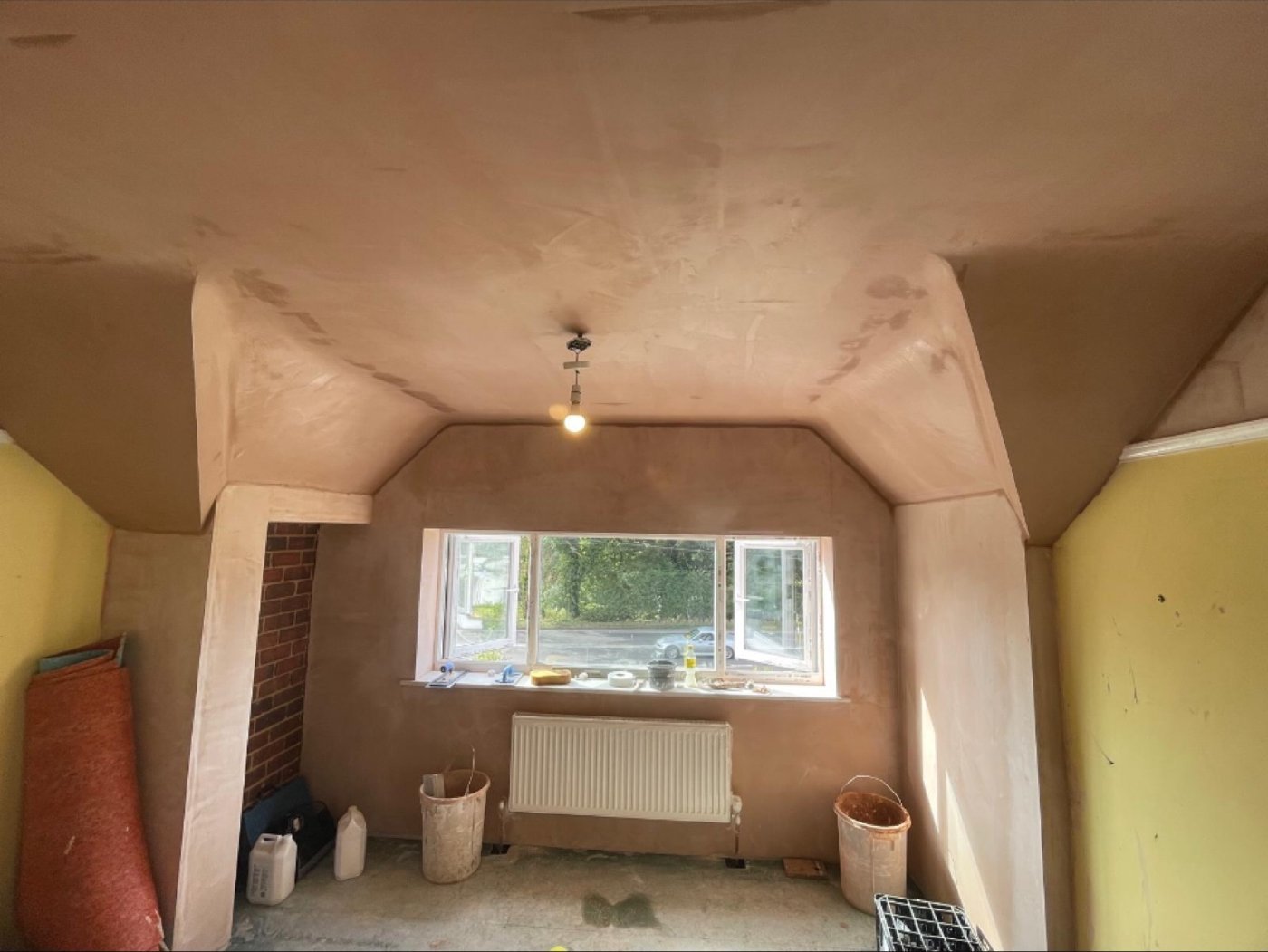
Plasterers by trade
I’m David. I am a plasterer and renderer by trade, and I still work on the tools. Across the team there are 62 years of combined experience. Coving looks simple, but it shows every mistake. A gap in a corner, a joint that sits proud, or a line that dips across the room will catch your eye every time you look up. So we take our time with it.
We are plasterers first. That means we can deal with the wall and the ceiling as well as the coving. If the ceiling has a crack, or the top of the wall is rough, we fix that too. You get one team for the whole job, not three.
What coving does
Coving has three jobs:
- It hides the joint. The line where the wall meets the ceiling is hard to get dead straight. Coving covers it.
- It hides cracks. Houses move a little with heat, cold and damp. The first place a crack shows is often along the top of the wall. Coving sits over that line, so the crack does not show.
- It makes the room look finished. A room with coving looks neat and calm. In older houses it puts back the look the room had when it was built.
Types of coving we fit
There are a few main kinds. On your visit we will tell you which one suits your room.
- Plaster coving. This is the most common kind. It is made from plaster with a paper face, or from solid plaster. It is strong, it takes paint well and it looks right in most homes.
- Plain curved coving. A simple, smooth curve. It suits most modern rooms and most semis and terraces. It comes in a few depths, so we can pick one that suits the height of your room.
- Shaped coving. This has steps, beads or a pattern in it. It suits older rooms, front rooms and halls with tall ceilings.
- Light coving. Made from foam or similar. It is light and quick to fit, but it does not look or feel like plaster. We will tell you plainly if we think it is the wrong choice for your room.
If you are not sure what you want, send us a photo of the room. We can tell you what will look right for the age and style of the house.
New coving or matching old coving
Some jobs are all new. You may have plain ceilings and want coving round the room. That is the simplest job.
Other jobs are about matching. Maybe one wall of coving was lost when a wall was moved, or a leak spoiled part of it. Then we need the new piece to match the old. Many plain shapes are still made, so a match is often easy. If your shape is rare, we can:
- find the closest shape we can get, and fit it where it shows least,
- or take out the old coving and fit the same new coving round the whole room, so it all matches.
We will show you the choice before we start, so there are no surprises.
Old cornice in Victorian and Edwardian homes
Many houses in Birmingham have old cornice. You see it in the front rooms and halls of terraces and villas in places like Moseley, Kings Heath and Harborne. It is often deep, with lots of shape in it. It may be covered in years of paint.
Old cornice is part of the charm of the house. We do not rip it out unless we have to. If small parts are cracked or broken, we can often fill and make good those parts so the line is sound again. If a long run has come away, we will tell you what we think is the best way to deal with it. Sometimes a close modern match is the best choice. Sometimes it is better to leave the old cornice and repair it.

How we fit coving, step by step
- Look at the room. We check the ceiling and the top of the walls. Is the ceiling sound? Are there cracks? Is the wall straight at the top?
- Protect the room. We cover floors and anything left in the room. Coving is not a messy job, but plastering can be.
- Fix the problems first. Loose plaster is cut out. Cracks are opened up, filled and taped. A ceiling that has come loose is fixed back before any coving goes up.
- Mark a line. We mark a level line round the room so the coving sits straight. In older houses the ceiling is rarely level, so we split the difference to make it look right from the floor.
- Cut the corners. Each piece is cut to fit the corners. Getting the corners tight is what makes coving look good.
- Fix it in place. The coving is stuck on with coving adhesive and held while it sets.
- Fill and finish. We fill the joints, the corners and the gaps at the top and bottom edge. Then we wipe it clean, so there is a crisp line.
- Plaster round it. If we are plastering the room too, we plaster the walls and ceiling up to the coving so it all looks like one finish.
Coving as part of a plastering job
A lot of our coving work is part of a bigger plastering job. When a room is being plastered, it is the best time to fit coving. The walls and ceiling get a fresh coat, the coving goes on, and the joints are made good at the same time. You only have the room out of use once.
It also helps with old ceilings. If a ceiling is cracked at the edges, or the line at the top of the wall is wavy, coving gives a neat edge to work to. See our page on ceiling plastering and repairs for more on ceilings.
Coving over Artex and textured ceilings
If your ceiling has Artex or another texture, it is best to deal with the ceiling first. We cover the texture and give you a smooth ceiling, then fit the coving. If the old coving is part of the textured finish, we may take it off and fit new. Our page on Artex covering in Birmingham has more on this.
How long it takes
- Coving on its own in one room: often half a day to a day.
- Coving plus small repairs: about a day.
- Plastering a room plus coving: often two to three days.
Plaster needs to dry before you paint. Coving fixed with adhesive is often ready to paint the next day. New plaster on the walls and ceiling takes longer, often a week or so, until it is an even light pink.
Painting your new coving
Once it is dry, paint the coving like any other plaster. On new plaster, start with a mist coat. That is white emulsion mixed with some water, so it soaks in and grips. Then paint as normal. Many people paint the coving the same colour as the ceiling, so the room looks taller. Some pick it out in a different shade. Both work.
Use a good brush on the edges and take your time. A clean line where the coving meets the wall makes all the difference.
Coving or cornice: what is the difference?
The two words get used for the same thing, but there is a difference. Coving is usually a simple, plain curve, made in lengths and stuck in place. Cornice is a moulding with more shape to it: steps, beads, leaves or other patterns. In older houses, cornice was often run in place by a plasterer using a shaped template dragged along wet plaster, so it is one continuous piece round the room. Modern coving and many modern cornices are made in lengths in a factory and fixed to the wall and ceiling.
For most homes the choice is about looks. A plain cove suits most rooms built from the 1930s onwards. A more shaped cornice suits older, taller rooms, or a room where you want a bit more character.
Choosing the right size
Coving comes in different depths, measured roughly as how far it reaches down the wall and across the ceiling. Getting the size right is one of the main things that makes it look as though it belongs.
- Low ceilings. In rooms with a standard modern ceiling height, a small or medium cove looks best. A large cove in a low room makes the ceiling feel lower.
- Tall ceilings. In Victorian and Edwardian rooms with high ceilings, a small cove looks lost. A deeper cornice fills the corner and suits the room.
- Small rooms. Box rooms, cloakrooms and small bathrooms usually look best with a slim, plain cove, or none at all.
- Open-plan rooms. Where rooms run into each other, it usually looks best to carry the same coving through all of them.
If you are unsure, hold a short sample length up in the corner of the room before deciding. We can bring a couple of sizes along so you can see them in place.
Rooms where coving works well
Living rooms and front rooms
The front room is where coving is most often fitted. It frames the ceiling, sets off a central light, and in older houses brings back the look the room was built with. A chimney breast adds extra corners to cut, which is where neat work shows.
Hallways and landings
Halls and landings often have the most cracking at the top of the walls, because the stair structure moves a little as people walk up and down. Coving hides that line well. Stairwells also have awkward angles where the coving has to follow a sloping ceiling or turn round a bulkhead, which takes careful cutting.
Bedrooms
Bedrooms often have plain ceilings with a crack round the edge where the ceiling meets the wall. A simple cove tidies this up in a day.
Kitchens and bathrooms
Coving can be fitted in kitchens and bathrooms, but steam needs thinking about. In bathrooms we use materials and adhesive that cope with damp air, and good ventilation matters to stop mould along the top edge. In kitchens, wall cupboards that reach the ceiling may mean coving is only fitted on part of the room, so we plan where it starts and stops.
Fixing coving to a ceiling that is not level
Very few ceilings are perfectly level, especially in older houses. Some dip in the middle, some slope from one side of the room to the other, and some have a step where a wall was taken out. Coving shows this, because it is a straight line running round the top of the room.
We deal with it in a few ways:
- We find the low and high points before fitting, so we know where the gaps will be.
- We set the coving to a line that looks right from the floor, not one that is perfectly level by the spirit level, because that is what you see.
- We fill any small gaps along the top edge so the line reads as one smooth curve.
- Where a ceiling is badly out, we may suggest plastering it first so the coving has a better edge to work to.
Corners: where coving succeeds or fails
Most of the skill in fitting coving is in the corners. Internal corners, where two walls meet in a room corner, and external corners, round a chimney breast or a bulkhead, both need the coving cut at an angle so the two pieces meet cleanly. Most room corners are not exactly square, so a cut that would be perfect in theory leaves a gap in practice. We measure each corner and adjust the cut to suit it. Small gaps are then filled and shaped so the curve carries right round.
A good test of any coving job is to stand in the doorway and look at the corners. The line should flow round without a step, a gap or a lump.
Joints along the length
Coving comes in fixed lengths, so long walls need more than one piece. The joint between two lengths has to be tight and filled flush, or it shows as a line once painted. We plan the lengths so joints fall away from the main view where possible, for example not right above the middle of a bay window. We also cut each end clean and square before joining.
Cracks in coving and how to fix them
Coving that has been up a long time sometimes cracks along the top or bottom edge, or at the joints. The usual reasons are:
- the ceiling or wall moving a little with the seasons,
- the joints not filled fully when the coving was fitted,
- a leak from above that softened the ceiling,
- the coving fitted to a ceiling that was loose or cracked behind it.
Small cracks along the edges can be raked out and filled with a flexible filler, then painted. Cracks at joints are cut out and refilled. If the coving itself has come away, we check the ceiling behind it first. There is no point sticking it back on a ceiling that is itself loose.
Repairing old cornice
Old cornice in Victorian and Edwardian homes is often buried under many coats of paint, which blurs the detail. It may also have cracks, missing sections and stains from old leaks.
Cleaning back the detail
Where the paint build-up is thick, gently cleaning it back brings the detail out again. Old cornice was often painted in soft distemper, which does not hold later paint well, so the coats on top can flake. Cleaning back is slow, careful work, and it is often worth doing on a feature room such as the front room or hall.
Filling chips and cracks
Small chips and cracks can be filled and shaped by hand to match the profile. Done well, the repair disappears once painted.
Missing sections
When a length of cornice is missing, for example where a wall was removed or a ceiling came down, it needs replacing with something that matches. Many common Victorian shapes are still made in lengths. Where the shape is unusual, a matching length can be run or cast to the same profile by a specialist. We will tell you what the options are and help you choose.
Coving and lighting
Coving changes how light falls in a room. A plain cove gives a soft shadow line round the top of the walls. Some people like to fit LED strip lighting along the top of the coving, so it lights the ceiling from the edges. That needs the coving fitted a little down from the ceiling, with a small gap above, and it needs planning with your electrician before the coving goes up.
Ceiling roses and coving go well together in older rooms. If you have a central light fitting, think about whether you want a rose to match the coving at the same time.
Taking old coving down
Sometimes the best answer is to take old coving down and start again, for example when it is cracked, the wrong size for the room, or a mismatch after part of it was lost. Taking coving down can pull away some of the ceiling and wall plaster behind it, because it was stuck on. We cut along the top and bottom edges first to keep the damage small, then make good any plaster that comes away before fitting the new coving.
Some old textured coving is part of an Artex finish. As with any old textured coating, we will ask whether it has been tested before we disturb it.
Coving in different homes across the Midlands
The houses in each part of the Midlands lean towards different styles of coving.
- Victorian terraces and villas in places like Moseley, Kings Heath, Harborne and Edgbaston, and in parts of Coventry, Wolverhampton and Leamington Spa, often have deep cornice in the front rooms and halls, with simpler coving at the back.
- Interwar semis across Hall Green, Acocks Green, Erdington, Olton and much of the Black Country usually suit a plain or gently stepped cove of medium size.
- Post-war and later homes around Sutton Coldfield, Solihull, Chelmsley Wood and the newer estates often have lower ceilings, where a slim plain cove looks best, or none.
- New-build homes usually have no coving at all from new. Adding a slim cove is a quick way to give a plain new room a finished look.
Doing it yourself or getting it fitted
Coving is often seen as a DIY job, and plenty of people fit it themselves. The straight runs are not too hard. The corners, joints and getting a clean line on an uneven ceiling are where most DIY jobs go wrong. If you want to have a go, practise your corner cuts on offcuts first, use plenty of adhesive, support each length while it sets, and fill the joints carefully.
If you would rather have it done for you, or the room also needs plaster repairs, it is often quicker and neater to have one team do both.
Preparing the room
- Clear the room or move furniture to the middle, so we can reach the top of every wall.
- Take down curtain poles, blinds and pictures near the ceiling line.
- Let us know about any lights, smoke alarms or speakers near the top of the walls.
- Tell us if there have been any leaks from above, so we can check the ceiling.
Coving and decorating timing
The best time to fit coving is before you decorate. If you have just painted, fitting coving can mark the fresh paint at the top of the walls. The usual order is plaster repairs first, then coving, then mist coat and painting. If you are papering the walls, hang the paper after the coving is up and painted, so the paper finishes neatly under it.
Materials in more detail
The material your coving is made from changes how it looks, how it is fixed and how long it lasts.
Paper-faced plaster coving
This is a plaster core wrapped in a paper face, in a plain curved profile. It is the most widely used kind in British homes. It is fairly light, cuts cleanly with a fine saw, and takes paint well once the joints are filled. It is ideal for most modern and interwar rooms.
Fibrous and solid plaster cornice
Fibrous plaster is plaster cast in a mould with a hessian or fibre backing for strength. It allows much finer detail and deeper profiles than paper-faced coving, so it is the usual choice for matching or replacing period cornice. It is heavier, so it needs fixing with care, sometimes with screws as well as adhesive into the joists and wall.
Polyurethane and foam coving
Lightweight coving made from polyurethane or foam is easy to handle and comes in many shapes. Good-quality polyurethane can look fine once painted. Cheap foam tends to dent easily and can look flat and plastic up close. We will tell you plainly where we think it is fine and where it will let the room down.
Coving on plasterboard ceilings
Most homes built since the war have plasterboard ceilings. Coving sticks well to a sound board ceiling, but cracks along the board joints near the edge of the room are common and can carry on through the coving if they are not dealt with first. We check the edge boards, re-fix any that have dropped, and tape any open joints before fitting. Then the coving goes up on a firm base.
Coving on lath and plaster ceilings
Older houses often still have their original lath and plaster ceilings: thin timber strips nailed to the joists with lime plaster pushed through them. Over time the plaster can lose its grip on the laths, especially near the edges and after leaks. Fitting coving to a ceiling like this is fine if the ceiling is sound, but heavy cornice on a loose ceiling edge is asking for trouble.
We tap along the edges of the ceiling first. If the plaster is sound, the coving goes up as normal. If it is loose, we fix it back or repair it before fitting. Where a whole ceiling is failing, the better answer may be to overboard and skim it, then fit the coving to the new surface. See our ceiling plastering and repairs page for more.
Bay windows and chimney breasts
Bay windows and chimney breasts are the hardest parts of a room to cove. A bay window can have five or more corners in a short run, many of them not at a standard angle. A chimney breast adds two outside corners and two inside corners, and the breast itself is often slightly out of square.
We measure each angle on the spot and cut each piece to suit. Outside corners on a chimney breast are the most visible in the room, so they get the most attention. A neat bay with crisp corners is often what people notice first when they walk in.
Bulkheads and boxed beams
Where a steel beam or boxing runs across a ceiling, coving can either stop at the box, run round it, or run along it. Each looks different. Running the coving round a bulkhead keeps the room tidy but adds many extra corners. Stopping the coving neatly at the box can look cleaner in a modern room. We will talk you through the choices before we start cutting.
Coving in rented homes and between tenants
Landlords sometimes ask for coving when a room has a crack round the ceiling line that keeps coming back between tenants. A plain cove fitted after the crack has been opened, taped and filled usually stops the cracking from showing again, and it makes the room look smarter for viewings. It is quick to fit in an empty property and can be painted the same day it is filled, once the adhesive has set.
Painting tips for coving
- Fill every nail hole, joint and gap with a fine filler, and let it dry fully before painting.
- Use a decorator’s caulk along the top and bottom edges where the coving meets the ceiling and wall. It stays a little flexible and stops hairline cracks showing.
- Cut in carefully along the bottom edge with a good angled brush.
- For a period cornice, a thinner paint applied in more coats keeps the detail crisp, rather than one thick coat that fills it in.
- Painting the coving the same white as the ceiling makes a low room feel taller.
Looking after coving
Once fitted and painted, coving needs very little care. Dust it when you dust the ceiling, keep an eye on bathrooms and kitchens for mould along the top edge, and deal with any leak from above quickly. If a hairline crack appears at a joint after a season or two, a little flexible filler and a touch of paint is usually all it needs.
Common questions we hear on site
Will coving make my room look smaller?
Not if the size is right. A slim cove in a modern room barely changes how big it feels, and many people find it makes the ceiling look neater and higher. It is only an oversized cove in a low room that makes it feel cramped.
Can coving go up in one day?
In a typical bedroom or living room with a sound ceiling, yes. Bays, chimney breasts and repairs add time.
Do you need to plaster first?
Only if the top of the wall or the edge of the ceiling is loose, badly cracked or very uneven. Otherwise coving can go straight onto the existing surface after a little preparation.
Picture rails, dado rails and skirting
Coving is one of several mouldings that give a room its character. In older houses, the front room might also have a picture rail a little below the ceiling and a dado rail at waist height in the hall. When you are fitting or matching coving, it is worth thinking about these at the same time. A deep period cornice above a modern slim skirting can look out of step, while a plain cove in a room with a tall Victorian skirting and picture rail can look a little thin.
We do not fit timber rails or skirting ourselves, as that is joinery, but we plaster up to them, make good the wall round them, and can tell you how the coving will sit with what is already there.
Damp, mould and coving
The top corner of an outside wall is one of the coldest parts of a room, so in a poorly aired room condensation can gather there and mould can grow along the coving line. Coving does not cause this, but it can make it more visible. If you see black spots along the top of an outside wall, improving the airflow in the room, using extractor fans and keeping some background heat usually helps a lot. Mould should be cleaned off and the area treated before new coving goes up or old coving is painted. If the damp is coming in from outside, for example through cracked render or a leaking gutter, that needs fixing first.
Our approach on every coving job
Whether it is one bedroom or a whole house, we work the same way. We look properly at the ceiling and walls first, deal with anything loose or cracked, set out the line so it looks right from the floor, take our time on corners and joints, and leave a clean, sharp edge that is ready to paint. If a room needs more than coving to look right, we will say so. If it needs less than you thought, we will say that too.
Why choose RCR Connections Ltd
- We are plasterers by trade, with 62 years of combined experience across the team.
- We do the coving, the walls and the ceiling, so one team does the whole room.
- We tell you plainly what your room needs, and what it does not need.
- We keep the mess to the room we are working in and clean up each day.
- We are Birmingham based, covering the whole of the Midlands.
What to send us
To give you a quick answer, send us:
- a photo of the whole room, taken from the doorway,
- a close photo of the top of the wall, where the coving will go,
- a photo of any old coving or cornice you want to keep or match,
- the rough size of the room,
- your postcode.
A short video walking round the room is even better. We can then tell you what we think and what the job will need.
Where we fit coving
We fit coving all over Birmingham and the Midlands. Much of our coving work is in the older streets, where tall rooms and old ceilings need a neat finish at the top of the wall.
Popular towns for this work: Sutton Coldfield, Moseley, Harborne, Kings Heath, Erdington.
See every town we cover on our plastering areas page.
Coving questions
Do you fit coving in Birmingham?
Yes. RCR Connections Ltd is Birmingham based, covering the whole of the Midlands. We fit new coving, swap old coving and plaster the walls and ceiling around it.
What is coving?
Coving is a curved strip that runs along the top of the wall, where the wall meets the ceiling. It hides the joint, hides small cracks and gives the room a neat, finished look.
Is coving the same as cornice?
Not quite. People use the words for the same thing, but coving is usually a plain curve. A cornice is often deeper and has more shape or pattern in it. Many old houses have a cornice.
Should I plaster first or fit the coving first?
On most jobs we fix any cracks first, fit the coving, then plaster the walls and ceiling up to it. If the walls and ceiling are already in good shape, we can fit coving on its own.
Can you match my old coving?
Often, yes. Many plain shapes are still made. If a shape is rare, we can look at a close match, or fit the same coving round the whole room so it all looks the same.
Will coving stop my ceiling cracking?
Coving hides the crack line where the wall meets the ceiling, and it helps to stop that crack showing again. It will not fix a ceiling that is loose or sagging. That needs the ceiling fixed first.
How long does it take to fit coving?
Most rooms take less than a day. If we are plastering the room as well, the whole job is often two to three days, plus drying time before you paint.
When can I paint the coving?
Plaster coving can be painted once the filler and adhesive are dry, often the next day. New plaster on the walls and ceiling needs longer. Wait until it is an even light pink, then use a mist coat first.
What are your working hours?
Monday to Friday 7am to 5pm, Saturday 7am to 1pm. We are closed on Sundays.
How do I get a quote?
WhatsApp me on 07453 614095 or message the page. Send pictures or videos of the room, the top of the walls and any old coving.
Get a free coving quote
WhatsApp me on 07453 614095 or message the page.
Send pictures or videos via WhatsApp for a quick response, a free quote and advice. Show us the room, the ceiling line and any old coving you want to keep or match. Tell us the rough room size and your postcode.
Opening hours: Monday to Friday 7am to 5pm, Saturday 7am to 1pm, Sunday closed.
See finished work on our projects page, or use our contact page. RCR Connections Ltd (Regal Colour Rendering), Birmingham based, covering the whole of the Midlands.