
Skimming is the job that turns tired, patched, uneven walls into a smooth surface ready for paint. It’s also the job most likely to go wrong in the wrong hands, because a skim coat is only a few millimetres thick and every ripple, trowel mark and lumpy corner shows the moment the light hits it. RCR Connections Ltd is Birmingham based, covering the whole of the Midlands, and skimming and re-skimming is the bread and butter of our plastering work, from a single bedroom ceiling in Kings Heath to every room in a full house renovation in Solihull.
For a free quote: WhatsApp me on 07453 614095 or message the page. Photos of each room, rough sizes and your postcode are all I need to start.
A plasterer by trade
I’m David. I’m a plasterer and renderer by trade, and I still work on the tools. If your skimming is part of a bigger job (a rewire, new kitchen, knock-through or loft conversion), we’ll fit the plastering in at the right point. Across the team we have 62 years of combined experience, and most of that time has been spent with a trowel and hawk in hand.
Plastering terms explained: finish coats and re-plastering
The words get used loosely, so here is how I use them when I quote:
- Skimming is applying a thin finishing coat of plaster, usually around 2 to 3 mm in two passes, over a surface that is already sound and reasonably flat. New plasterboard is the classic example: boards go up, joints are scrimmed, and the whole lot is skimmed.
- Re-skimming is skimming over existing plaster that’s still well stuck to the wall but looks bad: hairline cracks, old filler patches, wallpaper damage, lumps from decades of decorating, or a surface that has simply had enough. The old plaster stays; a fresh finish goes over the top.
- Re-plastering means taking the old plaster off back to brick or block and starting again with a backing coat and a finish. It’s needed when plaster is blown (hollow and coming away), crumbling, salt-damaged after damp, or so uneven that a skim won’t fix it.
The difference matters for your wallet. Re-skimming is quicker and less disruptive than re-plastering, and on many walls it’s all that’s needed. Part of my job on a survey is to tell you honestly which one your walls need, room by room, rather than quoting the biggest job by default.
Plastering signs to look for on walls and ceilings
- Fine cracks running across walls or ceilings that keep coming back after filling.
- Surfaces left rough and torn after stripping wallpaper.
- Patchwork walls where electricians, plumbers or kitchen fitters have chased in cables and pipes.
- Old textured coatings such as Artex that you want gone.
- Walls that look fine until a lamp or sunlight shines across them, then show every bump.
- Ceilings with visible board joints or nail pops.
If you tap the wall and it sounds hollow or drummy over a large area, that’s a sign the plaster behind has lost its bond, and the area may need cutting out or re-plastering rather than a skim.
Plastering ceilings
Ceilings are where good skimming really shows. Sound ceilings can be re-skimmed directly. Old lath and plaster ceilings with cracks and sagging areas are often over-boarded first: new plasterboard is screwed through into the joists, then the whole ceiling is skimmed. That avoids the dust and mess of pulling the old ceiling down, and it gives a flat, solid surface. Textured ceilings can usually be skimmed over after the right preparation; our guide on skimming over Artex explains what’s involved, including testing older coatings before any sanding or scraping.
Plastering a room: how we do it
- Protection. Floors are covered with dust sheets or protective film, the doorway is taped off, and furniture is moved out or sheeted in the middle of the room. Sockets and switches are loosened off the wall (with the power isolated by a qualified person where needed) so the plaster can run behind the faceplates for a clean finish.
- Preparation. Loose material is scraped off, big holes and chases are filled and allowed to set, and any cracks that need it are taped. Angle beads go on worn or damaged external corners.
- Bonding. Existing plaster or painted surfaces are treated with a bonding primer so the new skim grips and doesn’t dry out too fast. New plasterboard joints are scrimmed.
- First coat. A thin, even coat is laid on across the whole wall or ceiling.
- Second coat. Applied while the first is still green, to build an even thickness and fill any slight hollows.
- Trowelling up. As the plaster firms, it’s trowelled several times, with a little water at the end, to close the surface and leave it smooth and flat. Timing this stage is the real skill.
- Clean up. Edges are cut neatly at skirting, frames and ceilings, tools and buckets are cleaned outside, and the room is left swept.
Drying time and decorating
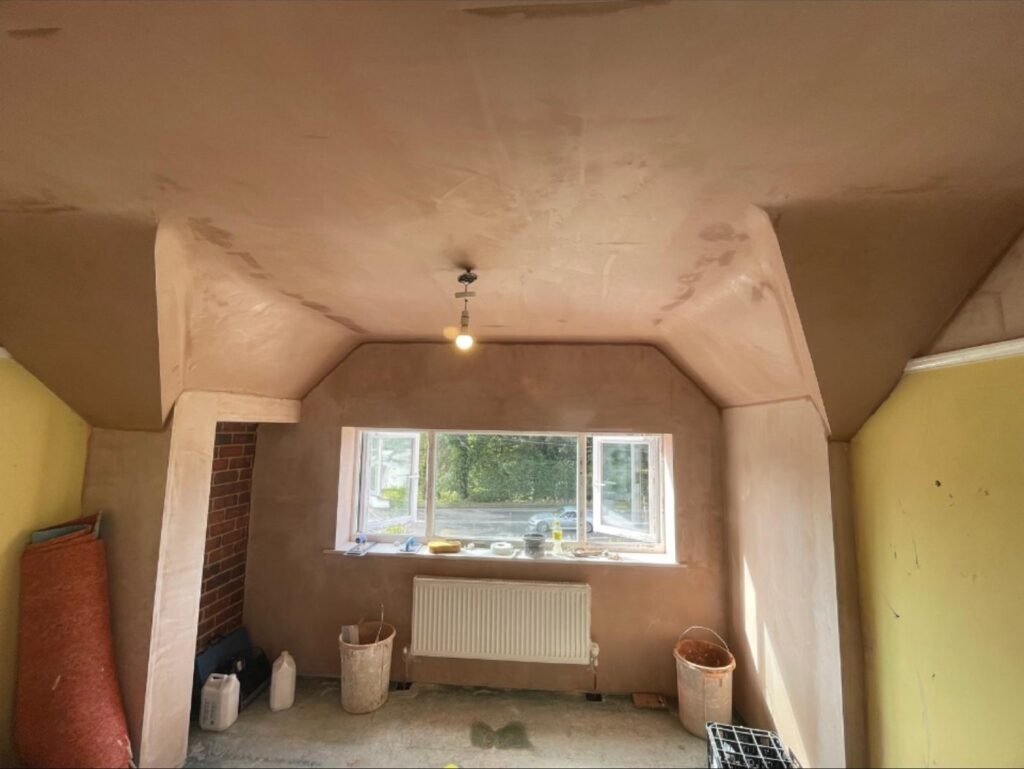
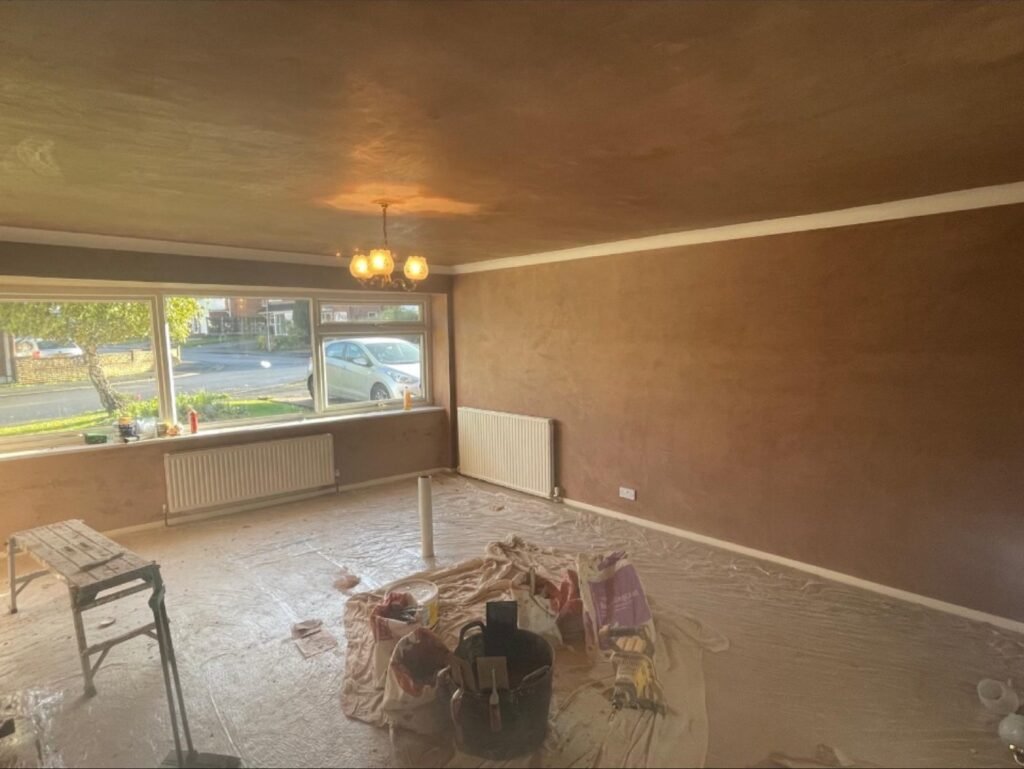
Fresh plaster is a dark pink or brown and slowly turns an even, pale pink as it dries. A thin skim on plasterboard in a warm, ventilated room might be ready in three or four days; a re-skim over old walls in winter can take a week or more. Keep a window open, keep the heating on low and steady, and don’t use fan heaters blowing straight at the wall, which can make it crack. When it’s ready, put on a mist coat (a watered-down emulsion) before your normal paint. Our guide on how long plaster takes to dry before painting covers this in more detail.
Plastering time: how long does a room take?
As a rough idea, an average bedroom’s walls and ceiling can usually be skimmed in one day once prep is done. A through lounge or open-plan kitchen-diner might take two days. A full house is planned room by room so you always have somewhere to live while the work goes on. I’ll give you a realistic timetable in the quote.
Plastering in extensions and conversions
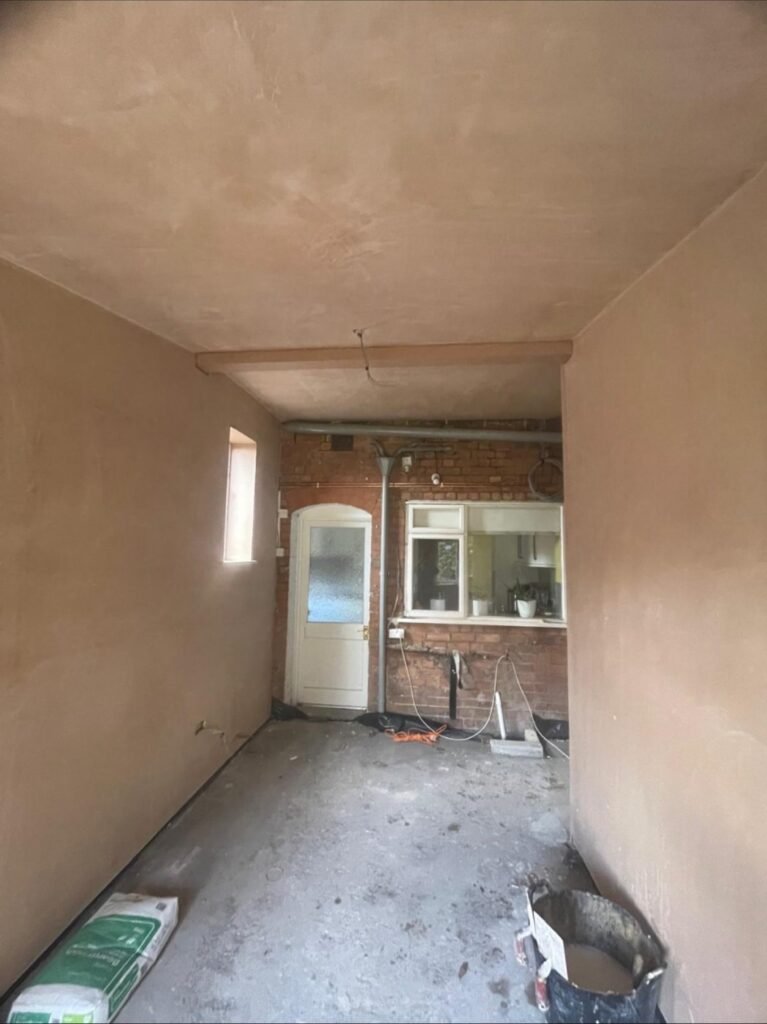
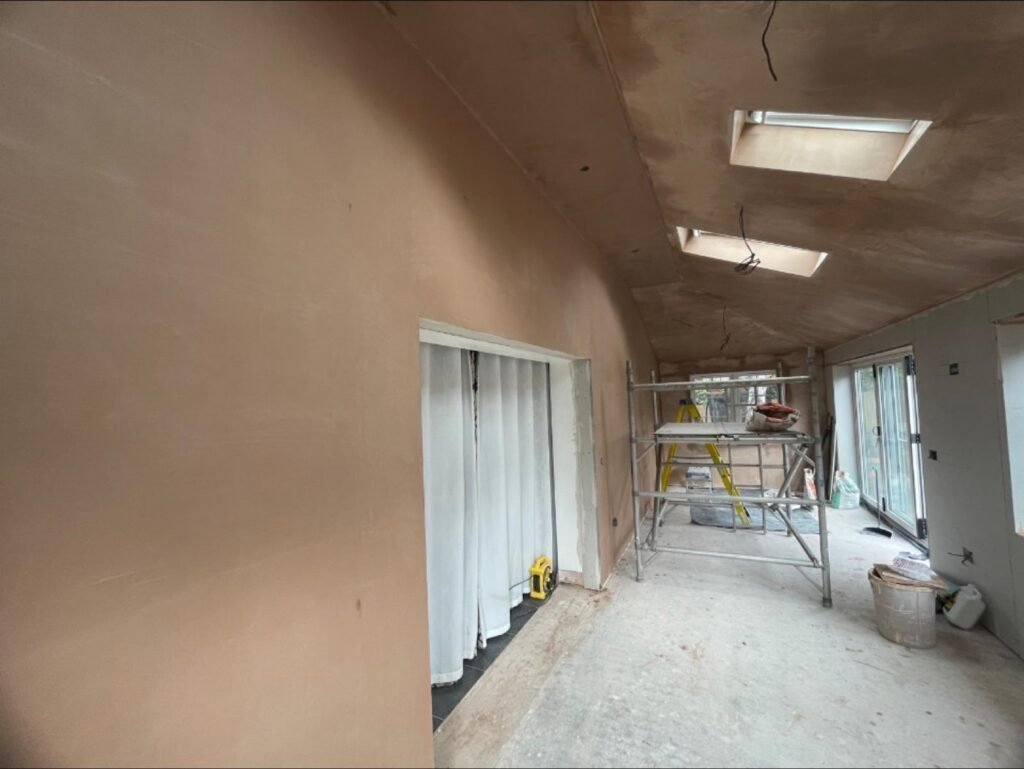
New extensions, loft rooms and garage conversions are usually boarded with plasterboard, then taped and skimmed. On a bigger job, the order matters: first-fix electrics and plumbing, then boarding, then skimming, then second fix and decorating. Getting that order right means nobody is cutting into fresh plaster a week after it’s finished, which saves you money and gets a better result. For boarding, see our plasterboarding and dry lining page.
Mess, dust and living with the work
Skimming itself is a wet trade and makes far less dust than people expect. The dusty part is any stripping or cutting out beforehand, which we keep contained with sheeting and by cleaning as we go. Mixing is done outside or on protected floors. You’ll need to keep pets and children out of the room while we’re working and while the plaster is soft, but otherwise most people stay in the house throughout.
Plastering quotes: what affects them
- Room size and ceiling height (stairwells and high ceilings need staging).
- Whether it’s a straight skim on new board, a re-skim, or part re-plastering.
- How much prep there is: wallpaper removal, filling, beads, over-boarding.
- Number of rooms and whether they can be done back to back.
- Access, parking and how much furniture needs moving.
Quotes are free and written, so you know exactly what’s included before any work starts.
Our work
More finished jobs are on our projects page.
Skimming walls and ceilings in Solihull
Inside Solihull homes, the most common plastering request is a skim: a thin finish coat over plaster that is still firm and reasonably flat, or over new plasterboard in an extension, loft room or freshly built stud wall. In the older B91 and B92 streets, and in inter-war semis around Olton, Shirley and Elmdon, that often means refreshing a lounge, hallway, stairs or bedroom that has been painted many times and no longer takes a decent finish. In Knowle, Dorridge, Bentley Heath, Dickens Heath and the newer parts of Shirley, it is just as often the new rooms after an extension or loft conversion, where the board has to be taped, jointed and skimmed so it paints as one surface with the rest of the house.
A skim is only the right job if the backing is sound. If the ceiling has a textured coating, have a sample tested before anyone disturbs it; we do not sand or scrape a coating that has not been tested. Where old plaster is hollow, badly cracked or coming away, it is usually better to hack off and re-plaster, or to over-board the ceiling and skim the new board. That choice is explained in more detail on our plasterer in Solihull page, including when a ceiling is better replaced than skimmed.
For boarding and dry lining, see plasterboarding and dry lining. Shirley plastering has its own page at plasterer in Shirley, and Knowle and Dorridge now have theirs too: plasterer in Knowle and plasterer in Dorridge. Davey is on site with the lads. Send a few photos, rough room sizes and your postcode on WhatsApp 07453 614095, or call 07453 614095.
Plastering areas we cover
We’re Birmingham based, covering the whole of the Midlands. Skimming jobs regularly take us across Birmingham and to Solihull, Shirley, Sutton Coldfield, Erdington, Harborne, Moseley, Coventry, Kenilworth, Warwick, Tamworth, Lichfield, Wolverhampton, Dudley, Stourbridge and Worcester. Local pages: Plasterer in Birmingham · Plasterer in Solihull · Plasterer in Shirley · Plasterer in Coventry · Plasterer in Sutton Coldfield · Plasterer in Tamworth. If the outside needs attention too, see silicone render and render repairs, or every service on the plastering and rendering services page.
Related services: ceiling plastering and repairs · plasterboarding and dry lining · Artex covering · all services.
Plastering questions
Can you plaster over painted walls?
Yes, if the paint is sound. The surface is cleaned and treated with a bonding primer first so the skim grips properly. Flaking or powdery paint has to come off.
Can you plaster over wallpaper?
No. Wallpaper needs stripping first, because the moisture in the plaster would lift it and the skim would fail. Lining paper too.
Do I need the whole room re-plastered, or just the bad wall?
One wall can be done on its own, but the new finish will look different from the old walls in raking light, so many people do the whole room at once. I’ll tell you what I think gives the best result for the money.
Why has my old plaster cracked?
Usually normal movement, old board joints that weren’t taped, or plaster that has lost its bond. Re-skimming with properly taped joints fixes the first two; blown plaster needs cutting out first.
Can you plaster in winter?
Yes. Indoor plastering carries on all year, as long as the house isn’t freezing. Drying just takes a little longer in colder months.
Do you do coving and small patch repairs?
Yes. We can fit plaster coving, make good after electricians and plumbers, and repair damaged corners, as a job on their own or alongside a skim.
More services: Plastering repairs · Plastering and coving · Plastering extensions and lofts.
Get a free plastering quote
WhatsApp me on 07453 614095 or message the page. Send photos of the rooms, rough sizes and your postcode, and I’ll come back with a quote or arrange a visit. You can also use our contact page. RCR Connections Ltd, Birmingham based, covering the whole of the Midlands.
For wall and ceiling skimming across Solihull borough, see plasterer in Solihull and plasterer in Shirley.