
Sand and cement is the old way to render a house. You see it on homes all over Birmingham and the Midlands, often painted white or cream. It is hard, strong and simple to repair. RCR Connections Ltd (Regal Colour Rendering) is Birmingham based, covering the whole of the Midlands. We render with sand and cement, and we also use K-Rend monocouche and silicone. We will tell you plainly which one suits your house.
For a free quote: WhatsApp me on 07453 614095 or message the page. Send pictures or videos via WhatsApp for a quick response, a free quote and advice. A photo of the whole wall and a few close ups are enough to start.

Renderers by trade
I’m David. I am a plasterer and renderer by trade, and I still work on the tools. Across the team there are 62 years of combined experience. We have worked with sand and cement render for years, long before coloured renders were common. We know how it behaves, where it cracks, and how to put it on so it lasts.
What is sand and cement render?
It is a mix of sand, cement and water. Some mixes have lime in them too, which makes the render a bit softer and helps it breathe. It is mixed on site and put on the wall in coats:
- A scratch coat. The first coat. It is scratched while wet so the next coat has something to grip.
- A top coat. The second coat. It is ruled flat and then finished.
Once dry, the render is grey. It is then painted with masonry paint in the colour you want.
Finishes
Sand and cement can be finished in a few ways:
- Smooth or sponge finish. A flat, even look, rubbed up with a float or sponge. This is the most common finish.
- Textured finish. A light texture that hides small marks and wear.
- Roughcast or pebbledash. Stones or a rough mix thrown on the wet render. Common on older semis. Our pebbledash guide covers your options if you have it now.
Sand and cement or K-Rend monocouche and silicone?
This is the big choice. Here is the plain version.
- Sand and cement is hard and strong. It is easy to patch. It needs painting, and the paint needs doing again every few years. It is rigid, so it can crack if the house moves a little.
- K-Rend monocouche has the colour mixed right through it. It goes on thick in one main coat and is scraped back to an even finish. It needs no paint.
- Silicone render is a thin coat over a base coat with mesh in it. It has the colour built in, it is flexible and it sheds water well, so it stays clean for longer.
Our guide K-Rend vs silicone vs sand and cement render goes into more detail. You can also read our pages on K-Rend in Birmingham and silicone render in Birmingham.
When does sand and cement make most sense?
- When you are matching or repairing a house that already has it.
- When you want a painted finish and are happy to repaint now and then.
- On garden walls, chimneys and small areas where a coloured system is not needed.
- As a base coat to straighten a wall before a coloured finish.
Old houses: take care with hard render
Many Victorian and Edwardian houses in Birmingham, Walsall, Dudley and the Black Country have solid brick walls with no cavity. These walls need to breathe. A hard cement render can trap damp inside the brick. Over time that can show up as damp patches inside, or render that blows off the wall.
On these houses, a softer mix with lime in it, or a breathable coloured system, is often the better choice. If someone wants to put hard cement render straight on an old solid wall, ask why. We will always look at the wall first and tell you what we think it needs.
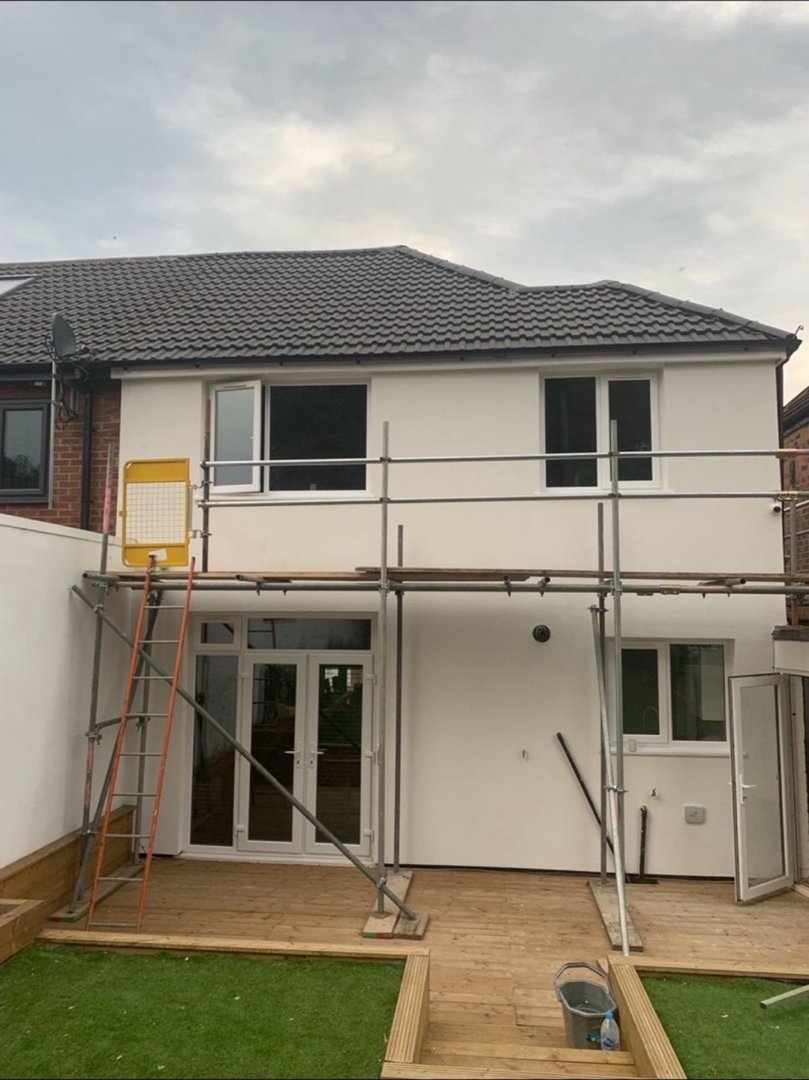
How we render with sand and cement, step by step
- Survey. We look at the wall, any old render, the brick or block, and any damp.
- Scaffold. Where needed, scaffold goes up so we can work safely and reach every part.
- Protect. Windows, doors, paths and plants are covered.
- Prepare. Old loose render is hacked off. The wall is cleaned and damped down, so the render does not dry too fast.
- Beads. Beads go on corners, round windows and along the bottom of the wall. The bottom bead keeps the render clear of the ground and above the damp-proof course.
- Scratch coat. The first coat goes on and is scratched to give a key.
- Top coat. Once the scratch coat has set, the top coat goes on, is ruled flat and finished.
- Cure. The render is left to set slowly. In hot weather it may be misted with water so it does not crack.
- Paint. When fully dry, the render is painted with masonry paint.
Repairing sand and cement render
Old render cracks and blows over time. Water gets in behind it, freezes in winter and pushes it off the wall. Signs to look for:
- cracks that are getting wider,
- patches that sound hollow when you tap them,
- bulges, or render falling off,
- damp patches on the wall inside.
We cut out the bad parts back to firm render, build them up in coats and finish them to match. Then the wall is painted so the patch blends in. If too much of the wall is bad, it can be better to take it off and render it again. See our page on render repairs and our guide on signs your render needs repairing.
Weather and timing
Render needs the right weather. It must not freeze while it sets, and heavy rain can wash it off the wall. Hot sun can dry it too fast and make it crack. We plan round the forecast and stop when we need to. Our guide on rendering in winter explains more.
Looking after it
- Repaint every few years with a good masonry paint.
- Keep gutters clear so water does not run down the wall.
- Fill small cracks early, before water gets in.
- Keep soil and plants away from the bottom of the render.
If you want to know what affects the total spend on rendering, our rendering cost guide explains it in plain words.
Why choose RCR Connections Ltd
- We are renderers by trade, with 62 years of combined experience across the team.
- We do sand and cement, and K-Rend monocouche and silicone, so we help you pick, not push.
- We look at the wall first and tell you plainly what it needs.
- We keep the site tidy and protect your home while we work.
- We are Birmingham based, covering the whole of the Midlands.
What to send us
- a photo of each wall you want rendered, from a step back,
- close ups of any cracks or loose render,
- a note of any damp inside,
- your postcode.
Where we render with sand and cement
We render homes all over Birmingham and the Midlands. Many older streets in the Black Country and the towns round Birmingham have sand and cement render, so we see it and repair it every week.
Popular towns for this work: Walsall, Halesowen, Tamworth, Redditch, Kidderminster.
See every town we cover on our rendering areas page.
Sand and cement render questions
Do you do sand and cement rendering?
Yes. RCR Connections Ltd is Birmingham based, covering the whole of the Midlands. We render with sand and cement, and with K-Rend monocouche and silicone. We help you pick the right one for your house.
What is sand and cement render?
It is the old, traditional render. Sand, cement, water and sometimes lime are mixed on site and put on in coats. It is hard and strong, and it is usually painted.
Does sand and cement render need painting?
Yes, in most cases. It is grey when it dries, so it is painted with masonry paint. The paint needs doing again every few years to keep it looking fresh.
Is sand and cement better than K-Rend?
Neither is best for every house. Sand and cement is hard and easy to repair in small patches. K-Rend monocouche and silicone have the colour built in, need no painting and are more flexible, so they crack less.
Can sand and cement go on an old house?
Take care on old solid brick houses. A hard cement render can trap damp in the wall. On those, a softer or more breathable mix is often better. We will tell you what suits your wall.
Can you repair old sand and cement render?
Yes. We cut out cracked and hollow patches back to sound render, build them up in coats and finish them to match. The wall is then painted so the repair blends in.
How long does it take?
A typical semi is often one to two weeks on site, with drying time between coats. Weather plays a big part. We do not render in frost or heavy rain.
Can you render in winter?
Only when the weather is right. Render must not freeze while it sets. We plan round the forecast and stop if it turns too cold or wet.
What are your working hours?
Monday to Friday 7am to 5pm, Saturday 7am to 1pm. We are closed on Sundays.
How do I get a quote?
WhatsApp me on 07453 614095 or message the page. Send pictures or videos of the walls you want rendered.
Get a free rendering quote
WhatsApp me on 07453 614095 or message the page.
Send pictures or videos via WhatsApp for a quick response, a free quote and advice. Show us the whole wall from a step back, and close ups of any cracks or loose patches. Tell us your postcode.
Opening hours: Monday to Friday 7am to 5pm, Saturday 7am to 1pm, Sunday closed.
See finished work on our projects page, or use our contact page. RCR Connections Ltd (Regal Colour Rendering), Birmingham based, covering the whole of the Midlands.