
If you’re looking for K-Rend in Shirley, or you simply want a rendered house that stays the same colour for years without repainting, a modern through-coloured system is usually the answer. At RCR Connections Ltd we specialise in K-Rend monocouche and silicone rendering. We’re Birmingham based, covering the whole of the Midlands, and with 62 years of combined experience across the team, these systems are our bread and butter.
Free K-Rend quote in Shirley: WhatsApp me on 07453 614095 or message the page, with a few photos of the house.
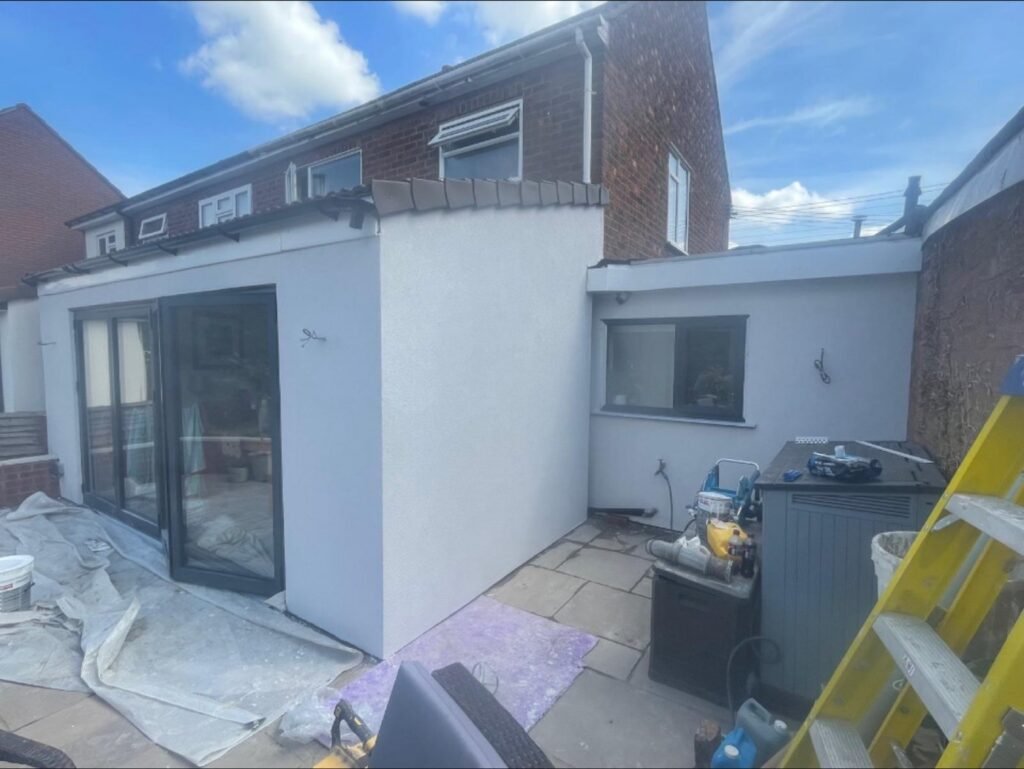
This page explains what K-Rend monocouche and silicone rendering are, how they differ, which Shirley houses they suit and how we apply them. For rendering more generally, including sand and cement and repairs, see rendering in Shirley.
What is monocouche render?
“Monocouche” simply means “single layer”. It’s a factory-made render with the colour mixed right through it, so there’s no paint on top to fade or peel. It’s applied by hand or machine in one or two passes, built up to around 15 to 20mm, and then scraped back once it has firmed up. Scraping takes off the surface skin and leaves a fine, slightly textured finish that hides minor marks and weathers evenly.
K-Rend is one of the best-known makers of these renders in the UK, with a long track record, and their monocouche renders come in a wide range of colours, from white and off-white through creams and greys.
What is silicone render?
Silicone render is a thin-coat finish, usually around 1.5 to 2mm, applied over a base coat with reinforcing mesh bedded in it. The silicone in the mix makes the surface water-repellent, so rain beads up and runs off, taking much of the dirt with it. It’s flexible, breathable and comes in a huge range of colours. The finish is a fine, even grain that looks very crisp.
K-Rend makes silicone thin-coat finishes too, and we often use a K-Rend base coat and a silicone finish together as one system.
Monocouche or silicone: which is better for a Shirley house?
Both are excellent. The choice usually comes down to the wall and the look you prefer.
- Monocouche is a thicker coat, so it’s good at evening out walls that are a bit irregular, such as older brickwork. Its scraped texture is forgiving, and it has a long track record.
- Silicone gives a smoother, sharper finish and keeps itself cleaner, which helps on walls that face north or sit under trees, where staining tends to build up. It’s also more flexible, which suits newer blockwork and extensions.
- On many jobs we combine them: a base coat and mesh for strength, and a silicone finish for looks and low upkeep.
We’ll look at your house and recommend the system that fits it, rather than pushing one product.
Which Shirley houses suit these systems?
Interwar semis
The 1920s and 30s semis around Shirley Park, Haslucks Green Road and Solihull Lodge often have tired pebbledash or painted render on the upper floor and bays. A K-Rend monocouche and silicone system can go over well-bonded pebbledash after a levelling coat, giving the whole front a clean, single-colour finish. Where the old coating is loose, we take it back to brick first.
Bungalows and post-war houses
Bungalows around Major’s Green and Cheswick Green are well suited to through-coloured render. There’s less height, so access is simpler, and the change in kerb appeal can be dramatic.
Extensions and newer homes
In Monkspath, Hillfield, Dickens Heath and around Blythe Valley, the jobs are often new extensions, garage conversions and garden rooms. Fresh blockwork is an ideal background for a K-Rend base coat and silicone finish, and we can choose a colour to sit well with the existing house.
Older solid-walled cottages
A handful of older properties around the edges of Shirley have solid walls and lime mortar. These may need a breathable lime render instead. We’ll tell you honestly if a modern system isn’t right for your walls.
K-Rend around Shirley, Solihull B90
Shirley is a big area, and the houses change as you go along the Stratford Road. This is how K-Rend and silicone render tend to fit each part.
- Shirley High Street and the Stratford Road (A34). Houses and flats close to the main road pick up traffic dirt. A silicone finish sheds rain and stays cleaner, so it’s often our first suggestion here.
- Shirley Heath, Shirley Park and Cranmore. Lots of interwar and post-war semis with pebbledash or painted render on the bays and upper floor. These are the classic K-Rend jobs: sound pebbledash levelled and covered, or loose coatings taken back first.
- Monkspath and Hillfield. Mostly newer estate houses, where render is usually going on an extension, a garage conversion or a gable rather than the whole house.
- Dickens Heath and Blythe Valley. Newer homes where the aim is a crisp, modern finish on fresh blockwork, in a colour that sits well with the brick and the neighbours.
- Cheswick Green and Major’s Green. Family homes and bungalows. Less height means simpler access, and a through-coloured finish can change the look of a bungalow completely.
- Hockley Heath. A village further down the Stratford Road by the canal, with a mix of larger detached homes and some older cottages. The older solid walls may need lime render instead, and we’ll tell you if so.
For sand and cement render, render repairs and the wider picture, see our main page on rendering in Shirley.
How we apply a K-Rend monocouche and silicone system
- Survey. We check the walls for loose material, cracks, damp and anything that would affect the bond, and look at access, sills, pipes and any changes in the wall surface.
- Protection. Windows, doors, paths, drives and plants are covered. Scaffolding goes up where needed.
- Preparation. Loose render or pebbledash is removed, the wall is cleaned, and any repairs are made. Downpipes, lights and satellite dishes are taken off where needed and refitted after.
- Beads. Stainless steel or PVC beads go on corners, around windows and doors, and along the base. The base bead stops the render short of the ground so it doesn’t draw up moisture.
- Base coat and mesh. On silicone systems, and on monocouche where the background needs it, a base coat goes on with alkali-resistant mesh bedded into it. This is what stops cracks.
- Finish. Monocouche goes on in one or two passes and is scraped the next day. Silicone is primed and then applied in a thin coat and floated to its grain. Each elevation is finished in one go so there are no visible joins.
- Clean down. Protection comes off, fittings go back on, and we walk round the house with you.
What your K-Rend quote covers
A good render quote should spell out the whole job, so you can compare like with like. Ours sets out:
- Access. What scaffold or towers the house needs, and whether scaffold is part of our quote or arranged separately.
- Preparation. What comes off (loose render, pebbledash, old paint) and any repairs to the wall underneath.
- The system. Which K-Rend monocouche or base coat and silicone finish we’ll use, and whether the walls need mesh.
- Beads and details. Corners, window and door edges, the base bead above ground level, and sills.
- Colour. The colour you’ve chosen from the samples.
- Fittings and waste. Taking off and refitting downpipes, lights and dishes, and taking the waste away.
To start, WhatsApp photos of each side of the house, your road or postcode in Shirley, and any colour ideas to 07453 614095.
Planning and Building Regulations
Re-rendering a house that’s already rendered, or covering pebbledash, doesn’t usually need planning permission. Changing a brick front to render is different: it can change the look of the street, so it’s worth checking with Solihull Council’s planning team first, and in a conservation area it will usually need permission. If you’re a flat owner or leaseholder, check with the freeholder too.
Building Regulations can also apply when more than a quarter of an outside wall is re-rendered. We’ll tell you at the quote stage if your job needs checking, so there are no surprises later.
Colour choices
Whites and off-whites are the most popular in Shirley, with soft greys and creams close behind. White looks very sharp but shows dirt sooner on a busy road like the Stratford Road; an off-white or light grey can be more forgiving. Darker colours can absorb more heat, so manufacturers limit some deep shades on sunny elevations. We’ll show you sample boards outside, so you can see colours against your brickwork, roof and windows in daylight.
Weather and timing
Both systems need dry weather and temperatures above about five degrees during application and for the first day or two afterwards. Frost and heavy rain are the enemies. That makes spring to early autumn the main season, though small areas can be done in mild winter spells. Silicone finishes in particular need a dry window to cure properly.
Looking after it
Neither system needs painting. A wash with a soft brush and low-pressure water every few years keeps it fresh, and clearing gutters stops dirty water running down the face. Avoid close-range pressure washing, which can damage the surface. If you notice a crack or a damaged corner, let us know early; small repairs are much easier than big ones.
Roads and house types for K-Rend in Shirley
Shirley is mainly B90. Along the Stratford Road (the A34) and the streets around the High Street, Shirley Park and Solihull Lodge you find a lot of inter-war semis, some with painted render, some with pebbledash, and some left in brick at the front with a rendered side or rear. Further out, towards Monkspath, Cheswick Green, Dickens Heath, Major’s Green and Blythe Valley, the houses are later: post-war estates, 1970s and 1980s homes, and newer developments where a garage, garden room or extension often needs a finish that sits quietly next to the original walls.
Haslucks Green Road, Streetsbrook Road, Shakespeare Road, Bills Lane, Marshall Lake Road and Tanworth Lane all have a mix of those types. A silicone finish is often a good choice close to the Stratford Road, because traffic dirt washes off more readily than it does from a painted sand-and-cement wall. On a quieter side road, a K-Rend monocouche or a silicone system can both work; the choice is more about the background, the look you want, and whether there is already a sound render or pebbledash to go over.
We fit K-Rend monocouche and silicone render. K-Rend monocouche is a through-coloured one-coat render. Silicone render is a thin, through-coloured finish coat over a base coat. Neither is a paint, and neither should be confused with a masonry paint over old sand and cement. For a wider look at finishes, see our rendering in Shirley page and K-Rend in Birmingham and Solihull.
Pebbledash, painted render and extensions
Many 1930s Shirley fronts still have their original pebbledash, sometimes painted, sometimes repaired in patches that no longer match. If the pebbledash is sound and well stuck, a K-Rend monocouche and silicone system can often go over it once loose areas are cut out and the wall is prepared. If large areas are hollow or have come away, those have to come off first. We will say which we are looking at once we have seen the house, in photos or on a visit.
Painted sand-and-cement render is also common. Where it is firm, it can often be repaired and overcoated, or prepared to take a new through-coloured system. Where it is cracked, hollow or holding damp, it is better to take the failed areas off than to put a new finish over a loose background.
New extensions, garage conversions and garden rooms around Dickens Heath, Monkspath and the later streets need a finish that meets the original house as neatly as possible. We can render the new walls in K-Rend monocouche and silicone, and we will be honest if a perfect match to an old painted render is unlikely. A sample on the wall is the only way to judge colour in real light.
Weather, scaffolding and looking after the finish
Render needs a suitable weather window. We do not apply K-Rend monocouche or silicone render in the rain, or onto a wall that is frozen or running with water. In winter the days are shorter and the walls dry more slowly; we will tell you if a planned date is realistic. For more on this, see our guides on rendering in wet weather and how long K-Rend takes to dry in winter.
Most Shirley houses need some access equipment, and many need a scaffold, especially for gables, bays and two-storey sides. That is allowed for in the quote. Once the work is finished, a through-coloured K-Rend monocouche or silicone finish does not need regular painting. Ordinary dirt can usually be washed off; we will tell you what is sensible for the system on your wall.
We do not invent a list of past Shirley rendering jobs on this page, and we do not put prices here. WhatsApp clear photos of the elevations, your B90 postcode and a note of any cracks or damp you have noticed, and we will come back with a free, written quote.
K-Rend in Shirley: quick questions
Does K-Rend monocouche need painting?
No. The colour runs right through it, so there’s no paint layer to fade or peel.
Can K-Rend go over pebbledash?
Usually, yes, as long as the pebbledash is sound. Loose areas are removed and the wall is levelled first.
Is silicone render the same as K-Rend?
Not quite. K-Rend is a brand that makes both monocouche and silicone renders. Silicone describes the type of thin-coat finish.
Can you render a garden room or outbuilding?
Yes. A garden room rendered in the same colour as the house ties the garden together nicely.
Do you fit K-Rend in Shirley and Hockley Heath?
Yes. RCR Connections Ltd is Birmingham based, covering the whole of the Midlands, and we render across Shirley, Monkspath, Dickens Heath, Cheswick Green, Hockley Heath and the rest of Solihull.
Will I need scaffolding for K-Rend?
For anything above the ground floor, usually yes, because each wall has to be finished in one go for an even look. A bungalow or single-storey extension can often be done from towers. We’ll tell you what access your house needs when we quote.
Can new K-Rend on an extension match my existing render?
We can get close by choosing from the colour range and holding samples up against the old render. Older render will have weathered, though, so an exact match isn’t always possible. Often the neatest answer is to render the extension and the main house in the same colour at the same time, or to pick a deliberate contrast.
What should I send for a K-Rend quote?
Photos of each side of the house, your road or postcode, and any colours you like. WhatsApp them to 07453 614095 or message the page, and we’ll come back with a free quote or arrange a visit.
What hours do you work?
Monday to Friday 7am to 5pm and Saturday 7am to 1pm. Sundays closed.
Samples on the wall, and colour in Shirley light
A through-coloured K-Rend monocouche or silicone finish should be judged from a sample on the wall, in real Shirley light, not only from a chart or a phone photo. A shade that looks quiet on a card can read quite differently on a west-facing gable, a shaded side passage, or a front that stands close to the Stratford Road. If you want to compare two colours, it is better to see both on the same elevation. We will say if a perfect match to an old painted render is unlikely; a sample is the only fair way to judge.
Along the A34 and other busier stretches, dirt is part of the decision. Silicone finishes are often chosen because ordinary dirt washes off more readily than it does from painted sand and cement, but the background still has to be sound. A sample on the dirty elevation, not only on a sheltered side, is the honest test. Neither system is a masonry paint, and neither should be confused with painting old sand and cement.
Windows, sills, drips and the line at the ground
A render job is often judged at the edges. Window reveals, cracked sills, missing drips, rusted beads and the line at the damp course are where water gets in, and where a new finish will fail first if those faults are ignored. We look for them on a visit or from close photos, and we will tell you if something else has to be put right first. Rainwater goods and flashings are not automatically part of a K-Rend quote unless we have said they are.
Where a new extension meets the original house, the stop has to be designed: a clean corner, a bead, or a change of plane, not a thin smear onto old brick or old paint. That is a common detail on later houses in Dickens Heath, Monkspath, Cheswick Green and the streets towards Blythe Valley. See rendering new extensions if the new walls are still bare, and render repairs if you think the job may only be a failed corner or a rusted bead.
Scaffold, neighbours and a family house
Most two-storey Shirley houses need a scaffold for a full elevation, especially for gables and the sides between neighbours. A note about a side passage, a steep drive, a conservatory roof or limited parking helps us plan. We aim to keep the front door usable and to protect paths, borders and cars where we can. Please tell us about outside lights, alarms and cameras on the walls. Cars are best moved off the elevation we are doing that day.
Most people stay at home while we work. Hours are Monday to Friday 7am to 5pm and Saturday 7am to 1pm, closed on Sundays. Render still follows the weather: we will not apply K-Rend monocouche or silicone onto a soaked or frozen wall. See our guides on rendering in wet weather and how long K-Rend takes to dry in winter.
Aftercare, and when a different system is better
A through-coloured K-Rend monocouche or silicone finish does not need regular painting. Ordinary dirt can usually be washed off; we will tell you what is sensible for the system on your wall. If a small area is damaged later, send photos rather than filling it with a product that will not match.
Sand and cement is still the honest choice on some Shirley walls: a painted finish you expect to recost later, a repair that needs to sit next to existing sand and cement, or a background that will not take a through-coloured system until more of the old coat has come off. See sand and cement rendering in Birmingham, rendering in Shirley and K-Rend monocouche and silicone in Birmingham and Solihull. We do not invent a list of past Shirley jobs on this page, and we do not put prices here. WhatsApp elevation photos, close photos of faults and a B90 postcode to 07453 614095, or use our contact page.
North walls, staining and washing a through-coloured finish
On a Shirley house the north and shaded elevations, and the walls that sit under trees near Streetsbrook Road, Haslucks Green Road or the older streets around Shirley Park, can pick up green staining sooner than a wall that gets the sun all day. That is not automatically a failure of the render. Algae and dirt sit on any reasonably sheltered surface in the Midlands climate. A through-coloured K-Rend monocouche or silicone finish can usually be washed, and we will tell you what is sensible for the system actually on the wall rather than handing you a generic cleaning product. Avoid anything that scours the face or leaves a patch that will weather differently from the rest of the elevation.
If the staining keeps coming back in the same place, look at the gutters, overflows and the way rain is shed from sills and copings, not only at the render. A leaking hopper at the back of a 1930s semi will mark a new finish just as it marked the old one. We will say if a stain looks like dirt or if it looks like moisture still moving through the wall. A through-coloured system does not need regular painting, which is a large part of why people in B90 ask for K-Rend monocouche and silicone, but it does need the rainwater goods and the details at the top and bottom of the wall to be doing their job.
Chimneys, porches, garages and the awkward parts of a Shirley house
Quotes that only describe “the front and the back” can miss the parts that take the most care. A chimney stack that is rendered, a porch with a thin roof and tight soffits, a side passage just wide enough for a bin, or a garage that steps forward of the main wall all need their own beads, drips and stops. On inter-war Shirley semis the bay, the porch and the parapet or flat-roofed addition at the back are usually the fiddly bits. On later houses towards Monkspath, Dickens Heath and Blythe Valley the awkward part is more often a meter box, a run of extracts, or a junction between the house and a later conservatory or garden room that is not going to be rendered in the same system.
We will not pretend a porch in a different material, or a timber conservatory, can take the same K-Rend monocouche or silicone coat as a masonry wall. If a surface is not a suitable background, we will say so and leave it out of the quote, or describe a different detail, rather than wrap everything in one finish and hope. Garden rooms and masonry outbuildings can be included when the background is right; flimsy timber or plastic cladding cannot. For the wider comparison of systems, see silicone render in Birmingham and K-Rend monocouche and silicone in Birmingham and Solihull.
Meeting a neighbour’s wall, and stopping the render cleanly
Many Shirley houses share a boundary wall, a drive, or a tight gap down the side. A new finish has to stop cleanly at the corner, at a fence line, or at the point where your wall becomes the neighbour’s. We do not render a surface that is not yours, and we will not leave a raw edge in a place that will let water in. Where the gap down the side is narrow, access and scaffolding need more thought than on an open front elevation, and we will say if that affects how the job is planned. Tell us if the neighbour already has a through-coloured finish, or painted sand and cement, so the junction can be considered in the quote rather than invented on the day.
At the ground, the render should not bridge the damp course. At openings, beads and sills should throw water off the wall, not back onto it. Those details matter as much as the colour. If you are still deciding between a through-coloured system and a painted sand and cement finish, sand and cement rendering explains when the older specification is still the honest choice. Weather windows still apply: we do not apply K-Rend monocouche or silicone onto a soaked or frozen wall. The practical seasonal notes are in our guides to rendering in wet weather and how long K-Rend takes to dry in winter.
Meter boxes, flues, cables and the services on a Shirley elevation
Almost every Shirley house has something fixed to the outside walls besides the windows: a meter box, a boiler flue, extracts from the kitchen and bathroom, a satellite cable, an alarm box, or an outside tap. A K-Rend monocouche or silicone finish has to be stopped and sealed at those points, not smeared over them. Photos of each elevation should include those fittings, even if they seem unremarkable, because moving a flue or a meter is not part of a standard render quote. If a fitting is coming out or being replaced, it is better if that happens before we start, so we are not cutting a hole in a new finish afterwards.
Cables clipped to the wall can be over-rendered only when that is a sensible, tidy detail; often they should be moved or boxed so the finished wall is clean. We will say which is realistic when we see the photos. The same is true of soil pipes and rainwater pipes: they can be left and rendered up to, or temporarily taken down if the brackets and the condition of the pipe allow it, but that has to be agreed rather than assumed. For a house where the main question is a failed patch rather than a new system, start with render repairs. For the rest of Solihull, rendering in Solihull and rendering in Shirley are the local pages to use alongside this one.
Related pages
- Plasterer in Shirley for plastering walls and ceilings indoors
- Rendering in Shirley
- Wall and ceiling replastering in Shirley
- Shirley plastering and rendering FAQs
- Rendering in Solihull and plasterer in Solihull for the rest of the borough
- K-Rend in Birmingham and Solihull and silicone render in Birmingham
- K-Rend monocouche render in the Midlands: the full guide
More services: Rendering with sand and cement · Rendering new extensions.
Get a free K-Rend quote in Shirley
WhatsApp me on 07453 614095 or message the page. Photos of each side of the house and your postcode help us give you an accurate quote. Quotes are free with no obligation. We work Monday to Friday 7am to 5pm and Saturday 7am to 1pm, and we’re closed on Sundays.