
One of the most common faults we find on rendered houses in Birmingham has nothing to do with cracks or colour. It is right at the bottom of the wall, where the render meets the ground. If render runs down past the damp proof course, it can let water from the ground bypass the DPC and soak into the wall above. This guide explains what the DPC does, why render must stop above it, and how to put it right.
RCR Connections Ltd is Birmingham based, covering the whole of the Midlands. We fit K-Rend monocouche and silicone render and repair older render, and our team has 62 years of combined experience. We never bridge the DPC, and we see the trouble it causes on other jobs every week.
What a damp proof course does
Bricks and mortar soak up water like a sponge. Without a barrier, water from wet ground would creep up the wall. A damp proof course is a waterproof layer built into the wall, normally about 150 mm above the ground. In older houses it might be slate, bitumen or engineering bricks. In newer houses it is usually a plastic strip in the mortar joint. Many older houses also have a chemical DPC injected later, which you can spot from a row of filled holes.
The DPC only works if water cannot find a way round it. That is where render comes in.
What bridging the DPC means
Bridging is anything that lets water get from below the DPC to above it. The most common bridges are:
- Render that runs down to the ground. Render holds water. If it starts in the soil and runs up the wall, it can carry ground water past the DPC.
- Ground built up too high. Patios, paths, drives and flower beds laid against the wall, at or above DPC level.
- Old render repairs. Patches that were run down to the path to tidy up the bottom edge.
- Things piled against the wall. Soil, logs or rubble heaped up over the years.
Any of these can let damp into the wall even when the DPC itself is fine.
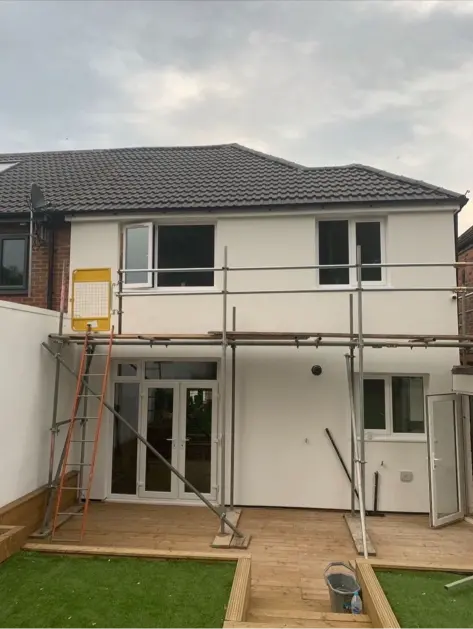
Signs your render is bridging the DPC
- Render that runs right down into the soil or on to the path with no gap or bead.
- A dark, damp band at the bottom of the render that stays wet after rain.
- Render that is flaking, crumbling or blown along the bottom edge.
- Damp patches, tide marks or peeling paint low down on the inside of the same wall.
- White salts on the bottom of the render or on the inside plaster. Our guide to white salts on render explains these.
- A musty smell or mould low down in the room behind.
Inside damp has many causes, so these are clues, not proof. But if the render runs to the ground, that is the first thing to sort out.
How render should finish at the bottom
A good render job stops just above the DPC on a bellcast bead, also known as a drip bead. The bead has a small kick at the bottom, so water running down the face drips off clear of the wall below. Below the bead, the brick or block is left bare, or painted with a masonry paint.
This does three jobs. It keeps the render clear of the DPC, it gives a straight, neat edge, and it stops water tracking back under the render. Every K-Rend monocouche and silicone render system we fit starts with beads set at the right height.
How we fix render that bridges the DPC
- Find the DPC. We look for the line in the mortar, or the injection holes, and check the ground level against it.
- Cut back the render. We cut a clean, straight line just above the DPC and take off the render below it.
- Fit a bead. A stop or bellcast bead goes on along the cut line.
- Make good. The render edge is made good up to the bead so it is neat and sealed.
- Sort the ground. If a path, patio or bed is too high, it may need to be lowered or cut back so there is a gap of about 150 mm below the DPC.
- Let the wall dry. A wall that has been damp for years takes time to dry out. Inside plaster that is salt-stained may need replacing once it has.
On a full re-render we build all of this in from the start. Our render repairs page covers smaller fixes, and our K-Rend in Birmingham and Solihull page explains how a full job runs.
Other rules that keep render dry
The DPC rule is one of a few simple rules that decide whether render lasts:
- Every coat no stronger than the one below. A hard top coat over a soft base, or a hard render on soft old brick, tends to crack and hold water. This matters most on old houses and with sand and cement render.
- Drips at sills and wall tops. Water should be thrown clear, not left to run down the face.
- Sealed edges. Joints around windows, doors and pipes need a good seal.
- Clear gutters. Overflowing gutters can soak a wall from the top down.
Will new render stop damp?
Render keeps rain off the wall. It does not stop rising damp, and render done badly can make damp worse. If you have damp inside, the cause needs finding first. Once the outside is right, the inside may need new plaster. We do both, so see our plastering repairs page for the inside work.
Worried your render is bridging the damp course?
Got render bridging a damp proof course?
RCR Connections Ltd is Birmingham based, covering the whole of the Midlands. Call or WhatsApp for a free quote — photos and your postcode are enough to start.
Related: Rendering in Birmingham · Render repairs · Plastering after a DPC
We work Monday to Friday 7am to 5pm and Saturday 7am to 1pm, and we are closed on Sundays. RCR Connections Ltd is Birmingham based, covering the whole of the Midlands. You can see the towns we cover on our plastering areas and rendering areas pages, and finished jobs on our projects page.
Render and the damp proof course: common questions
What is a damp proof course?
It is a waterproof layer built into the wall just above ground level. It stops water in the ground soaking up into the bricks above.
Should render go below the damp proof course?
No. Render should stop just above the DPC, usually on a bellcast bead. If it runs past it, water can bypass the DPC through the render.
How do I find my damp proof course?
Look for a thin line in the mortar about two or three bricks above the ground, sometimes black, grey or slate. Many houses also have a row of drilled holes from a later chemical DPC.
Can render cause damp inside?
Render that bridges the DPC, or render with cracks that let water in and hold it there, can lead to damp patches low down on inside walls.
How do you fix render that bridges the DPC?
We cut the render back to a clean line above the DPC, fit a stop or bellcast bead, make good, and make sure the ground is low enough below it.
How far below the DPC should the ground be?
As a rule, at least 150 mm. Patios, paths and flower beds that have built up over the years often need lowering or cutting back.