
Birmingham gets a lot of rain between October and March. That does not mean rendering stops for half the year, but it does change how and when we work. This guide explains what rain does to fresh render, when a wall is too wet to render, and how we keep new work dry while it sets. It covers K-Rend monocouche and silicone render as well as sand and cement.
RCR Connections Ltd is Birmingham based, covering the whole of the Midlands, and our team has 62 years of combined experience. Most of what follows comes from jobs where the forecast changed halfway through the day.
Why rain matters so much
Render is a mix of cement or lime, sand, water and, in modern systems, polymers and colour. It needs time to set and then to dry. While it is soft, rain can do real damage:
- Wash-off. Heavy rain can wash cement and fine sand out of the face. You are left with a rough, sandy patch that is weaker than the rest.
- Streaks and runs. On through-coloured render, water running down the face can carry colour with it and leave lines.
- Patchy colour. A wall that gets wet in one place and not another dries unevenly, so you can see light and dark patches for weeks.
- White marks. Too much water in the render brings salts and lime to the surface. Our guide to white salts on render explains this in more detail.
Most of this can be avoided by not rendering when rain is due, and by protecting the work for the first couple of days.
When a wall is too wet to render
Rain does not just affect the render. It soaks into the wall behind. Brick and block hold a lot of water, and an old solid wall can stay wet for days after a storm.
A slightly damp wall is fine. In fact we often dampen a dry, thirsty wall in summer so it does not suck the water out of the render too fast. The problem is a wall that is saturated. Then:
- the render cannot grip properly, so the bond is weaker;
- it stays soft for much longer and is harder to finish;
- water and salts from the wall come out through the new render as it dries.
So after a wet spell we look at the wall, not just the sky. If water is running off it, or it is dark and soaked from top to bottom, we give it time.
The 48 hour rule
Once render is on, we keep it dry and protected for at least 48 hours. That is the time when it is most at risk. In warmer weather it firms up quickly. In cold, damp weather it sets slowly, so the risky window is longer.
We also follow the temperature rule: render only goes on at 5°C and rising, with no frost due while it sets. Wet and cold usually come together in a Midlands winter, which is why our winter rendering guide is worth reading alongside this one.
How wet weather affects K-Rend monocouche
K-Rend monocouche goes on thick, about 18 mm, and is then scraped back by 2 to 3 mm once it has firmed up. That leaves at least 15 mm on the wall. Scraping takes off the skin and opens up the texture.
Timing the scrape is the skill. In warm, dry weather it can be ready in about 3 hours. In cold, damp weather it can take up to about 16 hours, which may mean coming back the next morning. If rain gets on the face before scraping, it can soften it and spoil the texture, so we watch the forecast closely on scraping days.
How wet weather affects silicone render
Silicone render is a thin top coat that goes over a base coat with mesh in it. Each layer needs to dry before the next goes on. Rain slows this down and can mark the top coat if it lands too soon.
Once it has cured, silicone render sheds water very well. That is one reason people like it. But until it cures, it needs keeping dry like any other render.
Sand and cement in the wet
Sand and cement render goes on in coats. Each coat is left to firm up before the next, and every coat should be no stronger than the one below. Wet weather stretches out the time between coats. If one coat is still soft and wet when the next goes on, you risk cracking and poor bonding later.
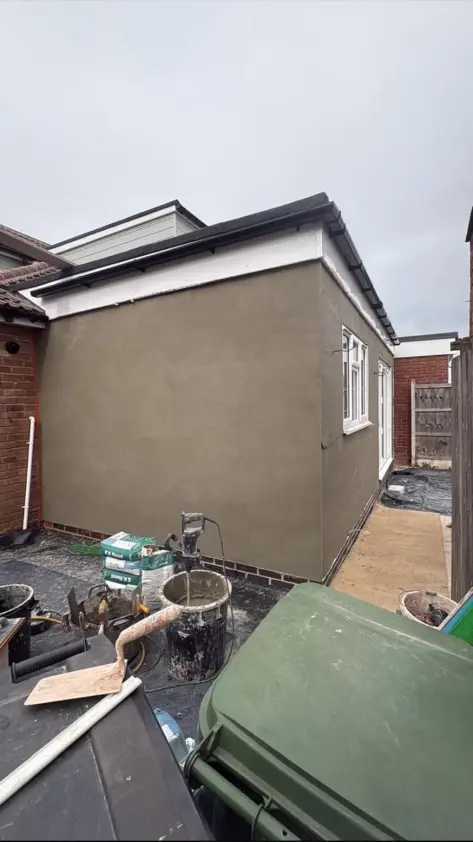
How we plan render jobs in wet months
We do not want to stand still all winter, and you do not want to wait until June. So we plan around the weather:
- Watch the forecast for the whole job. We look at rain, wind and overnight lows for the next few days, not just today.
- Sheet the scaffold. Sheeting keeps off drizzle and wind and helps the render set evenly. It is not a fix for heavy rain.
- Do the prep on poor days. Stripping old render, fixing beads, repairing the wall and masking windows can often go ahead when the weather is not right for render.
- Work one elevation at a time. We finish a whole wall in one go, so there are no joins that dry differently.
- Move the day if we need to. If the forecast turns, we stop and come back. A short delay is far better than a patchy wall.
Things you can do to help
- Fix leaking gutters and downpipes before the job. Water pouring down one spot can soak the wall and spoil new render.
- Keep sprinklers and hoses away from the wall for a week or so after rendering.
- Leave the scaffold sheeting in place until we say it can come down.
- Be patient with the colour. New render often looks patchy for a few weeks in winter and evens out as it dries.
Should you wait for drier weather?
Not always. Plenty of autumn and winter days are dry and mild enough. If your render is failing and letting water in, waiting months can make things worse. Our guide to the signs your render needs repairing helps you judge how urgent it is, and our render repairs page explains what we can do.
If you want K-Rend monocouche and silicone render on the whole house, see our K-Rend in Birmingham and Solihull page for how a full job runs. Closer to home in Solihull, see rendering in Solihull and rendering in Shirley.
Planning a render job this autumn or winter?
Need wet-weather rendering advice turning into a job?
RCR Connections Ltd is Birmingham based, covering the whole of the Midlands. Call or WhatsApp for a free quote — photos and your postcode are enough to start.
Related: Rendering in Birmingham · Rendering in Solihull · Render repairs
We work Monday to Friday 7am to 5pm and Saturday 7am to 1pm, and we are closed on Sundays. RCR Connections Ltd is Birmingham based, covering the whole of the Midlands. You can see the towns we cover on our plastering areas and rendering areas pages, and finished jobs on our projects page.
Rendering in wet weather: common questions
Can you render when it is raining?
No. We do not put render on in rain, or when heavy rain is due before it has set. Light drizzle on a sheeted scaffold can be fine for some stages, but not for the top coat.
How long does fresh render need to stay dry?
We protect new render for at least 48 hours. In cold, damp weather it may need longer, because it sets more slowly.
What happens if rain hits new render?
It can wash cement and colour out of the face, leave streaks and runs, or bring white marks to the surface. Bad damage may mean the coat has to come off and go on again.
Can you render a wall that is wet?
A damp wall is normal and some dampness helps the bond. A wall that is soaked through, with water running off it, is not ready. We wait for it to dry back first.
Does sheeting the scaffold help?
Yes. Sheeting keeps off light rain and wind, which helps the render set evenly. It does not make it safe to render in heavy rain or frost.
Will a wet week push my job back?
It can. We plan around the forecast and would rather move a day than risk the finish. Most jobs only slip by a few days.