
Plastering carries on all year, but cold weather changes how long new plaster takes to dry and what can go wrong while it does. This guide is for anyone having a room plastered between November and March, especially in an unheated extension, loft or garage conversion. It explains why cold rooms are slow, why condensation and damp cause trouble, and what you can do to help.
RCR Connections Ltd is Birmingham based, covering the whole of the Midlands. Our team has 62 years of combined experience, and we plaster rooms in winter every year.
Why cold weather slows plaster down
New plaster is full of water. A typical gypsum finish is mixed wet and put on in two thin coats, and backing coats hold far more. That water has to leave the wall before you can paint.
Two things make water leave a wall: warmth and moving air. In winter you have less of both. The air is cold, the walls are cold, windows stay shut and the air in the house is often already damp from cooking, washing and breathing. So plaster that would dry in a few days in July can take a couple of weeks in January.
How cold is too cold?
Gypsum plaster should not go on to a frozen wall, and it should not be allowed to freeze before it has set. Frozen plaster can lose its strength and come away later. As a working rule we like the room to be at least about 5°C and rising, and to stay above that overnight.
In a heated house this is rarely a problem. It matters most in:
- new extensions before the heating is connected;
- loft and garage conversions with no radiators yet;
- empty houses where the heating has been off for weeks;
- rooms with the windows out or a big opening knocked through.
If the room is that cold, we will talk about getting some gentle heat in a day or two before we start.
Drying times in cold weather
Every job is different, but as a rough guide in a cool winter room:
- Finish coat on plasterboard: often 5 days to 2 weeks, against 2 to 5 days in summer.
- Finish coat over a backing coat: usually longer, because the backing coat is still giving up water.
- Full backing coat and finish on brick or block: several weeks in a cold, closed room.
- Deep patches and filled chases: these can stay damp well after the rest of the wall is dry.
The signs that plaster is dry are the same in any season. It turns from dark brown to an even pale pink, with no darker patches. Our guide on how long plaster takes to dry before painting goes through the signs and the mist coat in detail.
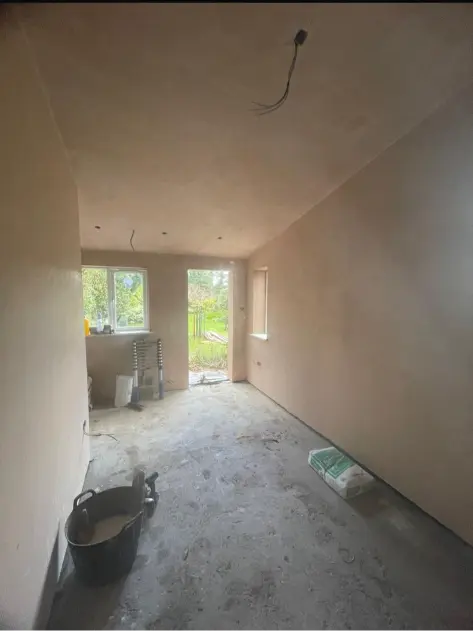
Condensation: the winter problem people miss
When warm, damp air meets a cold surface, the water in the air turns back into liquid. New plaster is a cold, wet surface, so in winter it can end up wetter, not drier, if the room is shut up and the rest of the house is warm.
You might see beads of water on the wall, damp patches that do not shrink, or water running down the windows. Left like that for weeks, you can get mould spots on the new plaster.
The answer is air flow. Keep a window open a little, even in cold weather, and keep the door to the rest of the house shut so damp air from the kitchen and bathroom does not drift in.
How to heat and air a room with new plaster
- Gentle, steady heat. Keep the room at a comfortable, even temperature. Radiators on low to medium are ideal.
- No heaters pointed at the wall. Fan heaters and gas heaters close to the plaster dry the face too fast. That can cause fine cracks or a dusty, weak surface. Bottled gas heaters also put a lot of water into the air.
- A window open a little. Damp air needs a way out.
- A dehumidifier helps. Once the plaster has set, a dehumidifier in a cold, damp room can make a big difference.
- Do not rush the paint. Painting too soon traps water in the wall and the paint can flake or blister.
Damp walls and winter plastering
Winter is when damp shows itself. Rain is driven into old brickwork, gutters overflow, and cold walls attract condensation. Plaster will not fix damp. If it goes on to a wet wall it can stay soft, stain, blow away from the wall or grow mould.
Before we plaster a damp-looking wall we look for the cause. Common ones in Midlands houses are leaking gutters and downpipes, cracked or failed render outside, render or soil bridging the damp course, and leaks from pipes or roofs. If outside render is part of the problem, our render repairs page explains how we sort it, and our guide to render and the damp proof course covers bridging.
Once the cause is fixed, the wall may need weeks to dry before new plaster goes on. Old salt-stained plaster usually needs to come off.
New extensions and conversions in winter
New block walls and new screeds are full of water from the build. In winter they dry slowly, and that water moves into the plaster. If your extension or loft is being plastered this winter, try to get some heat and air flow in early, keep it weather-tight, and allow extra time before decorating. Our extension and loft plastering page explains when the plasterer should come in.
What we do differently in cold weather
- We check the room temperature before we start and ask about the heating.
- We mix in smaller batches, because plaster can set unevenly in a cold room.
- We leave the right time between coats, which can be longer in winter.
- We tell you how to heat and air the room before we leave, and roughly when it should be ready for a mist coat.
You can read more about the work we do on our plastering walls and ceilings page and our plastering repairs page. We also fit K-Rend monocouche and silicone render outside, so if the damp is coming from the outside of the house we can look at that too. See our K-Rend in Birmingham and Solihull page.
Need a room plastered this winter?
WhatsApp me on 07453 614095 or message the page. Send a few photos of the room, rough sizes and your postcode, and say whether the room is heated.
We work Monday to Friday 7am to 5pm and Saturday 7am to 1pm, and we are closed on Sundays. RCR Connections Ltd is Birmingham based, covering the whole of the Midlands. You can see the towns we cover on our plastering areas and rendering areas pages, and finished jobs on our projects page.
Plastering in cold weather: common questions
Can you plaster in winter?
Yes. Most plastering is inside, so winter is fine as long as the room is not close to freezing. We like the room to be at least about 5°C and rising, and we want it to stay above that overnight.
How long does plaster take to dry in cold weather?
A finish coat that might dry in a few days in summer can take one to two weeks in a cold room. Backing coats and thick patches can take several weeks.
Should I put the heating on full to dry new plaster?
No. Gentle, steady heat is best. Blasting heat at new plaster can dry the face too fast and cause cracks, or a weak, powdery surface.
Why is my new plaster wet on the surface?
That is often condensation. Warm, damp air from the house hits the cold new plaster and turns to water. Open a window a little and keep the air moving.
Is it safe to use a dehumidifier on new plaster?
Yes, once the plaster has set, used with a window slightly open. It helps a lot in cold, damp rooms. Avoid putting a heater right next to the wall.
Can you plaster over a damp wall in winter?
We find and fix the cause of damp first. Plaster on a wet wall can stay soft, stain, blow or grow mould. Sometimes the wall needs weeks to dry before we plaster.