
If you have just had a damp proof course put in, or a firm has told you that you need one, the next question is the plaster. Old plaster usually has to come off, and what goes back on matters as much as the damp course itself. This guide explains why, how a wall is replastered after a damp course, and how long it all takes.
RCR Connections Ltd is Birmingham based, covering the whole of the Midlands. Our team has 62 years of combined experience, and we replaster after damp work in older houses across Birmingham most weeks.
First, make sure it really is rising damp
A lot of damp low down on walls is not rising damp at all. Before anyone injects a wall, it is worth ruling out the common causes we find:
- leaking gutters, downpipes or pipes inside the wall;
- outside render, soil or a patio bridging the existing damp course;
- cracked render or blocked air bricks;
- condensation in cold corners and behind furniture.
Our guide to render and the damp proof course explains how outside render can bridge a damp course that is actually working. Fixing that is often simpler than a new damp course.
Why the old plaster has to come off
Ground water carries salts. When a wall has been damp for years, those salts build up in the plaster. Many of them pull moisture out of the air, so the plaster can stay damp, stained and soft even after the water from below has stopped.
That is why damp course firms nearly always ask for the old plaster to be taken off and replaced. Leaving salty plaster on and painting over it usually means the marks come back.
How high the plaster comes off
The damp course firm should tell you in writing how high to hack off. As a rough guide it is often about a metre, or a good way above the highest sign of damp, whichever is higher. On chimney breasts and party walls it can be different. We follow their written advice rather than guessing, because their paperwork usually depends on it.
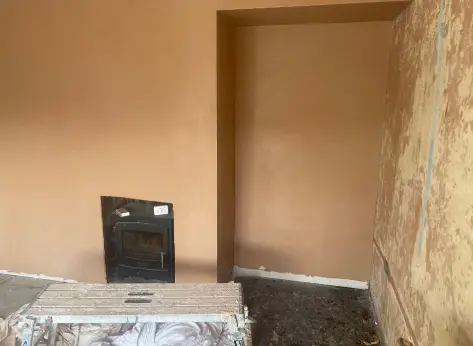
The old plaster is hacked off back to brick, the mortar joints are raked out if they are soft, and all the dust and loose material is cleared away.
Letting the wall dry
A solid brick wall that has been wet for years holds a lot of water. Injecting a damp course stops more water rising, but it does not dry the wall overnight. As a rough rule, a wall can take a month for every 25 mm of thickness to dry right out in good conditions, and longer in winter.
Some damp course systems are made so the new backing coat goes on soon after injection, and holds back the salts while the wall dries behind it. Others want a drying period first. Again, we follow the system you have had put in.
What goes back on the wall
This is where people get caught out. Ordinary gypsum backing plasters soak up salts and moisture. Put straight on to a salty, damp wall, they can break down, stain and blow off.
So after a damp course we normally use one of these:
- Sand and cement backing coat with a salt inhibitor or waterproofer. This holds the salts back while the wall dries behind it. It goes on in one or two coats and is scratched so the finish can grip.
- A backing plaster named by the damp course firm. Some systems come with their own salt-resistant plaster. If yours does, we use it.
Over the backing coat goes a gypsum finish such as MultiFinish, about 2 mm in two coats, for a smooth wall ready to paint. Our guide to plastering coats explains the different plasters in more detail.
Old houses and lime
Many Birmingham terraces from before the 1920s have solid walls and lime plaster. On some of these, a hard cement backing coat is not the best choice, because it can trap moisture in the wall. Every coat should be no stronger than the one below, and the same thinking applies to old brick. For these houses we look at the wall, the damp work and the house before deciding what goes on. Our plastering repairs page talks about old lime plaster.
Keeping the new plaster off the floor
New plaster should stop just above the floor, leaving a small gap, usually about 10 mm. If the plaster touches a damp floor or solid floor slab, it can draw water up and bridge the new damp course. The skirting board covers the gap. When skirting goes back, it should not be fixed with anything that pushes it hard against wet brick.
How we replaster after a damp course
- Read the damp course firm’s paperwork and follow it on height, backing coat and timing.
- Hack off the old plaster to the right height, rake out soft joints and clean down.
- Put on the backing coat, ruled flat and scratched, stopping short of the floor.
- Let it firm up, then put on a MultiFinish coat, about 2 mm in two coats.
- Leave the room to dry with gentle heat and a window open a little.
Drying and decorating
A sand and cement backing coat and finish take longer to dry than plaster on plasterboard. Allow several weeks, longer in winter. When the finish is an even pale pink with no dark patches, put on a mist coat and then a breathable emulsion. Avoid vinyl paint, vinyl paper and tiles low down for a few months, so the wall can keep drying. Our guide to how long plaster takes to dry covers the signs and the mist coat.
Some salt marks may still show as the wall dries. Brush them off dry; do not wash them. If they keep coming back in one spot, there may still be water getting in there.
Outside matters too
A damp course works best when the outside of the wall is right. Check the ground is well below the damp course, gutters are sound and render stops above the DPC. We also fit K-Rend monocouche and silicone render, so if the outside needs work we can do both. See our render repairs and K-Rend in Birmingham and Solihull pages.
Having a damp course put in?
Need plastering after a damp proof course?
RCR Connections Ltd is Birmingham based, covering the whole of the Midlands. Call or WhatsApp for a free quote — photos and your postcode are enough to start.
Related: Plasterer in Birmingham · Skimming walls & ceilings · Dry lining
We work Monday to Friday 7am to 5pm and Saturday 7am to 1pm, and we are closed on Sundays. RCR Connections Ltd is Birmingham based, covering the whole of the Midlands. You can see the towns we cover on our plastering areas and rendering areas pages, and finished jobs on our projects page.
Plastering after a damp proof course: common questions
Why does the old plaster have to come off after a damp course?
Plaster on a wall that has been damp for years is usually full of salts. The salts pull moisture out of the air, so the wall can stay damp and stained even after the damp course is in.
How high should the plaster be taken off?
It depends on the wall and the paperwork from the damp course firm. Often it is about a metre, or a good way above the highest damp mark. We follow their written advice.
Can you use normal gypsum plaster after a damp course?
Not straight on to a salty wall. We normally use a sand and cement backing coat with a salt inhibitor, or the backing plaster the damp course firm asks for, then a finish coat.
How long should I wait before replastering?
Follow the damp course firm. Some systems want the plaster on soon, others want a drying period. A wall that has been soaked for years can take months to dry right through.
Why do you leave a gap at the floor?
So the new plaster does not touch a damp floor and bridge the damp course. The skirting covers the gap.
When can I paint after replastering?
When the finish coat is dry and an even pale colour. Use a breathable paint at first, and do not put up vinyl paper or tiles too soon.