
Most new walls and ceilings in extensions, lofts and garage conversions are built with plasterboard. Boards go up fast, but the finish is what you see for years. This guide explains what happens between bare boards and a smooth wall: fixing, taping, beads and the MultiFinish coat.
RCR Connections Ltd is Birmingham based, covering the whole of the Midlands. Our team has 62 years of combined experience, and we board and plaster new rooms across Birmingham and the Midlands every week.
Getting the boards right first
A good finish starts with good boarding. The plasterer can hide a lot, but not everything. Things we look for:
- Right board for the room. Standard board for most rooms, moisture-resistant board in bathrooms and kitchens, and fire-rated board where Building Regulations ask for it, such as garage ceilings.
- Ivory face out. The plain side is made to take plaster. The grey printed side faces the wall.
- Screws at the right spacing. Enough screws to hold the board flat, set just below the surface without tearing the paper.
- Tight joints. Boards butted up with small gaps. Big gaps need filling before plaster.
- Staggered joints. Joints that do not all line up, so there are no long weak lines.
- Flat and solid. No boards bouncing between studs or joists.
We do the boarding ourselves on most jobs, which makes the finish easier to get right. Our plasterboarding and dry lining page covers boarding in more detail.
Taping the joints
Every joint between boards is a weak line. As timber dries, the house settles and the heating goes on and off, boards move a little. Without tape, the plaster tends to crack along the joints.
So before plastering, we tape every joint, usually with self-adhesive scrim tape. Internal corners, where walls meet walls or ceilings, are taped too. Wide gaps and damaged edges are filled first so the tape sits flat.
Beads on corners and edges
Beads are thin metal or plastic strips that give a straight, hard edge:
- Angle beads go on outside corners, such as chimney breasts, window reveals and boxing. They give a sharp line and stop the corner chipping.
- Stop beads go where plaster stops against something else, like a door frame, a tiled wall or a different surface.
- Arch beads bend to follow curved openings.
Beads are fixed straight and plumb before the plaster goes on. A crooked bead means a crooked corner, so this step takes care.
The MultiFinish coat
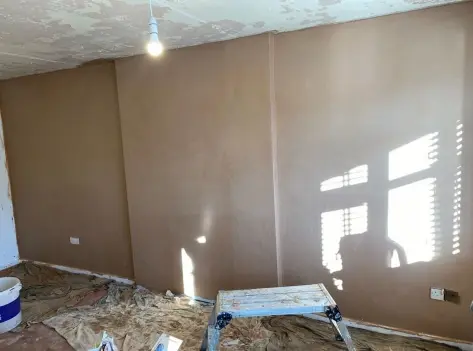
With the boards taped and beaded, the finish goes on. We usually use MultiFinish, which works on plasterboard and on backing coats, so the whole room has the same finish. There is also a board finish plaster made just for plasterboard.
The finish is about 2 mm thick, put on in two coats:
- First coat. A thin coat goes over the whole wall or ceiling and is flattened. Tape is bedded in and covered.
- Second coat. While the first is still firm but damp, the second coat goes on over it and is flattened again.
- Trowelling up. As the plaster starts to set, it is trowelled several times, with a little water if needed, until it is smooth and tight.
Timing is the skill. Too early and you drag the plaster about. Too late and it will not close up. That is why a ceiling and its walls are often done in a set order through the day.
Ceilings
New ceilings are boarded, taped and plastered the same way. Board on ceilings needs screws closer together and joints well supported, because a sagging board will crack the plaster. In lofts, sloping ceilings and dormers add a lot of angles and beads. Our extension and loft plastering page covers this.
Plaster or tape and joint?
Some builders tape and joint tapered-edge board and paint it without a plaster finish. That is quicker, but the surface is softer, the joints can show under some light, and it marks more easily. A plaster finish is harder and flatter, and it is what most homeowners expect. On square-edged board, a plaster finish is the normal choice.
Drying and painting
Plaster on plasterboard dries faster than plaster on a backing coat, because there is less water in it. In warm weather it can be ready in 2 to 5 days. In a cold room it can take a couple of weeks. Our guide to plastering in cold weather explains why.
When it is an even pale pink, put on a mist coat, then your normal emulsion. See our guide to how long plaster takes to dry.
Common problems and how to avoid them
- Cracks along joints. Usually missing tape, wide gaps or boards that move. Taping and good fixing avoid most of these.
- Screw pops. Small round bumps where screws work loose, often in new timber as it dries. They can be fixed and filled.
- Blisters or poor bonding. Often from plastering the wrong side, or very old, sun-faded or dusty board.
- Cracks at corners. Untaped internal corners and loose beads.
For other plaster faults, see our plastering repairs page. We also fit K-Rend monocouche and silicone render outside, which many extension owners need too. See our K-Rend in Birmingham and Solihull page.
Why we like to board and plaster
When one team does both the boarding and the plaster, the boards go up the way the plasterer wants them. Joints are tight, screws are set right, beads are planned at the same time, and there is no arguing between trades about whose fault a crack is. On a new extension or loft, it also means fewer visits and a shorter wait before you can decorate. If your builder is putting the boards up, we are happy to plaster them; we will just check them first and tell you if anything needs sorting before the finish goes on.
New boards ready for plaster?
WhatsApp me on 07453 614095 or message the page. Send photos of the boarded rooms, rough sizes and your postcode, and tell me when the boards will be up.
We work Monday to Friday 7am to 5pm and Saturday 7am to 1pm, and we are closed on Sundays. RCR Connections Ltd is Birmingham based, covering the whole of the Midlands. You can see the towns we cover on our plastering areas and rendering areas pages, and finished jobs on our projects page.
Plastering new plasterboard: common questions
Does new plasterboard need plastering?
Not always. Tapered-edge board can be taped and jointed and then painted. But a plaster finish gives a harder, flatter surface and hides the joints and screws, so most people choose it.
Why do you tape the joints?
Tape bridges the joints between boards so the plaster does not crack along them as the house moves and dries.
Which side of plasterboard do you plaster?
The plain ivory face. The grey side with the printing goes to the wall or studs. Plastering the wrong side can lead to poor bonding.
How thick is the plaster on plasterboard?
About 2 mm of MultiFinish or board finish, put on in two thin coats and trowelled smooth.
Do I need to PVA plasterboard before plastering?
Not usually. New board in good condition takes plaster well. Board that has been left in sun for a long time, or is very dusty, may need a primer.
How long does plaster on new board take to dry?
Often 2 to 5 days in warm weather, and up to a couple of weeks in a cold room. It is dry when it is an even pale pink.