
Kenilworth is a small Warwickshire town with a big history. The red sandstone castle, the ruins of the abbey in Abbey Fields, the timber-framed cottages of the Old Town, the Victorian villas on the Warwick Road and the quiet 1960s and 1970s estates all sit within a short walk of each other. RCR Connections Ltd renders, re-renders and repairs homes all over the town, from the High Street and Castle Green out to Crackley, Thickthorn, Windy Arbour, Whitemoor and Burton Green. We’re Birmingham based, covering the whole of the Midlands, and Kenilworth is an easy run down the A452 for us.
The team has 62 years of combined experience. We fit K-Rend monocouche and silicone render, and we repair old render and pebbledash. This page covers rendering only. For walls and ceilings inside, see our page for a plasterer in Kenilworth.
Rendering quotes in Kenilworth: WhatsApp me on 07453 614095 or message the page. We work Monday to Friday 7am to 5pm and Saturday 7am to 1pm, and we’re closed on Sundays.
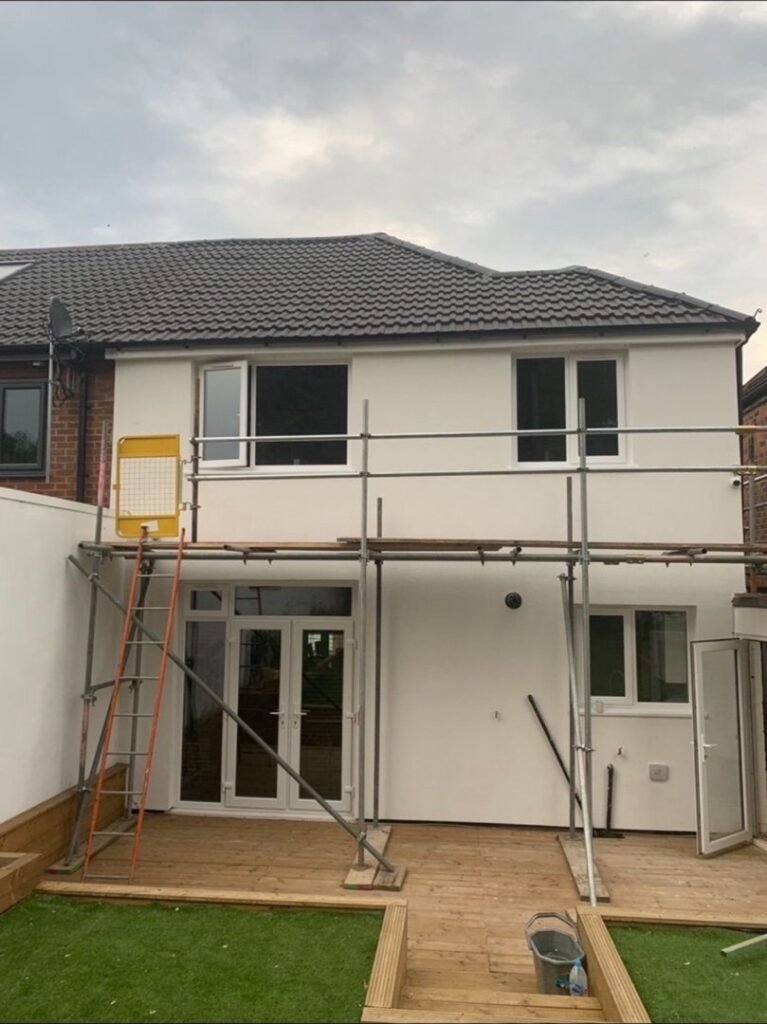
K-Rend monocouche and silicone render in Kenilworth
K-Rend monocouche
K-Rend monocouche is a through-coloured render. It goes on in one thick coat, or two close together. Once it has firmed up, we scrape the face back. That leaves a soft, even texture with the colour running all the way through. It never needs painting. If it gets a small knock, the same colour shows underneath.
In Kenilworth it is a good fit for:
- Post-war and 1960s semis with tired pebbledash or painted render.
- 1970s and 1980s homes with gable walls, panels or tile hanging that need a fresh look.
- New block extensions, side builds and garage conversions.
- Homes that are let to students or families, where low upkeep matters.
Silicone render
Silicone render is a thin coat over a base coat with mesh. It gives a smooth, crisp finish, sheds rain well, keeps dirt off for longer and lets the wall breathe.
In Kenilworth it is a good fit for:
- Victorian and Edwardian villas where a smooth, smart finish suits the house.
- Walls under trees near Abbey Fields, the Common and the edges of town, where green growth is a problem.
- Older walls that need to breathe.
- Sound but tired render that needs a fresh coat.
Which one?
We look at the wall first. On a lot of Kenilworth homes both would work well, and it comes down to the look you like. On older walls, the wall itself often decides. We fit K-Rend monocouche and silicone render, and on the oldest walls in the Old Town we will tell you if lime is the right answer. Our guide K-Rend monocouche vs silicone vs sand and cement render explains the differences.
A town built round a castle
The castle and the abbey
Kenilworth Castle was begun in the 1120s and grew over the next 450 years into one of the great castles of England. It was besieged for months in 1266. In 1575 Robert Dudley, Earl of Leicester, held a famous 19-day visit for Elizabeth I here. After the Civil War, Parliament had the castle slighted so it could not be used again, and it has been a ruin ever since. Leicester’s Gatehouse was turned into a home and still stands whole.
The Augustinian priory, later an abbey, stood in what is now Abbey Fields. After it was closed in the 1530s, much of its stone was taken for other buildings. Parts of the gatehouse and the old barn still stand near St Nicholas Church.
Red sandstone and timber
The castle and the abbey were built from local red sandstone. So were parts of some older houses in the town. The Old Town, along Castle Hill, Castle Green, High Street and New Row, has timber-framed cottages, sandstone walls and Georgian brick houses. Many are listed, and the whole area is a conservation area.
These buildings need the right care. Soft sandstone and old timber frames need to breathe. Hard cement render can trap damp and cause the stone or the timber to decay. On these homes, lime is often the only right finish, and changes outside need consent. If you own one, we will always tell you honestly what we think is best, even if that means pointing you to a specialist.
Victorian Kenilworth
The railway came in 1844, and the town grew. Villas went up along the Warwick Road, Leamington Road, Upper Spring Lane and the roads round the station. Many are brick with stone details, some with render or stucco on parts. Most have solid walls. This part of town is also largely a conservation area.
The station closed in the 1960s and reopened in 2018, which has made the town even more popular with people working in Coventry, Birmingham and beyond.
The 20th century
Between the wars, and much more after 1945, Kenilworth spread out. Inter-war semis went up along the main roads. In the 1950s, 60s and 70s, large estates were built at Crackley, Thickthorn, Windy Arbour, Whitemoor, Park Hill and round Fieldgate Lane and Tainters Hill. The University of Warwick opened in 1965 just to the north, and many staff and students have lived in the town since. Talisman Square, the shopping area, was built in the 1960s.
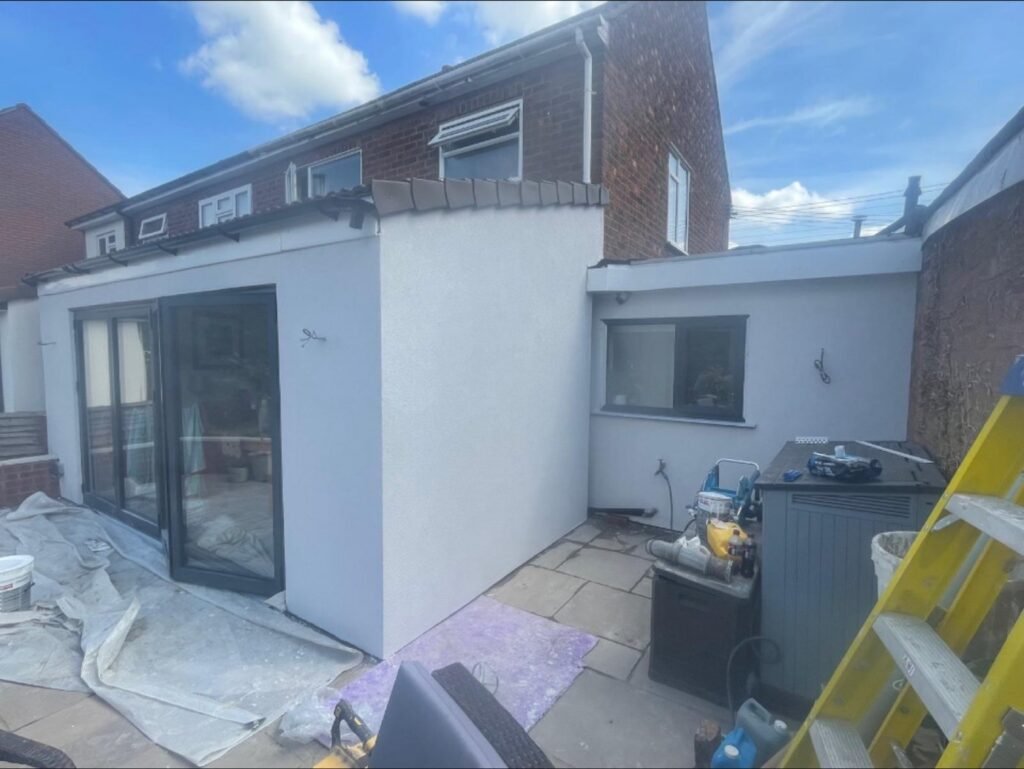
The homes we render most in Kenilworth
Old Town cottages and listed houses
Castle Green, Castle Hill, High Street, New Row and the lanes near the castle. Timber-framed, sandstone or old brick. Listed or in the conservation area. Lime is often the answer, and the council will need to agree any change. We do small repairs on these homes, and we always check with you what consent is needed.
Victorian and Edwardian villas
Warwick Road, Leamington Road, Station Road, Priory Road, Spring Lane and the streets round Abbey Fields. Solid walls, often with brick fronts and render on the sides or back. On these we usually suggest a breathable base with a silicone finish, or lime on very old or soft walls.
Inter-war semis
Along the main roads out of town and in some of the older side streets. Brick below and pebbledash or roughcast above is typical. After so long, much of it is hollow or cracked. K-Rend monocouche over a sound base, or a full strip and re-render, gives a clean, fresh look.
1950s to 1970s estates
Crackley, Thickthorn, Windy Arbour, Whitemoor, Park Hill and the streets off Fieldgate Lane and Tainters Hill. These homes have cavity walls and often have render or pebbledash on parts, or panels of tile hanging, timber or plastic cladding. Many owners want to swap the old panels for render. We take the panels off, check the wall behind, fix the right board or block, and render it.
Newer homes
Newer homes on the edges of town, including the new estates going up to the south and east, often have some render already. Thin modern render on block can crack early. We repair it, re-coat it and match new work to it.
Student lets
Many Kenilworth homes are let to students and staff at the University of Warwick. Landlords want a finish that lasts and needs no painting. K-Rend monocouche fits that well, and we can work between tenancies or with tenants in.
Neighbourhood notes
Old Town and Castle Green
The oldest part of town, by the castle. Listed homes, conservation area, sandstone and timber. Small repairs, lime and careful advice.
Town centre and Abbey Fields
The High Street, Warwick Road and the streets round Abbey Fields. Victorian and Edwardian villas, shops with flats above, and some later homes. Side and back walls, flats above shops, and repairs.
Crackley and Burton Green
To the north, toward the university. Crackley has 1950s to 1970s homes. Burton Green is a village between Kenilworth and Coventry. Full re-renders, gables and extensions.
Thickthorn and the south side
Post-war and 1960s homes near the A46 and the Leamington Road. Pebbledash and cladding panels are common.
Windy Arbour, Whitemoor and Park Hill
Large estates of semis and detached homes from the 1950s to the 1980s. K-Rend on gables, panels and extensions is our most common job here.
Leek Wootton and the villages
Just south of town, Leek Wootton, Ashow and Stoneleigh have older cottages and some larger homes. Many are in conservation areas, and some are listed.
Planning and conservation areas in Kenilworth
Kenilworth has conservation areas covering the castle and Old Town, the town centre and Abbey Fields, and the Victorian villa streets. Warwick District Council looks after planning here. In a conservation area, rendering over brick or stone on the front of a house usually needs consent. Listed homes need listed building consent for almost any change outside. Replacing old render with new render that looks the same is usually fine, but always check first.
We will give you a clear note of what we plan to do, so you can talk to the council. We won’t start work that needs consent until it is in place.
Common render problems in Kenilworth
Hard render on soft walls
Older homes in Kenilworth often have cement render on soft brick or sandstone. It traps damp, and the wall behind starts to crumble. We take the cement render off and put on a breathable system, or lime.
Blown pebbledash
Tap an old pebbledash wall and you will hear the hollow patches. They grow each winter. We mark them, take them off, and patch or re-render.
Render below the damp course
Render taken down to the path soaks up water and hides the damp course. We cut it back and fit a base bead.
Cracks round windows and doors
Corners of openings crack first, mainly where there was no mesh or beads. We cut out the crack and put in mesh and beads.
Green growth
Shady walls under the trees round Abbey Fields and on the edges of town go green. A gentle clean and a silicone finish help.
Tired cladding panels
Panels on 1960s and 1970s homes rot, fade and crack. Replacing them with render gives a fresh, clean look.
Pebbledash: keep, cover or strip?
- Keep and patch if only small areas are loose.
- Cover if it is stuck on well across most of the wall. Base coat with mesh, then the finish.
- Strip if large areas are hollow, or we need to see the wall behind.
We tap every wall before we decide. We won’t cover pebbledash that is coming away.
Getting the wall ready
- Scaffold or towers go up.
- Paths, drives, lawns, plants and sills are covered.
- Windows, doors, gutters and pipes are masked.
- Old render, loose dash and old panels come off where needed.
- Cracks are fixed and bad joints filled.
- Beads go on at corners, edges, openings and the base.
- Mesh goes in where needed.
- Base coat, then K-Rend monocouche or silicone finish.
Beads, mesh and joints
- Base beads keep render off the ground and give a straight line at the bottom.
- Corner beads give strong, crisp corners.
- Stop beads give neat edges at windows and doors.
- Drip beads throw rain off over openings.
- Mesh stops cracks, most of all over joins between brick and block.
- Movement joints let long walls move without cracking.
Colours that suit Kenilworth
Kenilworth homes suit soft, warm colours. White, off-white, cream and soft stone shades look good with red brick and clay roofs. Light greys suit newer homes. Near the Old Town, warm creams and soft whites sit well with the sandstone. On a semi, think about next door. We can bring sample boards so you can see colours against your own brick and roof.
Extensions, garage conversions and garden rooms
Many Kenilworth homes have rear or side extensions and garage conversions. If they are block, render is the neatest finish. We can match the house or choose a contrast, such as white on a brick house. Garden rooms and outbuildings are quick, tidy jobs.
Detached houses
Detached homes in Kenilworth have four sides to think about, and often a mix of brick, render and panels. We will talk through where the lines between brick and render should go, so it looks planned.
Bungalows
There are bungalows on several estates and on the edges of town. Low walls mean easy access. Dormer gables take the most weather and often need the most work.
Damp inside the house
Damp low on a wall that gets worse after rain often comes from render bridging the damp course or cracks letting rain in. Damp on cold corners that gets worse in winter is more often condensation. We will tell you honestly what we think before we suggest any work.
When we render
Render needs dry, mild weather. We don’t render in frost, heavy rain, strong wind or very hot sun on the wall. Spring to early autumn is best. Winter is fine for repairs on dry, mild days.
Looking after your render
- Clear gutters, most of all in autumn.
- Keep soil and paving below the base bead.
- Cut back plants so the wall can dry.
- Get small cracks looked at before winter.
- Clean gently with a soft brush. Don’t jet wash close up.
What to ask a renderer
- Which system and why?
- Will you strip the old render or go over it?
- Will you stop the render above the damp course?
- Where will you use mesh?
- Have you worked in conservation areas?
- Can I see finished jobs?
How a Kenilworth job runs
Photos
WhatsApp me photos of each side of the house and your postcode.
Visit
We look at every wall, tap it for hollow areas, and talk through the finish you want.
Quote
A clear written quote with the work, the system and how long it should take.
The work
Scaffold up, house protected, old render off where needed, new render on.
Walk round
Scaffold down, site cleaned, and a walk round with you to check every wall.
Working safely and tidily
Proper scaffold or towers on every job that needs them. Lawns and borders protected. Paths kept clear where possible. Site left tidy and safe every evening.
What a good finish looks like
- Straight, crisp corners and edges.
- Even colour and texture.
- A neat line at the base, above the damp course.
- Clean windows, sills, doors and paths.
- Tidy finishes round pipes, vents and fixings.
How to tell what is on your wall
Kenilworth has a real mix of walls, and knowing what you have helps you choose the right finish. A few simple signs:
- Red sandstone is soft, reddish and often shows layers. You find it in and near the Old Town and in some garden and boundary walls. It should not have hard cement render on it.
- Timber frame shows as dark beams with panels between. The panels may be old wattle and daub, brick, or later render. Old timber frames need lime and breathable finishes.
- Soft Victorian brick is red, sometimes uneven, and often laid in lime mortar. If you can scratch the mortar with a key, it is likely lime. These walls need to breathe.
- Cavity brick and block is what most post-1930s homes have. Look for a regular brick pattern with no headers (the short ends of bricks). Modern render systems suit these walls well.
- Old cement render is hard, grey under the paint, and often has cracks with brown or green stains below them.
If you are not sure, send us photos of the wall, close up and from a distance. We can usually tell a lot from them.
Lime render explained
Lime render was the normal finish on old houses for hundreds of years. It is softer than cement and lets damp pass through and dry out. It moves a little with the wall rather than cracking off. The downside is that it takes longer to put on, needs more care as it sets, and often needs lime wash on top.
On the oldest Kenilworth homes, lime is the right choice. On many Victorian solid walls, a breathable base with a silicone finish gives a good middle path, as it lets the wall breathe while giving a clean, modern look. On cavity walls built after the 1930s, K-Rend monocouche and silicone render both work very well.
Brooks, the Common and damp ground
Finham Brook runs through Abbey Fields and on toward Stoneleigh, and there are smaller streams and low, damp ground on parts of the town’s edge. Kenilworth Common, to the east, is old woodland. Homes on low ground or near the brook and the woods often have damper air and walls that stay wet for longer. For these homes we pay extra attention to the base of the wall, so the render stops above the damp course, and to gutters and drip beads, so rain is thrown clear.
Shops and flats on Warwick Road and Talisman Square
The town centre has shops with flats above along the Warwick Road and round Talisman Square and Station Road. Upper floors are often rendered at the back or the side, and can be hard to reach. We plan access with care, work round opening hours and do the top first so nothing gets marked once it is done. If you own a flat, check your lease to see who looks after the walls.
Corner houses
Corner plots show two faces to the street and take more weather on the open side. On long side walls we often fit movement joints so the render doesn’t crack. We also think about how the colour looks from both roads.
Garden and boundary walls
Many Kenilworth homes have old brick or sandstone garden walls, block walls by the drive or low front walls. Render can tidy block and newer brick walls and make them match the house. Old sandstone walls are best left as stone or repaired with lime. All garden walls need a good coping on top to throw off the rain.
Shared walls and neighbours
On semis and terraces, render often runs up to the line with next door. Talk to your neighbour before work starts, as scaffold may need to go on their side. Agree where the render will stop and finish it with a neat bead. If your neighbour is keen to render too, doing both at once often looks best.
If you have just moved to Kenilworth
Lots of people move to Kenilworth for the schools, the station and the green space. If your new home needs work outside, sort the render before you decorate inside. Send us any survey notes, as they often point to the walls that need the most work. Plan bigger jobs for the dry months if you can.
Render systems at a glance
- K-Rend monocouche: through-coloured, scraped finish, never needs painting, hard-wearing. Best for most post-war and later homes and for extensions.
- Silicone render: thin coat over a base with mesh, smooth and crisp, sheds water and dirt, breathable. Best for Victorian villas, shady walls and walls that need to breathe.
- Lime: for sandstone, timber-framed and listed homes in the Old Town.
Questions we often get in Kenilworth
Will render suit a brick house in a street of brick houses?
Sometimes it does, sometimes it doesn’t. In a conservation area, rendering a brick front may not be allowed. Outside them, a soft colour on the upper floor or the back can look very good. We will give you an honest view.
Can you render just the back of the house?
Yes. Many Kenilworth jobs are on the back and sides only, where old render has failed or a new extension needs a finish.
Can you match the colour to an old painted render?
With K-Rend the colours are fixed, but there is a wide range to choose from. We can usually get very close to an old painted colour. For a perfect match on a small patch, a paint finish may be needed.
Is K-Rend all right on a house near the university?
Yes. Many homes near the university are 1960s and 1970s cavity-wall homes, which suit K-Rend monocouche well.
The year in render
- January and February: good months to send photos and book in. Small repairs on mild, dry days.
- March and April: the season starts. We watch the forecast closely.
- May to August: the best months. On hot days we work round the sun on south-facing walls.
- September and October: still good, and often busy before winter.
- November and December: repairs on dry, mild days. Bigger jobs planned for the spring.
Why so many owners choose through-coloured render
Painted render looks good for a few years, then starts to flake and fade. Through-coloured render has no paint layer to fail. The face wears very slowly, and the colour under it is the same. A gentle wash now and then is usually all it needs. For busy families and landlords alike, that is the main reason they choose K-Rend monocouche.
Swapping old panels for render, step by step
So many Kenilworth homes from the 1960s and 1970s have panels under the windows or on the gables that it is worth explaining how we replace them.
- We look at the panels and the wall round them, and check whether there are pipes, cables or vents behind.
- The old panels come off. On many homes we find old timber battens behind, and sometimes rot.
- Rotten timber is taken out. If the space behind is open, we build it up with block or fix a cement board made for render.
- We fit beads round the window frames and at the edges, so the new render has clean lines.
- Mesh goes over any joins between old and new, so cracks don’t follow the line.
- The base coat goes on, then the K-Rend monocouche or silicone finish.
The result is a clean, flat panel that sits well with the rest of the house. It is a small job, but it can change the look of the whole front.
Roads, traffic and clean walls
Homes on the busier roads, such as the Warwick Road, the Leamington Road, the Coventry Road and Birches Lane, pick up dirt from traffic. Light colours show it more. Silicone render resists dirt better than most finishes, and an off-white or soft stone shade hides what does build up. On quieter estate roads, any colour works well.
Narrow lanes and parking
Parts of the Old Town and some of the older streets are narrow, with little room to park. We plan deliveries and scaffold with care, and keep paths clear. If a permit or a short road closure is needed for scaffold, we will tell you early so it can be sorted before the start date.
Flats and maisonettes
There are blocks of flats and maisonettes across Kenilworth, many from the 1960s and 1970s. The outside walls are usually shared, or owned by a freeholder or a management company. Before any rendering, check your lease to see who is in charge of the walls. We are happy to quote for a whole block so all the owners can see it. A whole wall done at once looks far better than patches done flat by flat.
Weather in Kenilworth
Kenilworth is fairly sheltered compared with the hills to the west, but it still gets cold, wet winters with plenty of frost. Water that gets into cracks freezes and pushes render off from the inside, so small cracks soon turn into hollow patches. Fixing cracks early, and using mesh in new render, stops that.
Areas we cover around Kenilworth
We render homes across the whole town, including the Old Town, Castle Green, the town centre, Abbey Fields, Crackley, Thickthorn, Windy Arbour, Whitemoor, Park Hill, Fieldgate Lane and Tainters Hill, along with Burton Green, Leek Wootton, Ashow, Stoneleigh and Honiley.
Nearby pages include plastering in Kenilworth, rendering in Coventry, plastering in Warwick, plastering in Leamington Spa, plastering in Balsall Common, plastering in Berkswell and rendering in Stratford-upon-Avon. See every town on our rendering areas page.
Nearby, we also cover rendering in Leamington Spa.
What our customers say
Was amazed by the punctuality from them as far as tradesmen go and the experience was stress-free with a great finish to my maisonette.
James Tranter
We chose them for our home extension, and the transformation was amazing. Their work is top-notch, and I’d recommend them to anyone seeking both quality and luxury in construction.
Emma S
These guys were great lads, grafted hard, and was really happy with the price and the end result. Blimey, it was outstanding!
Michael T
Very impressed with the workmanship and attention to detail. The project was completed on time and exceeded my expectations!
Sophia Reynolds, Property Manager
Our services
More services: Rendering with sand and cement · Rendering new extensions.
Get a rendering quote in Kenilworth
WhatsApp me on 07453 614095 or message the page. Send pictures or videos via WhatsApp for a quick response, a free quote and advice. Send a photo of each side of the house and your postcode.
Opening hours: Monday to Friday 7am to 5pm, Saturday 7am to 1pm, Sunday closed.
You can also email rcrconnectionsltd@gmail.com or use our contact page. See finished jobs on our projects page.
Rendering in Kenilworth: common questions
Do you cover Kenilworth and the surrounding area?
Yes. RCR Connections Ltd is Birmingham based, covering the whole of the Midlands, and works across Kenilworth, from the Old Town to Crackley, Thickthorn, Windy Arbour and Burton Green.
How do I get a rendering quote in Kenilworth?
WhatsApp me on 07453 614095 or message the page. Send photos of each side of the house and your postcode. We will come back with a free quote, or arrange a visit.
Do you fit K-Rend in Kenilworth?
Yes. We fit K-Rend monocouche and silicone render across Kenilworth, on semis, detached homes, extensions, garage conversions and garden rooms.
Can you render my house in the Old Town?
Many Old Town homes are listed or in the conservation area. We will look at the wall and tell you honestly what suits it. Lime is often the right finish on old sandstone and timber-framed homes, and consent may be needed.
Can you replace the old panels on my 1970s house with render?
Yes. We take off the old panels, check the wall behind, fix the right board or block, and render it to match or contrast with the rest of the house.
What hours do you work?
Monday to Friday 7am to 5pm and Saturday 7am to 1pm. Sunday closed.