
Walls and ceilings take a lot of punishment over the years: rewires, new radiators, damp, settlement, layers of filler and decades of redecorating. When they’re past patching, replastering puts them right. RCR Connections Ltd is Birmingham based, covering the whole of the Midlands, and we replaster walls and ceilings across Shirley, Monkspath, Cheswick Green, Dickens Heath, Major’s Green, Solihull Lodge and the roads around Blythe Valley. Across the team we have 62 years of combined experience.
Free plastering quote in Shirley: WhatsApp me on 07453 614095 or message the page, with a few photos of the walls or ceilings.
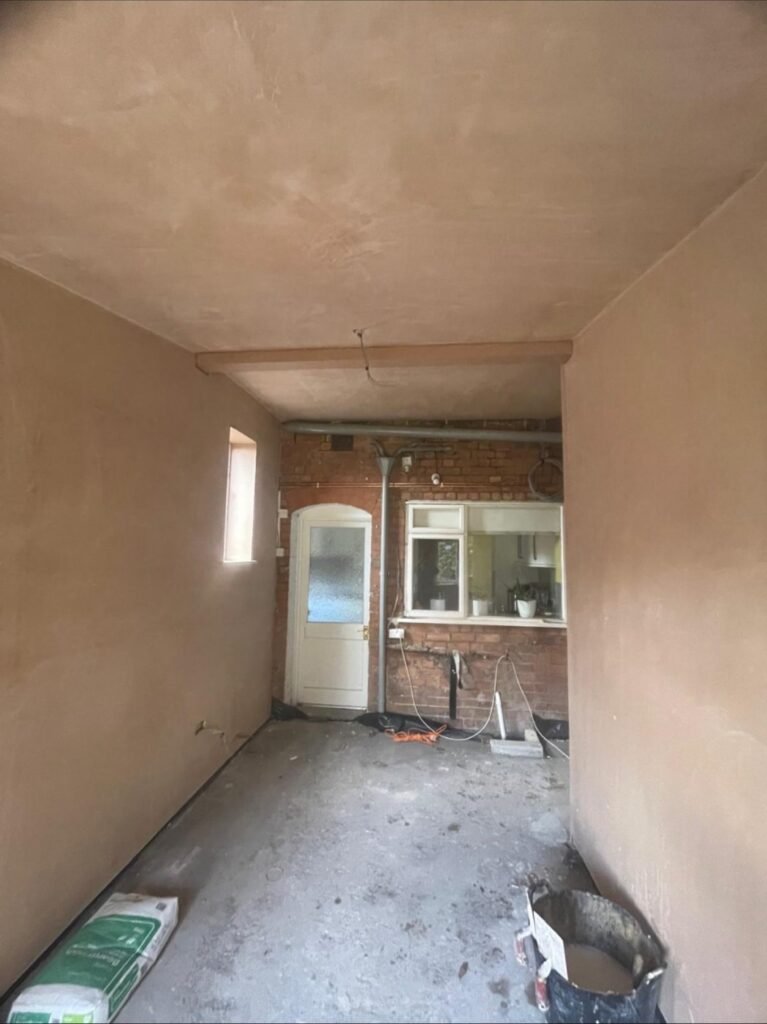
This page covers plastering walls and ceilings inside the house: when a skim is enough, when the old plaster has to come off, how ceilings are dealt with and how a job runs. For outside work see rendering in Shirley, and for the full overview see our main page for a plasterer in Shirley.
Which plastering job do you need?
There are three main ways to bring a tired wall or ceiling back, and the right one depends on what’s under the surface.
- Skim. A thin coat of finishing plaster over a wall or ceiling that’s sound but rough, cracked or patchy. It’s quick, tidy and the most common choice when the old plaster is still firmly stuck to the wall.
- Replaster. Where the old plaster has blown, crumbled or been damaged by damp, it’s hacked off back to brick or block and replaced with a backing coat and a finish coat. This is a bigger job but gives a fresh start.
- Over-board. On ceilings especially, new plasterboard is screwed through the old surface into the joists, then skimmed. It’s often the best answer for cracked, sagging or textured ceilings.
We tap and check every wall and ceiling before recommending anything. A skim over loose plaster won’t last, and we’d rather tell you that up front.
Walls in Shirley homes
Interwar semis
The 1920s and 30s houses off the Stratford Road, around Shirley Park and towards Solihull Lodge, mostly have plaster on solid brick or early cavity walls. Typical problems are walls covered in old filler and ridges, chimney breasts with blown plaster, cracks above doorways and the channels left after a rewire. Often a ground floor that has had damp treatment needs replastering with a suitable backing coat.
Post-war and later estates
In Shirley Heath, Hillfield and Monkspath, many walls are plasterboard dabbed onto blockwork or fixed to studs. These tend to show cracks along board joints, popped screws and damaged corners. Taping the joints and skimming usually sorts them out. Garage conversions and new stud walls are common here, and we board and plaster them from scratch.
Newer homes
In Dickens Heath, Cheswick Green and around Blythe Valley, it’s mainly plasterboard throughout. Settlement cracks in the first few years, dents and holes, and making good after loft or garage conversions are the usual reasons to get in touch.
Ceilings
Ceilings are harder than walls. You’re working overhead, light from the windows shows every ripple, and a ceiling that isn’t properly fixed can come down. The ceiling problems that come up most in Shirley homes are:
- Fine spidery cracks in older plaster ceilings, which a skim with scrim tape usually cures if the ceiling is firm.
- Sagging or bowing, often in lath and plaster, where the plaster has lost its grip. Over-boarding or replacing is the answer.
- Cracks along board joints in later houses, where the joints were never taped or the boards weren’t fixed well enough.
- Water damage after a leak from a bath, shower or tank. The leak must be fixed and the ceiling dried before repair.
- Textured ceilings from the 1970s and 80s. A textured ceiling needs a condition assessment and appropriate asbestos advice before a method is chosen. Overboarding can disturb a coating when fixings pass through it; a positive asbestos test is not a reason to board over it without assessment. Do not sand, scrape or drill suspect coatings. Any asbestos work needs a suitable risk assessment, controls and appropriately trained people. See our page on textured ceilings and Artex in Birmingham.
For more on this, see our guide to ceiling plastering and repairs.
Plastering after damp
Plaster that has been soaked by rising or penetrating damp often stays salty and soft, and new paint or a skim over it will bubble and stain. Before we replaster, the cause of the damp needs sorting, whether that’s a bridged damp course, a leaking gutter, render running down into the ground or condensation from poor ventilation. Once the wall has dried, the old plaster comes off and we use a backing coat suited to the wall, then a finish coat. On older solid walls, a breathable lime plaster can be the better choice. We’ll explain what we find rather than simply plastering over a problem.
How a replastering job runs
- Photos and survey. Send photos on WhatsApp. For bigger jobs we visit to check the walls and ceilings.
- Quote. A written quote sets out exactly what will be done in each room.
- Preparation. We ask for the room to be cleared as far as possible. Floors, windows and anything left in the room are covered, and doorways sealed to keep dust in.
- Stripping and making good. Blown plaster is hacked off, loose material removed and the background treated so the new plaster bonds. Beads go on corners and around openings.
- Plastering. Backing coats where needed, then the finish coat, trowelled up to a smooth surface ready for decorating.
- Clean up. We take away the waste and leave the room swept and tidy.
Working around other trades
Plastering usually sits in the middle of a bigger job. Electricians and plumbers should finish their first fix before we arrive, so cables and pipes are in place and we don’t have to come back to patch. Windows and doors in a garage conversion or extension should be fitted first so we can plaster neatly into the reveals. Once we’ve finished, second fix and decorating follow. If you have a builder or other trades on the job, we’re happy to fit in with their schedule.
Drying and decorating
A skim usually needs a few days to dry; thicker backing coats need longer, depending on the time of year and ventilation. Keep the room ventilated but don’t blast it with heaters, which can make plaster crack. When it’s an even pale colour all over, it’s ready for a mist coat of watered-down emulsion, followed by your normal paint. Avoid vinyl paints on new plaster as they can trap moisture.
Finishing plaster as part of the job
Many plastering jobs in Shirley’s semis end with a skim over the whole wall or ceiling, and it’s often all that’s needed. If you just want a room skimmed before decorating, we do that too; our page on skimming and re-skimming explains more.
Roads and neighbourhoods in Shirley, B90
Most of Shirley sits in the B90 postcode, in the Metropolitan Borough of Solihull. The suburb runs along the Stratford Road (the A34), with older and inter-war houses closer to the High Street and Shirley Park, and later estates spreading out towards Monkspath, Cheswick Green, Dickens Heath, Major’s Green, Solihull Lodge and the roads around Blythe Valley.
The roads people usually mention are Stratford Road, Haslucks Green Road, Streetsbrook Road, Shakespeare Road, Bills Lane, Marshall Lake Road, Tanworth Lane and the streets around the High Street and St James’s. We do not need a well-known road name on the quote. A B90 postcode and a few photos of the rooms are enough.
Towards Dickens Heath and Monkspath the houses are often newer, with plasterboard already on the walls and ceilings, so the work is usually a skim, a repair after a leak, or boarding out a loft or extension. Closer to Shirley Park, Solihull Lodge and the older side roads off the Stratford Road there are more 1920s and 1930s semis, where decades of filler, paper and paint have left walls that no longer take a clean finish. Cheswick Green and the later post-war streets sit somewhere in between: cavity-walled houses, mixed plaster, and plenty of rooms that have been altered for new kitchens or heating.
When a wall in Shirley needs more than a patch
A small crack or a tidy hole after a radiator is often just a fill-and-sand job, and there is no sense in stripping a whole wall for that. Replastering is the better route when the plaster is hollow, loose, or so uneven that a thin finish coat would still show every ridge. That is common after a rewire, when the chases have been filled at different times, or after a leak from a bathroom or a flat roof has left a stain and a soft patch that will keep coming back if you only paint over it.
On a 1930s semi, one wall can be sound while the chimney breast, the reveal around a bay, or the wall that once had a serving hatch is blown. We will say which walls can take a skim and which need the old plaster taking off back to a firm background. On a newer house in Dickens Heath or Monkspath, the problem is more often a board joint that has cracked, a loft slope that was never finished properly, or a garage conversion that does not paint as one room with the rest of the house.
We do not invent a list of past Shirley jobs on this page. Photos of the rooms, rough sizes and your postcode are enough for a written quote. If the photos are not enough, Davey will arrange a visit.
Ceilings, loft rooms and textured coatings
Many inter-war and post-war ceilings in Shirley are plasterboard, sometimes with a textured coating on top, and sometimes with cracks along the joints where the boards have moved. Where the boards are still firm and reasonably flat, a skim can be enough. Where they have sagged, or the joints keep opening, it is usually better to over-board and skim the new board, so you are not chasing the same crack every time you decorate.
If a ceiling has a textured coating, have a sample tested before anyone disturbs it. A textured ceiling needs a condition assessment and appropriate asbestos advice before a method is chosen. Overboarding can disturb a coating when fixings pass through it; a positive asbestos test is not a reason to board over it without assessment. Do not sand, scrape or drill suspect coatings. Any asbestos work needs a suitable risk assessment, controls and appropriately trained people.
Loft rooms and conversions are a regular request around Shirley, especially on the later estates and on houses with a decent roof pitch. We can board the slopes and the new walls, tape the joints and skim so the room is ready for paint, working around the joiner and the electrician if they are still finishing their part.
After a rewire, a leak or a new kitchen
A rewire leaves chases up walls and across ceilings. If the old plaster is still well stuck, we can fill the chases and skim the whole wall so it paints as one surface. If the plaster has come away around the chases, it is usually cleaner to take that wall back and replaster it, rather than leave a patchwork that shows in the light from a window or a bay.
Leaks from bathrooms, hoppers or flat-roofed extensions are another common reason to get in touch. Once the leak is stopped and the background is dry enough, we cut out the damaged plaster or board and put the surface back. Painting over a stain does not fix a soft or crumbled patch underneath.
New kitchens in Shirley semis often mean a wall coming out, a hatch being closed, or new plasterboard on a rearranged run of units. We can close openings, board new studs and skim so the decorator can follow on. We will work to your fitter’s dates if you tell us them when you ask for the quote.
Extensions, garage conversions and new rooms
A lot of Shirley houses have had a rear extension, a garage turned into a room, or a loft conversion. The new rooms are usually plasterboard, and they need taping and a skim so they do not look like a separate, rougher space next to the original house. Where the new work meets an older plastered wall, we tidy the junction so it does not crack along the join the first winter.
On the newer developments around Dickens Heath, Monkspath and Blythe Valley the whole house may already be boarded. The work there is often a repair, a room that was never finished, or a new stud wall for a home office. The method is the same: firm boards, taped joints, and a skim ready for paint. For boarding specifically, see also our dry lining and plasterboarding page. For a wider skim, see plastering and re-plastering walls and ceilings.
Plastering in Shirley: quick questions
Can you plaster just one wall?
Yes. A single wall, a chimney breast or a ceiling on its own is fine.
How long does a room take?
It depends on the size and whether walls need stripping first. A skim on an average room is often a day; full replastering takes longer because backing coats need time to set.
Will there be a lot of dust?
Plastering itself isn’t very dusty. Hacking off old plaster is, so we seal the room and keep it to that space as far as possible.
Can I stay at home?
Usually, yes. Most people carry on as normal while we work.
What hours do you work?
Monday to Friday 7am to 5pm and Saturday 7am to 1pm. Closed on Sundays.
Do you cover Dickens Heath, Monkspath and Cheswick Green?
Yes. They are all in the same B90 area as Shirley, and we cover them along with Major’s Green, Solihull Lodge and the roads around Blythe Valley. For the wider town, see our main plasterer in Shirley page and plastering in Solihull.
Can you plaster over a textured ceiling in Shirley?
A textured ceiling needs a condition assessment and appropriate asbestos advice before a method is chosen. We do not sand, scrape or drill suspect coatings. Overboarding can disturb a coating, so a positive test is not a reason to board over it without assessment.
Room by room in a lived-in Shirley house
Most Shirley jobs happen while the family stays at home. A single bedroom or a dining room can usually be isolated. A through lounge, an open kitchen or a hall and landing have to be planned more carefully, because they are the rooms you still need to use. We will agree the order of rooms with you. Floors are sheeted, fittings are protected, and we leave tidy at the end of each day. Hours are Monday to Friday 7am to 5pm and Saturday 7am to 1pm, closed on Sundays.
It helps if breakable things are out of the room and if larger furniture can be pulled into the middle or into a room we are not doing that day. Wall-hung televisions, family photographs and delicate lights are better taken down before we arrive. If a ceiling has a smoke alarm or a special fitting, tell us. Pets and children can stay in the house, but they need to be kept out of the room we are working in and out of any hallway we are using for boards and tools.
Papered walls, blown corners and what a photo can miss
Shirley houses have often been papered, painted and patched for decades, especially the inter-war semis off the Stratford Road and around Shirley Park, and the later houses towards Monkspath, Cheswick Green and Dickens Heath. A wall can look all right in a wide photo and still be hollow at a corner, soft around a socket, or loose behind old lining paper. If we are not sure from the pictures, we will visit rather than guess. If we open a wall and find something that changes the job, we will stop and tell you rather than put a thin coat over a background that will fail.
Making good to skirtings, architraves and window boards is part of a tidy room, but we will not force a modern, dead-flat finish onto a wall that has moved over the years if a straight line would only crack. After a kitchen or a bathroom, we work around units already in place where we can, and we will be honest if a wall needs taking back instead of a local fill.
Halls, landings and high ceilings
Halls and landings in Shirley houses are often the rooms people notice first, and they are often the hardest to finish well. The light usually comes from the side, from a stair window or a front door, and that shows every ridge. Stairwells need a safe work platform. We will mention that on the quote if the photos show a high or awkward ceiling.
If a hallway ceiling has a textured coating, the method is not a free choice. A textured ceiling needs a condition assessment and appropriate asbestos advice before a method is chosen. Overboarding can disturb a coating when fixings pass through it; a positive asbestos test is not a reason to board over it without assessment. Do not sand, scrape or drill suspect coatings. Any asbestos work needs a suitable risk assessment, controls and appropriately trained people. See textured ceilings and Artex in Birmingham and ceiling plastering and repairs.
After the plaster is on
New plaster needs time to dry before it is painted. It goes from dark pink to an even light pink, then it is ready for a mist coat of watered-down white emulsion, then your normal paint. Our guide on how long plaster takes to dry before painting explains how to tell when it is ready. Drying is slower in cold, still rooms and in winter. We will say what to expect for the rooms we have just finished.
We do not invent a list of past Shirley jobs on this page, and we do not put prices here. WhatsApp photos, rough room sizes and a B90 postcode to 07453 614095, or use our contact page. Related pages: plasterer in Shirley, Shirley plastering and rendering FAQs, K-Rend monocouche and silicone in Shirley, plastering and re-plastering walls and ceilings and plasterboarding and dry lining.
Chimney breasts, bays and the parts a photo often misses
In a typical Shirley semi the walls that cause the most trouble are rarely the large, flat ones in the middle of a room. Chimney breasts, the alcoves either side, and the reveals around a bay window are thinner, more knocked about, and more often patched than the rest of the wall. A serving hatch that has been boarded up, a cupboard that has been taken out, or an old fireplace opening that was closed years ago can leave a hollow or a ridge that only shows once the room is empty and the light from the bay hits it. We look at those junctions as carefully as the main run of wall, because a perfect skim on the flat and a crack at the breast looks worse than a slightly tired wall that was left alone.
Bay windows on the inter-war roads off the Stratford Road, Haslucks Green Road and Streetsbrook Road often have slim reveals and a sill that has been painted many times. The plaster there can be thin, and it can be damp at the corners if the external sill or the pointing has been letting water in. We will not plaster over an active damp patch. If the outside needs attention first, we will say so, and the indoor finish waits until the background is dry enough. The same applies to the wall below a first-floor bay, where a leaking gutter or hopper on a Shirley house can stain the plaster for months before anyone looks up.
Picture rails, dado rails and any original cornice are worth protecting rather than cutting through if they are staying. Tell us what you want left in place when you send photos. Built-in cupboards, wardrobe recesses and the small landing cupboard over the stairs are easy to forget on a quote, and they take time if the plaster inside them is blown. A couple of extra photos of those spots save a surprise later. For work that is mainly a cracked or stained ceiling rather than the walls, start with ceiling plastering and repairs. If the coating on a ceiling is textured, use textured ceilings and Artex in Birmingham and the official assessment-first approach on this page; do not sand, scrape or drill a suspect coating while you wait.
Working through a lived-in Shirley semi
Most of the plastering we are asked to do in Shirley is in a house that is still being lived in. You do not have to empty the whole house. What helps is a clear room, or a clear half of a room, so we can protect the floors and still reach the walls and ceiling. On a three-bed semi that often means doing the downstairs first and then the bedrooms, or taking one floor at a time, so you still have a kitchen and a place to sleep. Halls and landings are the awkward bit, because they are the route through the house; we will agree a sequence so you can still get in and out, and so the new plaster is not being brushed against while it is drying.
Furniture can usually be moved to the centre of the room or into a room we are not working in that day. We ask you to take down curtains, wall-hung TVs and anything fragile before we start, and to lift small items and ornaments yourself. Fitted kitchens and bathrooms stay in place; we work around units and protect worktops. If a room has a newly fitted kitchen and only the ceiling or one wall is being plastered, say so on the quote so we can plan the protection properly. Parking is usually on the drive or on the street outside. If you live on a busier stretch of the A34, or on a narrower estate road towards Dickens Heath or Cheswick Green, a line in the message about access is enough.
Dust is unavoidable when old plaster is coming off, but it can be managed. We isolate the room as far as the layout allows, protect floors, and tidy as we go. A full strip of a room will always be messier than a skim on a sound wall. If you are sensitive to dust, or if someone in the house works night shifts and needs a quiet bedroom in the day, tell us when you book; we can often plan the noisier stages around that. We work Monday to Friday 7am to 5pm and Saturday 7am to 1pm, and we are closed on Sundays, which suits most family houses in B90 better than late evening work.
When walls and ceilings should be done together
A single wall in a Shirley front room can be replastered on its own if the rest of the room is sound. It is often better, though, to do the ceiling at the same time if you are already emptying the room, especially where the ceiling joints have been cracking or the cornice line will have to be made good against new wall plaster. Doing them on separate visits means moving furniture twice and taking a risk that the junction between old and new will show in the light from the bay. We will say on the quote if a “one wall” request would leave an obvious step against the walls or ceiling you were planning to keep.
The same question comes up between rooms. A through-lounge where a wall has been taken down, or a kitchen that now opens into the dining room, needs the new plaster to read as one space. If only the extension side is new plasterboard and the original house still has old plaster, the join needs to be planned, not left as a ridge on the floor line or around the old opening. We tidy that junction so it can be painted as one room. If the outside of the same house also needs render, that is a different job with different weather limits; start with rendering in Shirley or K-Rend monocouche and silicone in Shirley rather than mixing the two on this page.
Once the plaster is on, leave it to dry before decorating, and use a mist coat on new plaster rather than a standard vinyl emulsion first. How long that takes depends on the thickness, the time of year and how well the room is ventilated; our guide on how long plaster takes to dry before painting covers the practical signs. We will not quote a single number that pretends every Shirley room dries at the same speed. If anything in the room still feels cold or damp after a leak, say so before decorating starts.
Newer B90 houses, and when a room only needs a careful repair
Not every plastering request in Shirley is a full strip of a 1930s semi. On the later estates towards Monkspath, Cheswick Green, Dickens Heath and Blythe Valley the walls and ceilings are usually plasterboard, and the job is more often a room that was never quite finished, a crack along a joint that was not taped, or damage after a fitting was moved. In those houses a careful repair, or a skim of one room, can be the right answer, and there is no sense in opening every wall. We will still tap and check, because a tidy-looking board can be loose on the dabs, but we will not talk you into a larger job than the rooms need.
If you are only decorating and have found a few holes, cracked joints or a mess around a new extractor, send photos of those spots rather than the whole house. We do take on smaller work, and we will tell you if what you have is a filler job you can do yourself or a plastering job that will show if it is rushed. For dry lining and new boards specifically, see dry lining and plasterboarding, and for the main Shirley plastering page see plasterer in Shirley.
Related pages
- Plasterer in Shirley, Solihull B90 (main plastering page)
- Rendering in Shirley
- K-Rend monocouche and silicone rendering in Shirley
- Shirley plastering and rendering FAQs
- Plasterer in Solihull and plasterer in Birmingham
- All our plastering and rendering services
More services: Plastering repairs · Plastering and coving · Plastering extensions and lofts.
Get a free plastering quote in Shirley
WhatsApp me on 07453 614095 or message the page. Photos of the walls or ceilings, rough room sizes and your postcode are all we need to get started. Quotes are free with no obligation. We work Monday to Friday 7am to 5pm and Saturday 7am to 1pm, and we’re closed on Sundays.