
Render rarely fails all at once. It starts with a hairline crack under a window, a patch that sounds hollow when you knock it, a brown stain spreading down from a sill, or a bead at the bottom of the wall that has started to rust and bulge. Caught early, most of these are straightforward repairs. Left for a few winters, water gets behind the render, freezes, and pushes larger areas off the wall. RCR Connections Ltd is Birmingham based, covering the whole of the Midlands, and render repairs are a big part of what we do, on everything from 1960s painted render to modern K-Rend monocouche and silicone finishes.
For a free quote: WhatsApp me on 07453 614095 or message the page. A close-up photo of the problem, one of the whole wall, and your postcode are perfect.
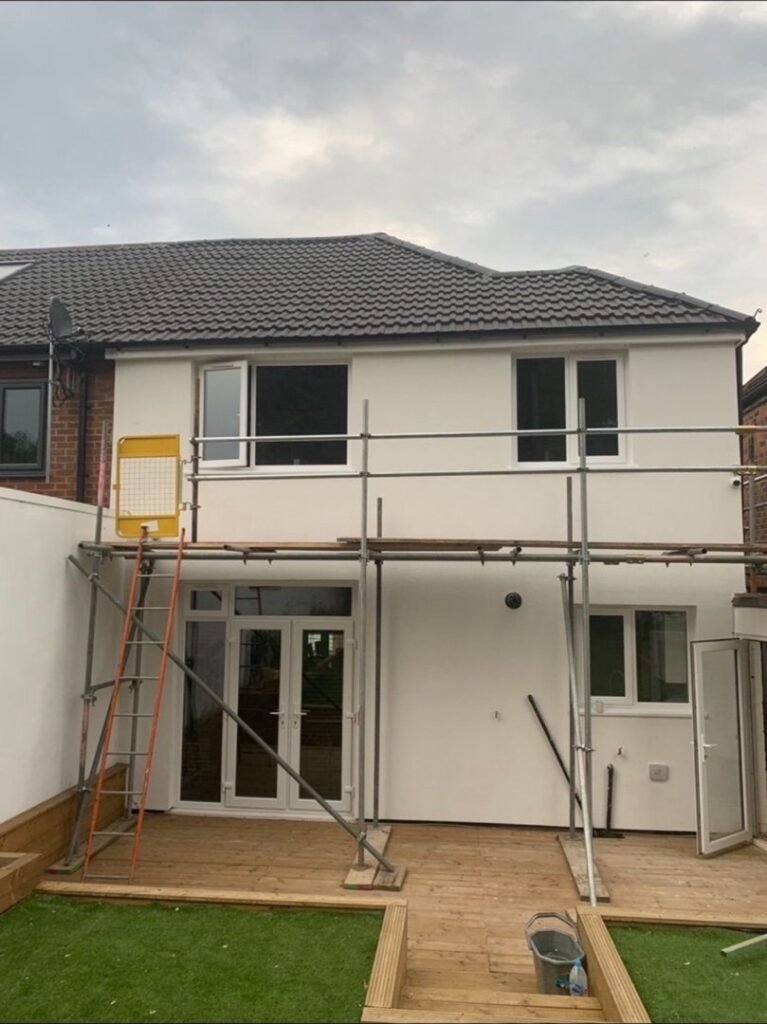
Who will look at your render
I’m David, a plasterer and renderer by trade. I look at the walls myself, explain what’s going on in plain words and tell you whether it’s a repair or something bigger. With render repairs the cause is often somewhere else: a leaking gutter, a failed window sill, a roof flashing, or a damaged downpipe. I’ll point out what needs fixing so the repair lasts. Across the team there are 62 years of combined experience.
Common render problems we repair
Cracks
Fine hairline crazing on old sand and cement render is mostly cosmetic. Wider cracks, especially ones that run diagonally from the corners of windows and doors, or straight lines where an extension meets the house, let water in. They need opening up, filling with a compatible material, and sometimes a movement joint or mesh so they don’t come straight back.
Hollow or “blown” render
If you tap the wall with a knuckle or the handle of a screwdriver and some areas sound drummy, the render there has lost its grip on the brick or block. It might look fine for now, but it’s the area most likely to crack and fall off in a hard frost. Hollow sections are marked out, cut back to sound edges, and re-rendered.
Damp patches and staining
Dark patches that stay wet after rain, green algae on shaded walls, and rust or brown streaks below sills and beads all point to water sitting in or behind the render. Sometimes the fix is a render repair; sometimes it’s clearing a gutter, adding a drip to a sill, or replacing a corroded bead.
Failed beads and edges
Older galvanised beads at corners and the base of the wall rust over time. The rust expands and splits the render along the line of the bead. The answer is to cut out along the bead, replace it with stainless steel or PVC, and patch back.
Render bridging the damp course
Render that runs down to the ground, or below the damp-proof course, can wick ground moisture up into the wall. We cut it back to a proper bellcast bead above the DPC, which lets the wall drain and dry.
Flaking paint on old render
Masonry paint on old render can blister and peel, especially if a non-breathable paint was used. Underneath, the render may be sound or may be crumbling. We check before quoting a repaint or an overcoat.
Damage from fittings
Removed satellite dishes, old alarm boxes, cable clips and redundant pipes leave holes and patches. These are cut neatly, filled and blended.
Why render fails in the Midlands
Most of the render failures I see come down to a few causes. Water is the main one. Our winters bring plenty of rain followed by frosty nights, and any water that gets into a crack expands when it freezes, opening the crack a little further each time. Leaking gutters and downpipes concentrate water on one area of wall for years. Older renders were often mixed too strong, so they’re harder than the brick behind them and crack rather than flex. Movement between an extension and the main house, or around a bay window, is another regular culprit. And some render simply wasn’t applied well: too thick in one go, applied in frost or full sun, or put on a wall that wasn’t prepared.
Knowing the cause is what makes a repair last. There’s no point patching a crack under a sill if the sill itself is still pouring water down the wall. You’ll find more on this in our guide signs your render needs repairing before winter.
How we assess the wall
- Photos first. A close-up and a wide shot on WhatsApp often tells me a lot, and for small jobs I can sometimes quote from them.
- Tap test. On site I tap across the wall to map hollow areas, usually more than you can see.
- Look for the cause. Gutters, downpipes, sills, flashings, beads, the ground level against the wall and any signs of structural movement.
- Identify the render type. Sand and cement, painted render, pebble-dash, monocouche or a thin-coat silicone system. Each one is repaired differently.
- Honest options. A repair, a repair plus a new finish coat over the whole elevation, or a full re-render, with the pros and cons of each.
Repair or re-render?
I’ll always tell you if a repair is enough. As a rough guide:
- Repair makes sense when the damage is limited to a few areas and the rest of the render is well bonded and in decent shape.
- Repair and overcoat suits a wall where the render is mostly sound but patched, cracked and tired-looking. Damaged areas are repaired, then a base coat with mesh and a new finish goes over the whole elevation, so there are no visible patches. A silicone finish is often used for this; see our silicone render page.
- Full re-render is the answer when large areas are hollow, the render is crumbling, or water has been getting behind it for years. Patching a wall like that is money wasted, because the next area will go next winter.
If your house has pebbledash, our guide to rendering over pebbledash sets out the options.
Will the repair show?
This is the question everyone asks, and it deserves a straight answer. On painted render, a well-made repair disappears once the wall is repainted. On through-coloured monocouche, a patch can be matched closely in colour and texture using the same product, though weathering means the new area may look slightly fresher for a while. On silicone thin-coat systems, small repairs are possible, but the most even result usually comes from re-coating the whole elevation, corner to corner, so the texture is continuous. On pebble-dash, matching stone size and colour is hard; we’ll show you a sample before you commit. I won’t promise an invisible patch when it isn’t realistic.
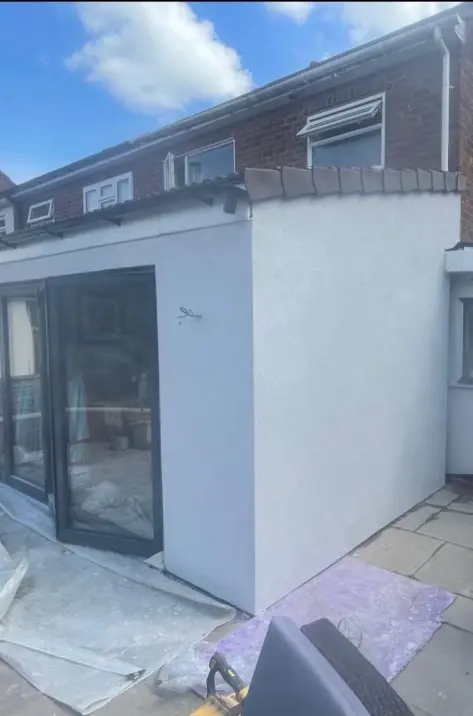
How a render repair is carried out
- Access and protection. Ladders or towers for small areas, scaffold for higher or larger repairs. Windows, paths and plants are protected.
- Cut out. Damaged or hollow render is cut back to sound, well-bonded edges with straight, neat lines.
- Prepare. Loose material and dust are cleaned off, the background is checked, and failed beads are replaced. Very absorbent backgrounds are treated so the new render doesn’t dry too fast.
- Re-render. The patch is built up in layers to match the existing thickness, using a material compatible with the old render. Mixing a modern hard render into a soft lime-based wall, for example, causes more problems than it solves.
- Finish. The surface is matched to the texture around it: floated, scraped, textured or dashed.
- Cure and decorate. Painted render is left to cure before painting. Through-coloured and silicone finishes need no painting.
Timing and weather
Like all outdoor rendering, repairs need dry weather above about 5°C. Small repairs can often be fitted into mild spells over the winter, which is worth doing because it stops frost making the damage worse. Larger jobs are booked for spring to autumn. If a section is loose and at risk of falling, we can make it safe first and plan the full repair for better weather.
What affects the cost of render repairs
- The size and number of areas to repair, and how high up they are.
- Access: a ground-floor patch needs very little, a gable end needs scaffold.
- The type of render and finish to be matched.
- Whether beads, sills or gutters also need attention.
- Whether you choose a repair, an overcoat or a full re-render.
Quotes are free, and if the honest answer is that you only need a small repair, that’s what I’ll quote for.
Render repairs as part of a bigger job
Render repairs often come up when people are selling a house, after a survey flags cracked render, or when new windows, a porch or an extension is going in. It’s best to sort the guttering, sills and roofline first, so the repaired render isn’t damaged again. Inside, if damp has damaged the plaster, we can strip, re-plaster and skim; see our skimming and re-skimming page.
Where we repair render
We’re Birmingham based, covering the whole of the Midlands, including Solihull, Sutton Coldfield, Coventry, Tamworth, Lichfield, Walsall, Wolverhampton, Dudley, Halesowen, Stourbridge, Oldbury, Smethwick, Redditch, Bromsgrove and Kidderminster. Local pages: Rendering in Birmingham · Rendering in Solihull · Rendering in Shirley · Rendering in Halesowen · Rendering in Redditch · Rendering in Kidderminster. See every service on our plastering and rendering services page, and finished jobs on the projects page.
Related services: ceiling plastering and repairs · plasterboarding and dry lining · Artex covering · all services.
Render repair questions
Is a hairline crack in render a problem?
Fine surface crazing on old render is usually cosmetic. Cracks you can fit a fingernail into, cracks with staining around them, or cracks that are getting longer should be looked at, because they let water in.
Can you repair monocouche render?
Yes. We work with K-Rend monocouche and silicone systems, and we repair other monocouche renders too, using a matching through-coloured product and texture.
Can you just fill the cracks?
Sometimes, for fine cracks on sound render, a flexible filler and repaint is the right answer. Where the render around a crack is hollow, filling only hides the problem, so the hollow area is cut out and re-rendered.
Why does my render have green marks on it?
Algae grows where the wall stays damp: north-facing sides, under trees, and below leaking gutters. A suitable cleaner usually removes it. If it keeps coming back quickly, the wall is staying too wet and the cause is worth finding.
Do I need scaffold for a render repair?
Not always. Ground-floor and low-level repairs can be done from steps or a tower. High-level or large repairs need scaffold, which we arrange.
Will my house insurance cover render damage?
Policies vary and gradual wear usually isn’t covered, but sudden damage sometimes is. Check with your insurer. I can provide photos and a written description of the damage if that helps.
More services: Rendering with sand and cement · Rendering new extensions.
Get a free render repair quote
WhatsApp me on 07453 614095 or message the page. Send a close-up of the damage, a photo of the whole wall and your postcode. You can also use our contact page. RCR Connections Ltd, Birmingham based, covering the whole of the Midlands.